



Loading profile. Please wait . . .
Habronattus sabulosus (Peckham and Peckham, 1901)
Heggie's Rock Jumping Spider


Federal Protection: No US federal protection
State Protection: No Georgia state protection
Global Rank: GNR
State Rank: S1S2
Element Locations Tracked in Biotics: Yes
SWAP 2015 Species of Greatest Conservation Need (SGCN): Yes
SWAP 2025 Species of Greatest Conservation Need (SGCN): Yes
2025 SGCN Priority Tier: High Conservation Concern
Element Occurrences (EOs) in Georgia: 11
Habitat Summary for element in Georgia: Granite outcrops in the Piedmont
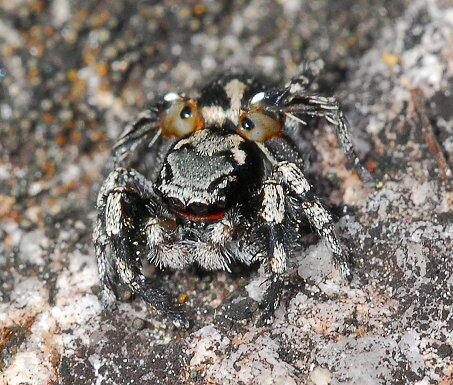
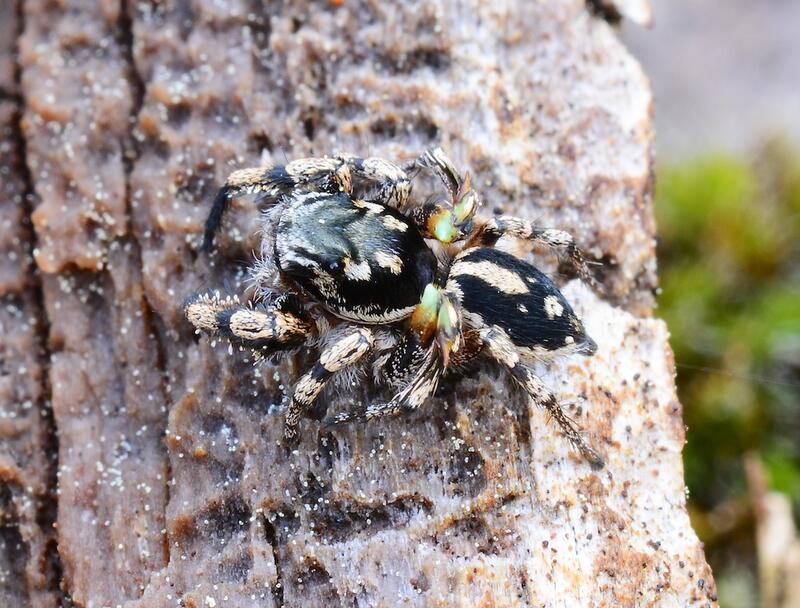
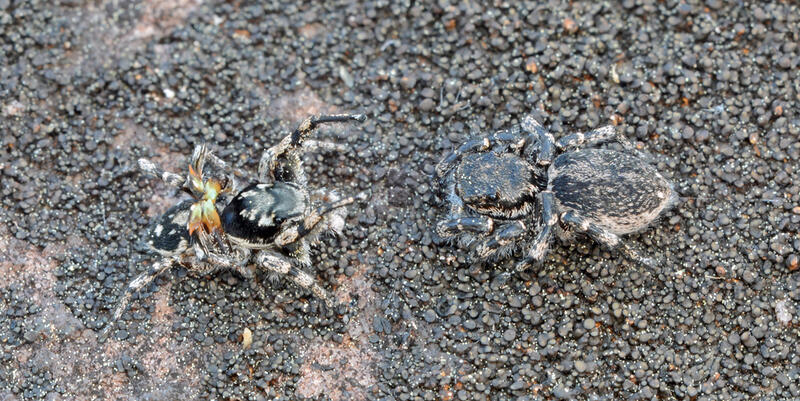
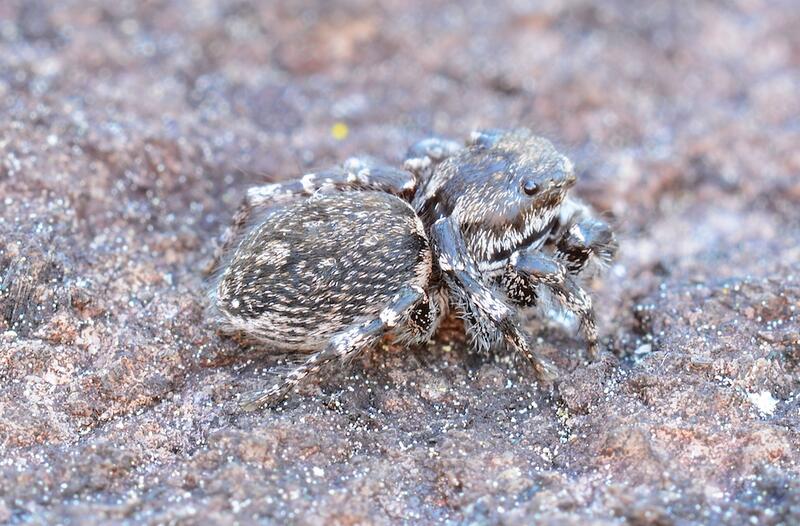
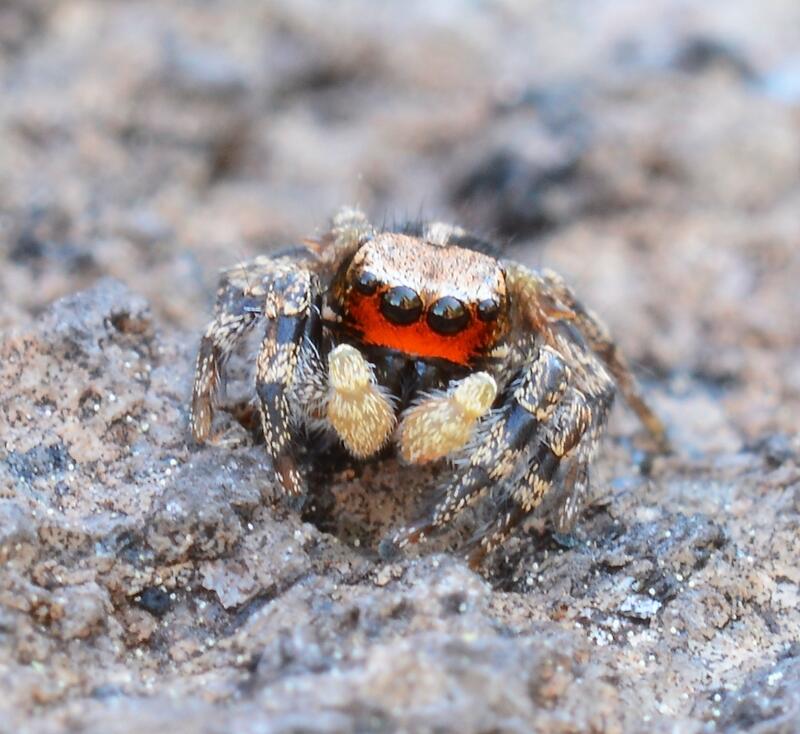
A very small jumping spider found on granite outcrops, averaging around 5-7mm in length with females on the larger end and males slightly smaller. All Habronattus species jumpers have the 3rd leg longer than the 4th leg, which is easily seen in the field, and which separates this genus from other similar genera. Also known as Paradise Spiders for the vivid colors of the adult male and the complex courtship dances they perform, these spiders are hard to spot due to their small size but well worth the effort. Males are much more brightly patterned than females in H. sabulosus; females are tan-colored as subadults and dark brown or blackish as full adults; both have a few pale spots on the dorsal surface. Adult males have a dark cephalothorax with several tan spots on the posterior end, and a bright red face which they can hide or expose as part of courtship. The abdomen is mostly black dorsally with a wide tan-colored stripe down the middle, with a break toward the rear end. At the posterior end of the abdomen there are two small tan spots. Finally, there is a striking bright green and orange spot at the femorotibial joint on the 3rd leg of males which is displayed when the spider is sitting with its legs in close and facing the observer (or a female) which separates this species from other Habronattus.
The most similar spider is the closely related Habronattus coecatus, but males of that species lack the coloration at the femorotibial joint (they have green along the femora but no orange) and females of that species have two conspicuous dots at the distal end of the abdomen. Additionally, the dorsal pattern of the two species is quite different, with H. coecatus having more lateral markings in both sexes and not mediodorsal markings like H. sabulosus.
Found on open rock faces of granitic outcrops, primarily so far in the Piedmont of Georgia. Often seen hunting on squamulose lichen mats on the outcrop face, such as Peltula cylindrica, where they are somewhat camouflaged.
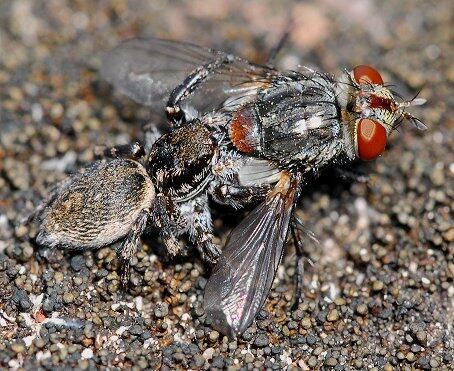
Like most jumping spiders, Habronattus sabulosus is able to capture and subdue arthropod prey much larger than itself, including other spiders. There is a record of a female H. sabulosus successfully capturing a much larger muscid fly, at least twice her size.
Largely unknown, but the spiders have a large spring period in Georgia, from at least mid-March to late April and possibly further on either end. In the one Blue Ridge site (in South Carolina) they have been found in July, so it is likely they have at least a delayed season in spring at higher elevations. In Georgia, there are also a few fall records possibly indicating a fall period along with spring, but it’s currently unknown if the fall period is as important as the spring period. These rock faces are extremely hot in the summer, up to 120F on the rock face, so little study has been done then and it is also likely that there is little insect or arthropod activity then until the cooler temperatures of fall. In spring, all four age and sex classes are typically found at the same time with only full adults found in the later part of spring.
The male’s courtship displays are truly mesmerizing, with him moving closer to and then further away from the female, all while moving his forward legs in various patterns and tapping other legs on the substrate. The orange and green on the legs 3 is also part of this display, as is the red face. If the female signals acceptance, the dance gets closer and more frenzied.
As listed below, very little is known of this species and so much work remains to be done. A thorough survey of all the potential outcrop sites in Georgia and in other southeastern states with outcrops is necessary, plus detailed studies of life history. This should be accomplished in the spring when the peak period of activity is thought to occur, but known sites should also be surveyed in fall to determine the extent of the fall period.
Found on granitic outcrops from extreme eastern Alabama through Georgia into northwestern South Carolina. Likely also occurs on outcrops in North Carolina and possibly Virginia. There are over 30 Georgia counties with outcrops, and all of them should be surveyed to really determine the range of this spider. Approximately 12,000 acres of granite outcrops exist in the southeast, and about 90% of that is in Georgia, so there are lots of places to look. The species has also been found in Randolph County, Alabama and Greeneville County, South Carolina.
Different outcrops are composed of different types of rock, from varying types of granite to gneiss, but this spider has been found at several different types of rock so the exact rock makeup is not currently thought to be critical. Based on the type locality of Waycross, outcrops of silicious rock have also been surveyed including Harrison Outcrop in Washington County and Broxton Rocks in Coffee County but without finding H sabulosus.
Just about all of Georgia’s outcrops are in the Piedmont physiographic region so their elevations are all around 1000’. However, the South Carolina site is right on the edge of the Blue Ridge at almost 3000’ so intermediate elevation sites also need to be surveyed.
This spider was initially described from “several females” collected by famed spider team the Peckhams in 1901, but the date and the exact location are unknown. The location was listed as “Waycross” but this is much farther south than any outcrops.
The list of threats to outcrop sites is long, but the largest threats include quarrying (both for intact stone i.e. dimension stone and for crushed stone), farm or feral animal degradation of habitat, excessive unregulated use including foot traffic or ATV traffic, vandalism (i.e. spray painting or trash dumping) and weathering such as acid rain. Nearby quarrying can also cause habitat degradation due to a film of rock dust.
| Threat 1 | Threat 2 | Threat 3 | |
|---|---|---|---|
| General Threat | Human intrusions & disturbance | Natural system modifications | Climate change & severe weather |
| Specific Threat | Recreational activities | Fire & fire suppression | Habitat shifting & alteration |
S2 for Georgia
The first urgent requirement is to survey other outcrops to determine the full range of this spider. Next, the sites where this species has been documented need to be protected from the threats listed above. Fortunately, many of the sites where this species has been found already are currently protected by the state of Georgia and by The Nature Conservancy.
Chamberlin, R. V., and W. Ivie. 1944. Spiders of the Georgia region of North America. Bulletin of the University of Utah 35(9):1-267.
Griswold, C. E. (1987a). A revision of the jumping spider genus Habronattus F. O. P.-Cambridge (Araneae; Salticidae), with phenetic and cladistic analyses. The University of California Publications in Entomology 107: 1-344.
Giff Beaton
22 December 2021