



Loading profile. Please wait . . .
Mycotrupes cartwrighti Olson and Hubbell, 1954
Cartwright's Mycotrupes Beetle


Federal Protection: No US federal protection
State Protection: No Georgia state protection
Global Rank: G3
State Rank: S2
Element Locations Tracked in Biotics: Yes
SWAP 2015 Species of Greatest Conservation Need (SGCN): Yes
SWAP 2025 Species of Greatest Conservation Need (SGCN): Yes
2025 SGCN Priority Tier: High Conservation Concern
Element Occurrences (EOs) in Georgia: 15
Habitat Summary for element in Georgia: Longleaf pine savannas
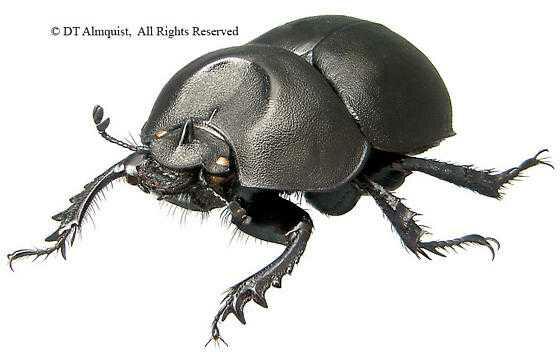
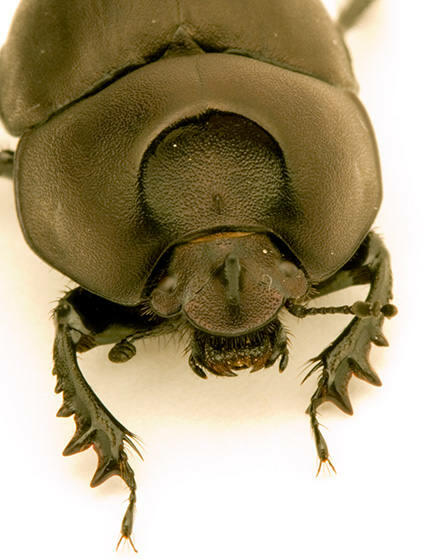
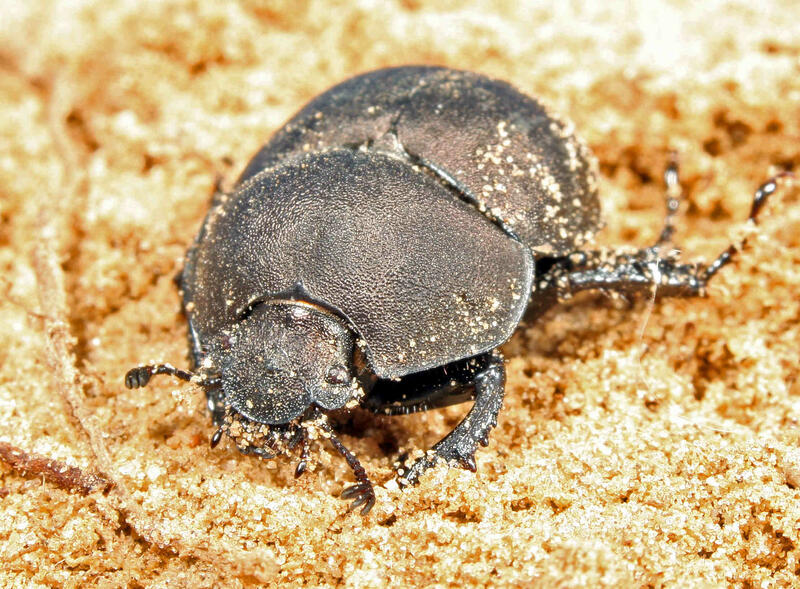
Medium-sized, about 15 mm [0.6 inch] long. Oval, convex, with a distinctly granular surface, this flightless beetle is a dull black (not shiny) in color. Elytral grooves are practically absent. Anterior part of pronotum with a pronounced apical depression (in males, as large or larger than the head) lending it a dimpled appearance. Clypeus of male with a small horn.
Easily distinguished by the fused elytra and the absence of metathoracic wings. May be differentiated from Mycotrupes lethroides by its much smaller size and allopatric range.
Mixed pine-oak communities and mesophytic hardwood forests (hammocks) underlain by sandy loam soils with some clay content (e.g., Orangeburg Series) and forested with loblolly pine and a diverse suite of hardwood tree species including red oak, black oak, and hickory. Habitats supporting populations of this beetle may be managed and enhanced through the use prescribed burns.
The diet of adult M. cartwrighti is known to include dung. It’s likely that fungi and acorns are also in the diet of this beetle. Food of larvae unknown.
Adults dig deep (typically 20-25 cm, but up to 1 m) vertical burrows in friable soils. These burrows are used by feeding and resting beetles, and for nest-building. There is typically a single individual per burrow, and burrows terminate when the digging beetle encounters compact, clayey soils. At the ground surface, newly created burrows are marked by a prominent mound of sand (i.e., “push-up”) or a raised rim of clay. These beetles may stridulate when handled. Activity is diurnal and highly seasonal, with this species most active from September through March. The larva is undescribed.
This species is under-surveyed in Georgia and future field work may result in the discovery of new populations. Additional surveys are warranted at state WMA’s, natural areas and other protected sites (in the species’ putative Coastal Plain range) that possess potentially suitable mixed pine-oak forests habitat (e.g., Riverbend WMA, Thomas County; Moody Forest Natural Area, Appling County). The species may be collected from September-March in large numbers using pitfall traps baited with dung or fermenting malt/molasses mixed with dung.
Restricted to north Florida and the Coastal Plain of Georgia, with the majority of records from an area extending from north of Tallahassee, Florida, to Ft. Valley, Georgia. Known only from a handful of widely separated sites in Georgia. Populations have been documented for the Red Hills region (near Thomasville, Thomas County) and on/near Fort Stewart (Hinesville, Liberty County). The genus Mycotrupes is a small group comprised of five species (all earth-boring and flightless, with ranges corresponding to ancient shorelines) with non-overlapping Coastal Plain distributions that, collectively, extend from South Carolina to central Florida (with two species known from Georgia).
Loss, degradation and fragmentation of naturally-functioning upland forests and hammocks threaten the future of this species.
| Threat 1 | Threat 2 | Threat 3 | |
|---|---|---|---|
| General Threat | Natural system modifications | Human intrusions & disturbance | Climate change & severe weather |
| Specific Threat | Fire & fire suppression | Work & other activities | Other impacts |
In Georgia, there are a small number of sites known for this beetle, some of which may no longer be extant. Vulnerable due to few populations and flightlessness making dispersal and recolonization unlikely in general. The Atlantic Coastal Plain population inhabiting Fort Stewart, Georgia (and vicinity) is of biogeographic interest inasmuch as it is separated from the main range of M. cartwrighti by the Altamaha River. This beetle is classified as “Rare” by the Florida Committee on Rare and Endangered Plants and Animals.
Conduct additional surveys for the beetle throughout its presumed Georgia range. Preserve and appropriately manage upland pine-oak landscapes supporting beetle populations.
Beucke, K.A. 2009. Phylogenetics, niche modeling and biogeography of Mycotrupes (Coleoptera: Geotrupidae). Ph.D. dissertation. University of Florida, Gainesville.
Howden, H.F. 1963. Speculations on some beetles, barriers, and climates during the Pleistocene and pre-Pleistocene periods in some non-glaciated portions of North America. Systematic Zoology 12(4):178−201.
Jameson, M.L. 2002. Geotrupidae, Latreille 1802. Pp. 23−27, In R.H. Arnett, Jr., M.C. Thomas, P.E. Skelley, and J.H. Frank (eds.). American Beetles, Volume 2 – Polyphaga: Scarabaeoidea through Curculionoidea. CRC Press, Boca Raton, FL.
Olson, A.L., T.H. Hubbell, and H.F. Howden. 1954. The burrowing beetles of the genus Mycotrupes. Miscellaneous Publications of the Museum of Zoology, University of. Michigan 84:1−84.
Woodruff, R. E. 1973. The Scarab Beetles of Florida. Arthropods of Florida and Neighboring Land Areas Vol. 8. Florida Dept. of Agriculture and Consumer Services, Division of Plant Industry, Gainesville, FL. 200 pp.
Woodruff, R.E., and M. Deyrup. 1994. Rare: Cartwright’s Mycotrupes, Mycotrupes cartwrighti Olson and Hubbell. Pp. 384−386, In M. Deyrup and R. Franz (eds.), Rare and Endangered Biota of Florida: Volume 4 − Invertebrates. University Press of Florida, Gainesville.
Dirk J. Stevenson
1 December 2018