



Loading profile. Please wait . . .
Trillium delicatum A. Floden & E.E. Schill.
Ocmulgee Trillium


Federal Protection: No US federal protection
State Protection: No Georgia state protection
Global Rank: G1
State Rank: S1
Element Locations Tracked in Biotics: Yes
SWAP 2015 Species of Greatest Conservation Need (SGCN): Yes
SWAP 2025 Species of Greatest Conservation Need (SGCN): Yes
2025 SGCN Priority Tier: Highest Conservation Concern
Element Occurrences (EOs) in Georgia: 8
Habitat Summary for element in Georgia: Floodplains, terraces over limestone
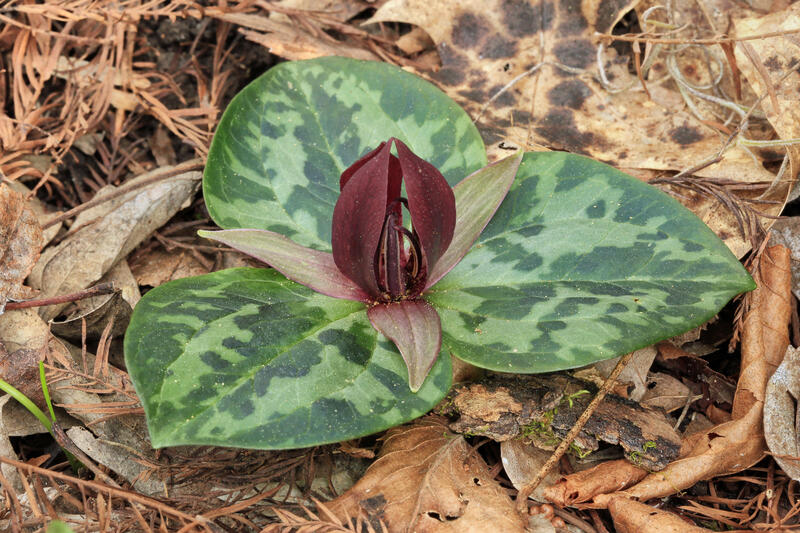
Perennial herb usually occurring in clonal patches. Stems are 2 - 3 inches (5 - 8 cm) long, densely short-hairy on angles, straight, held at a low angle to the ground so that the leaves appear to be resting on the forest floor. Leaves are 1.4 - 2 inches long and 0.8 - 1.5 inches wide (3.5 - 5 cm long and 2 - 4 cm wide), three in number, broadly oval, mottled with silver and three or more shades of green, and with three conspicuously raised veins on the lower surface. A single flower, smelling of animal dung, is held at the top of the stem at the bases of the three leaves. The three sepals are up to 0.8 inch (2 cm) long and 0.3 inch (0.75 cm) wide, lance-shaped, reddish-green. The three petals are up to 1 inch (3 cm) long and 0.5 inch (1.1 cm) wide, dark maroon, widest above the middle and with a short point at the tip. The six stamens are up to 0.5 inch (1.2 cm) long, dark maroon, with the anther sacs opening inwards, revealing yellow pollen. The ovary is 6-lobed and dark maroon. Fruits are 0.5 inch (1.25 cm) wide, fleshy, weakly 6-angled, greenish-white with a maroon tip.
Decumbent (or Trailing) Trillium (Trillium decumbens) occurs in northwest Georgia in moist, limestone-based forests. Its leaves also rest on the ground, but its stem is S-curved rather than straight. Decumbent Trillium leaves are larger than those of Ocmulgee Trillium and have only one or two shades of green (plus silver); its flowers are larger with anther sacs that open outwards.
Relict Trillium (Trillium reliquum, Endangered) occurs in middle and southwest Georgia in rich forested ravines and stream terraces and is the most likely Trillium species to be confused with Ocmulgee Trillium. Relict Trillium stems and leaves often rest on the forest floor too. Its leaves are also mottled with silver and three or more shades of green, but it is a larger plant overall that occurs singly, not in clonal patches. Also, Relict Trillium stems are S-curved and hairless (rather than straight and hairy); its leaves are usually more than 2.8 inches (7 cm) long; and its petals are almost always longer than 1 inch (3 cm), up to 2.4 inches (6 cm) long. For more information, see: https://www.georgiabiodiversity.a2hosted.com/portal/profile?group=plants&es_id=17442
There are at least 22 named species of Trillium in Georgia, 12 of which are rare:
Trillium decipiens (Mimic Trillium) occurs in moist hardwood forests and limesink forests in southwest Georgia. For more information, see: https://www.georgiabiodiversity.org/portal/profile?group=plants&es_id=20231
Trillium delicatum (Ocmulgee Trillium) occurs in central Georgia in moist to wet floodplain forests with high pH soils. For more information, see: https://www.georgiabiodiversity.org/portal/profile?group=plants&es_id=34971
Trillium discolor (Pale Yellow Trillium) occurs in moist hardwood forests only in the Savannah River watershed. For more information, see: https://www.georgiabiodiversity.org/portal/profile?group=plants&es_id=18320
Trillium flexipes (Bent Trillium) occurs in moist hardwood forests over limestone in northwest Georgia. For more information, see: http://beta.floranorthamerica.org/Trillium_flexipes
Trillium lancifolium (Lanceleaf Trillium) occurs in floodplain forests and lower slopes over basic soils in widely scattered locations in Georgia. For more information, see: http://beta.floranorthamerica.org/Trillium_lancifolium
Trillium persistens (Persistent Trillium, Edna's Trillium) occurs in mixed Pine-Hemlock-hardwood forests in ravines or along streams in northeast Georgia, often with rhododendrons or in lowbush blueberry thickets. For more information, see: https://www.georgiabiodiversity.org/portal/profile?group=plants&es_id=19927
Trillium pusillum (Dwarf Trillium) occurs in seasonally wet, red maple-blackgum-oak woods in calcium-rich, clay soils in northwest Georgia. For more information, see: https://www.georgiabiodiversity.org/portal/profile?group=plants&es_id=18756
Trillium reliquum (Relict Trillium) occurs in mature hardwood forests in rich ravines and on stream terraces, over calcium-rich bedrock such as amphibolite or limestone. For more information, see: https://www.georgiabiodiversity.org/portal/profile?group=plants&es_id=17442
Trillium simile (Sweet White Trillium) occurs in Georgia's Blue Ridge mountains in rich coves or slopes over mafic rocks, often in or near seepage. For more information, see: http://beta.floranorthamerica.org/Trillium_simile
Trillium sp. [newly recognized, unnamed species] (Lookout Mountain Toadshade) occurs in rich forests in northwest Georgia, southeast Tennessee, and northeast Alabama; it resembles Trillium ludovicianum.
Trillium sp. [newly recognized, unnamed species] (Amicalola Trillium) occurs in Blue Ridge cove forests in Georgia and South Carolina; it resembles Trillium simile.
Trillium sulcatum (Barksdale Trillium) occurs in rich, moist hardwood forests in northwest Georgia. For more information, see: http://beta.floranorthamerica.org/Trillium_sulcatum
Ocmulgee Trillium occurs in four central Georgia counties in moist to wet floodplain forests with a variety of calcium-loving species, including Florida Maple (Acer floridanum), Slippery Elm (Ulmus rubra), Bitternut Hickory (Carya cordiformis), Carolina Shagbark Hickory (Carya carolinae-septentrionalis), Shumard Oak (Quercus shumardii), Red Buckeye (Aesculus pavia), and Needle Palm (Rhapidophyllum hystrix).
Trilliums are perennial herbs that send up stems, leaves, and flowers in early spring, after temperatures have risen but before the forest canopy has leafed out. After flowering and fruiting, the aboveground plant usually disappears, persisting through late summer, fall, and winter as an underground rhizome. Seeds shed in the summer germinate the following spring and, within a year or two, send up a single, spatula-shaped seed leaf (cotyledon) for one year’s growing season. The next year, a true leaf is produced and, in subsequent years, three-leaved plants appear. After 5 - 7 years (possibly fewer in the Coastal Plain), the plant produces a flowering stalk. Trillium seeds have small, fat-rich appendages called elaiosomes that are appealing to ants, yellow jackets, and other wasps, which carry the seed back to their nests, coincidentally dispersing the Trillium seeds. Seeds are dispersed longer distances when the fruits are eaten by animals such as deer and woodchucks. Some seeds are left where they fall if the elaiosomes are eaten off by beetles, resulting in clusters of seedlings near the parent plant. Some trilliums produce clonal rhizome offshoots that develop into immature plants that are eventually separated from the parent plant as the rhizomes decay. Mature trillium plants are very long-lived, perhaps living more than 100 years, but since the rhizome continues to lengthen and produce shoots on one end while the other end decays, it is impossible to determine age from rhizome growth scars.
Ocmulgee Trillium flowers in April but should be recognizable by the appearance of leaves and stems and its clonal growth habit from late March till early summer.
Ocmulgee Trillium has been documented in four middle Georgia counties: Houston, Bleckley, Muscogee, and Greene. Further surveys in those and surrounding areas may discover more populations.
Habitat destruction – especially logging, silviculture, and development – is the greatest threat to Ocmulgee Trillium. Deer browsing and digging by feral hogs threatens populations of this species as well as other trilliums in central Georgia.
| Threat 1 | Threat 2 | Threat 3 | |
|---|---|---|---|
| General Threat | Invasive & other problematic species, genes & diseases | Agriculture & aquaculture | Transportation & service corridors |
| Specific Threat | None | None | None |
Ocmulgee Trillium is ranked S1 by the Georgia Department of Natural Resources, indicating that it is critically imperiled in the state. The five currently known populations are monitored for hog damage and fenced to deter digging and browsing.
Protect populations from feral hog digging and deer browsing. Protect sites from logging and development with conservation easements or purchase. Monitor sites for exotic pest plant invasion.
Broyles, B.B., S.M. Smith, T.R. Smith, and J.R. Kindt. 2013. A reevaluation of the use of rhizome scars to age plants of Trillium erectum (Melanthiaceae). American Journal of Botany 100(6): 1155-1161.
Chafin, L.G. 2007. Field guide to the rare plants of Georgia. State Botanical Garden of Georgia and University of Georgia Press, Athens.
GADNR. 2019. Element occurrence records for Trillium delicatum. Georgia Department of Natural Resources, Wildlife Resources Division. Social Circle, Georgia.
Leege, L. M., J. S. Thompson, and D.J. Parris. 2010. The responses of rare and common Trilliums (Trillium reliquum, T. cuneatum, and T. maculatum) to deer herbivory and invasive honeysuckle removal. Castanea 75(4): 433-443.
NatureServe. 2008. Trillium delicatum species account. NatureServe Explorer. Arlington, Virginia. https://explorer.natureserve.org/Taxon/ELEMENT_GLOBAL.2.1128060/Trillium_delicatumhttps://explorer.natureserve.org/Taxon/ELEMENT_GLOBAL.2.147783/Trillium_persistens
Ohara, M. 1989. Life history evolution in the genus Trillium. Plant Species Biology 4:1-28. https://esj-journals.onlinelibrary.wiley.com/doi/epdf/10.1111/j.1442-1984.1989.tb00044.x
Schilling, E.E., A. Floden, J. Lampley, T.S. Patrick, and S.B. Farmer. 2019. A new species of Trillium (Melanthiaceae) from Central Georgia and its phylogenetic position in subgenus Sessilium. Systematic Botany 44(1): 107-114. https://doi.org/10.1600/036364419X697958
Vellend, M., J. Myers, S. Gardescu, and P. Marks. 2003. Dispersal of Trillium seeds by deer: implications for long-distance migration of forest herbs. Ecology 84(4):1067-1072. https://esajournals.onlinelibrary.wiley.com/doi/full/10.1890/0012-9658%282003%29084%5B1067%3ADOTSBD%5D2.0.CO%3B2
Weakley, A.S. 2015. Flora of the southern and mid-Atlantic States. University of North Carolina Herbarium, University of North Carolina, Chapel Hill. http://www.herbarium.unc.edu/flora.htm
Zettler, J. A., T. P. Spira, and A. A. Craig. 2001. Yellow Jackets (Vespula spp.) disperse Trillium spp. seeds in Eastern North America. American Midland Naturalist 146(2): 444-446. https://bioone.org/journals/The-American-Midland-Naturalist/volume-146/issue-2/0003-0031(2001)146[0444:YJVSDT]2.0.CO;2/Yellow-Jackets-Vespula-spp-Disperse-Trillium-spp-Seeds-in-Eastern/10.1674/0003-0031(2001)146[0444:YJVSDT]2.0.CO;2.full
Linda G. Chafin
L. Chafin, October 2019: original account.