


Loading profile. Please wait . . .
Asarum reflexum E.P. Bicknell
Common Wild Ginger


Federal Protection: No US federal protection
State Protection: No Georgia state protection
Global Rank: G5TNRQ
State Rank: S3?
Element Locations Tracked in Biotics: Yes
SWAP 2015 Species of Greatest Conservation Need (SGCN): No
SWAP 2025 Species of Greatest Conservation Need (SGCN): No
2025 SGCN Priority Tier:
Element Occurrences (EOs) in Georgia: 7
Habitat Summary for element in Georgia: Floodplain and riparian forests, and moist to somewhat mesic deciduous woodlands.
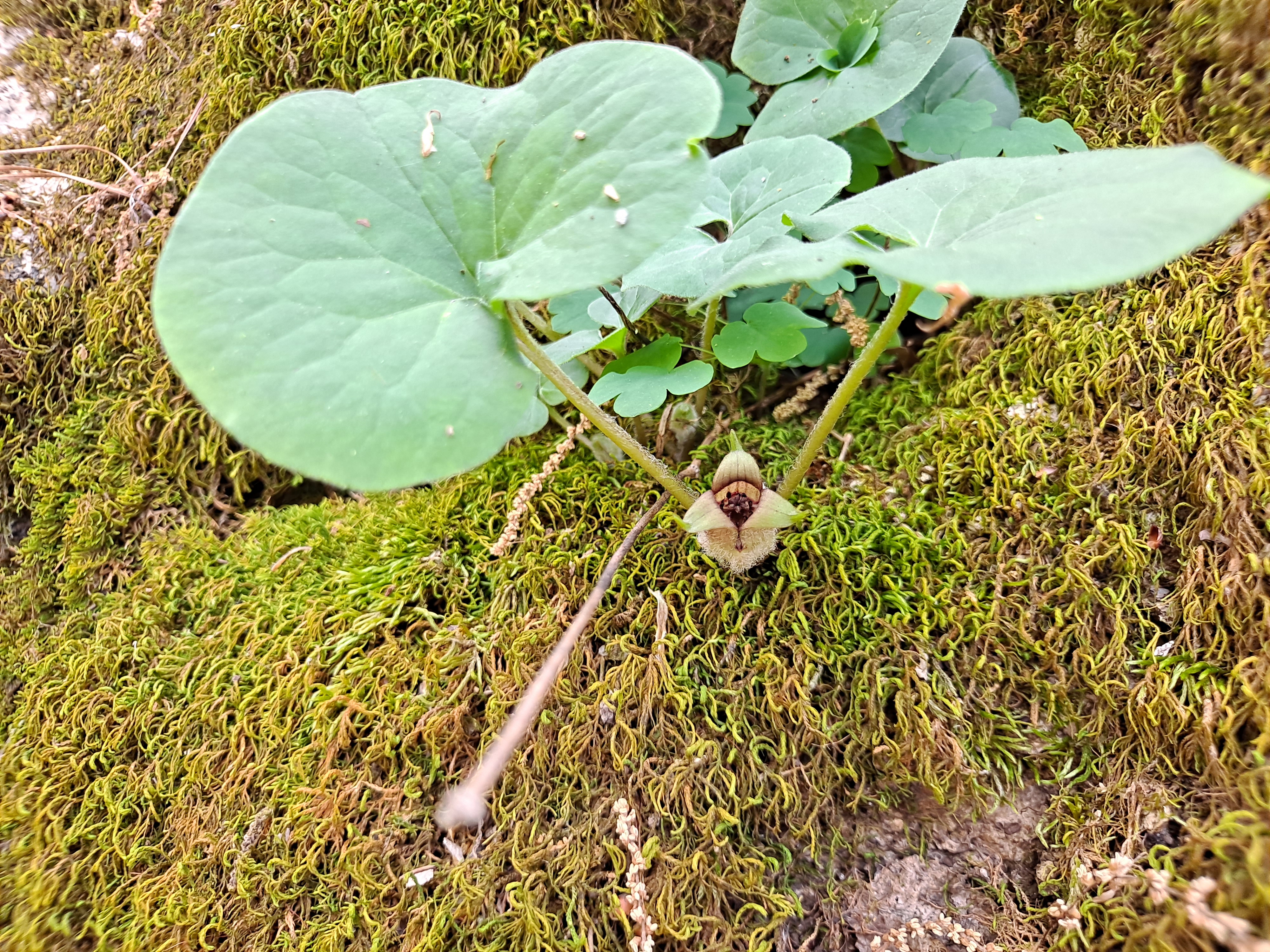
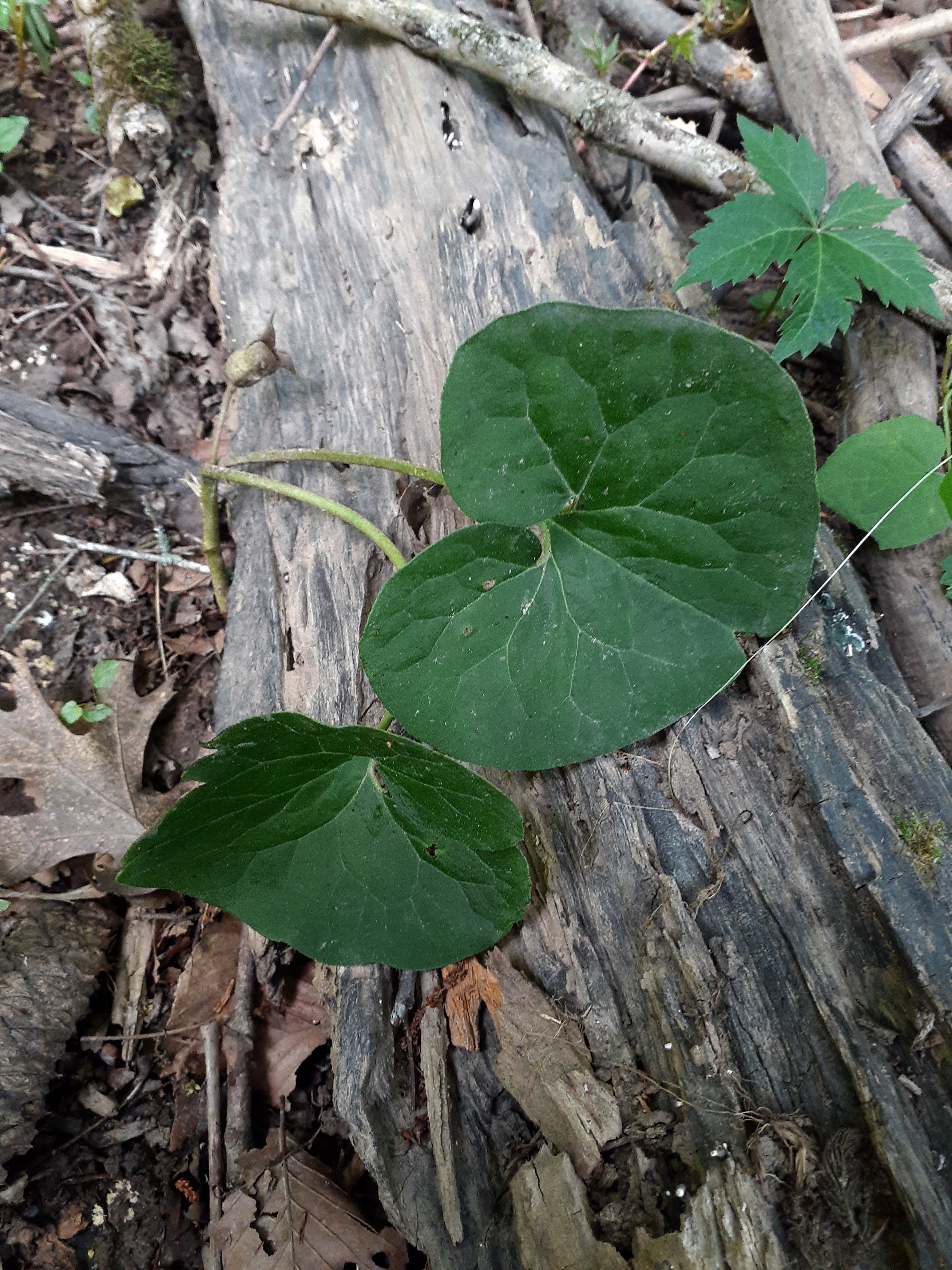
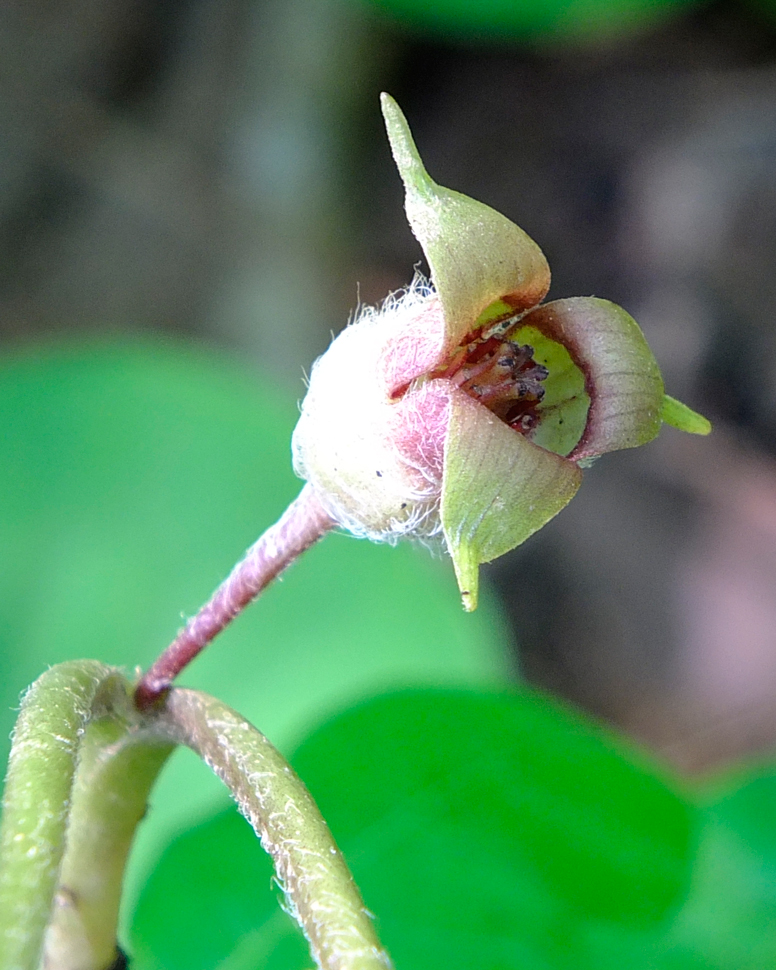
Herbaceous perennial up to 12 in. (30 cm) tall. Stems are very short, at or just above ground level, green to dark green, and sparsely pubescent. The two basal leaves arise separately on long, erect, pilose petioles. Leaf blades are light green, simple, entire, strongly cordate at the base, and typically measure about 3 in. long by 4 in. wide. Roots are rhizomatous, allowing plants to form colonies. A single flower develops at the basal split of the petioles, borne on a short stalk. Flowers are ½–1 in. (1.2–2.5 cm) long, light red, orbicular, and pilose. Outer calyx lobes are deep red with prominent dark veins, reflexed back along the flower. The reproductive column inside is also red. Blooming occurs in mid to late spring and lasts 3–4 weeks. Fruits are dry capsules that split open to release seeds bearing an elaiosome, which attracts ants for dispersal.
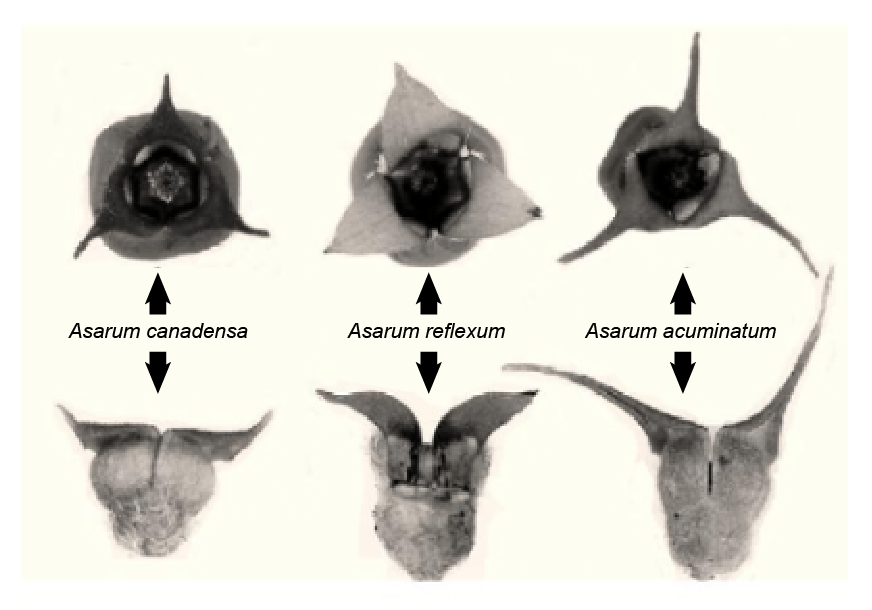
Canada Wild Ginger (Asarum canadense) is similar to Asarum reflexum in leaf shape and color; however, its flower calyx lobes are ruby red and spread outward to slightly ascending. In contrast, Asarum reflexum has calyx lobes that are strongly reflexed backward, and unlike A. canadense, it occurs outside the mountain region and is not restricted to northern Georgia.
Canada Wild Ginger (Asarum canadense) is also rare in Georgia.
Reflexed Canada Wild Ginger is found in floodplain, riparian, and low moist to mesic forest habitats.
Asarum reflexum is an herbaceous perennial that can live for several years. It grows primarily in shaded to partially sunlit mountain forests along stream headwaters, where populations include both vegetative and flowering plants that often form colonies. Rhizomatous roots allow colonies to spread gradually along streams. Flowers appear in early summer and last for several weeks. They are pollinated by flies and ground-dwelling insects such as ants and beetles, which may also aid in seed dispersal.
Asarum reflexum may be identified during the growing season (spring to fall) by its light green strongly cordate leaves, and during spring with its light red flower with strongly reflexed calyx lobes.
Found throughout eastern North America and into Manitoba, reaching its southeastern range limit in Alabama, Georgia, and the Carolinas. In Georgia, Asarum reflexum has been documented statewide, with six verified occurrences in the northwest portion of the state.
Logging, dams, and conversion of habitat to pine plantations and residential and commercial developments.
Asarum reflexum is ranked S3? by the Georgia Department of Natural Resources, indicating it may be vulnerable in the state but requires further review. The verified occurrences of Reflexed Canada Wild Ginger in Georgia are mostly on private land. It is likely more widespread and may occur in additional stream, river, and low woodland habitats in similar regions of the state.
Protect known populations from logging, dams, and other forms of habitat destruction.
GADNR. 2025. Element occurrence records for Asarum reflexum. Georgia Department of Natural Resources, Wildlife Resources Division, Wildlife Conservation Section. Social Circle, Georgia.
Illinois Wildflowers. 2025. https://www.illinoiswildflowers.info/woodland/plants/wild_ginger.htm.
Lake County, Illinois, USA, Seed Collection Guide-spring woodland forbs. 2021. https://fieldguides.fieldmuseum.org/sites/default/files/rapid-color-guides-pdfs/1271_usa_illinois_lakecounty_summerwoodlandforbs_v2.pdf.
NatureServe. 2025. Species account for Asarum canadense var. reflexum. NatureServe Explorer: an online encyclopedia of life. NatureServe Network Biodiversity Location Data accessed through NatureServe Explorer [web application]. NatureServe, Arlington, Virginia. Available https://explorer.natureserve.org/. Accessed 2025 February 28.
North Carolina Native Plant Society, 2024. https://ncwildflower.org/wild-gingers-hexastylis-and-asarum-in-north-carolina/.
Spaulding, D.D., T.W. Barger, and H.E. Horne. 2018. Flora of northern Alabama, part 3. Primitive Angiosperms. Phytoneuron 2018-11: 1–120. Published 26 February 2018. ISSN 2153 733X (comm. Estes, 2015).
Weakley, A.S. 2020. Flora of the southeast United States. University of North Carolina at Chapel Hill Herbarium, North Carolina Botanical Garden. University of North Carolina, Chapel Hill.
Nathan Thomas
28 February 2025