



Loading profile. Please wait . . .
Solidago arenicola B. R. Keener & Kral
Black Warrior Goldenrod


Federal Protection: No US federal protection
State Protection: No Georgia state protection
Global Rank: G3
State Rank: S1
Element Locations Tracked in Biotics: Yes
SWAP 2015 Species of Greatest Conservation Need (SGCN): Yes
SWAP 2025 Species of Greatest Conservation Need (SGCN): Yes
2025 SGCN Priority Tier: High Conservation Concern
Element Occurrences (EOs) in Georgia: 1
Habitat Summary for element in Georgia: Riverside scour areas
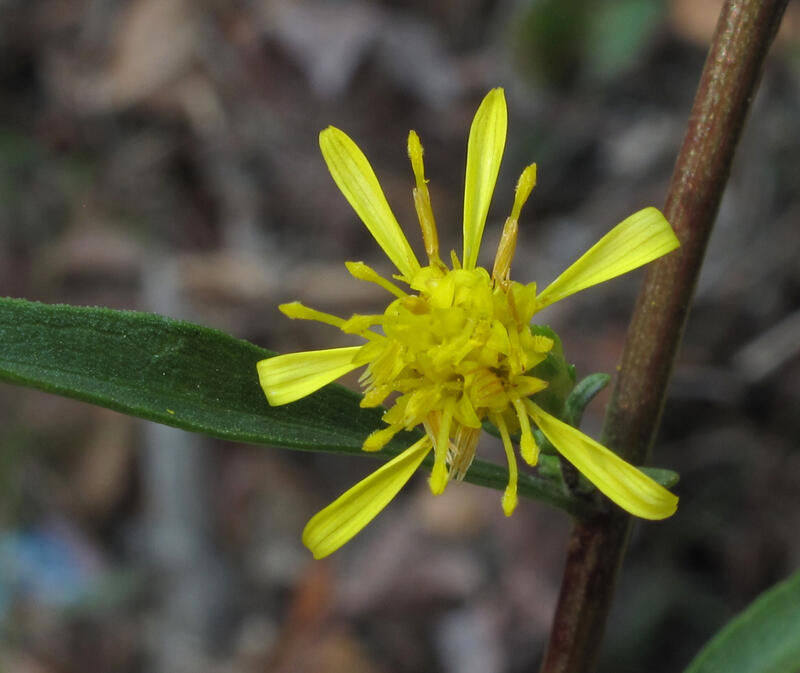
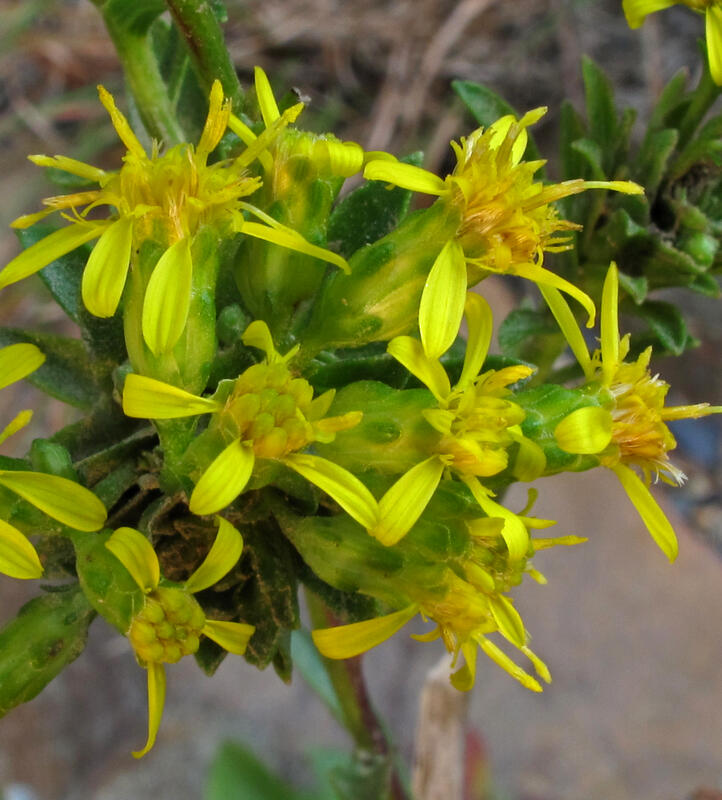
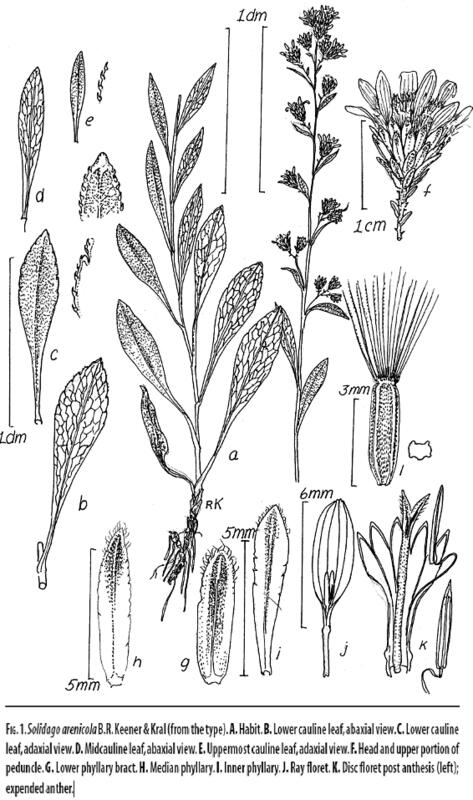
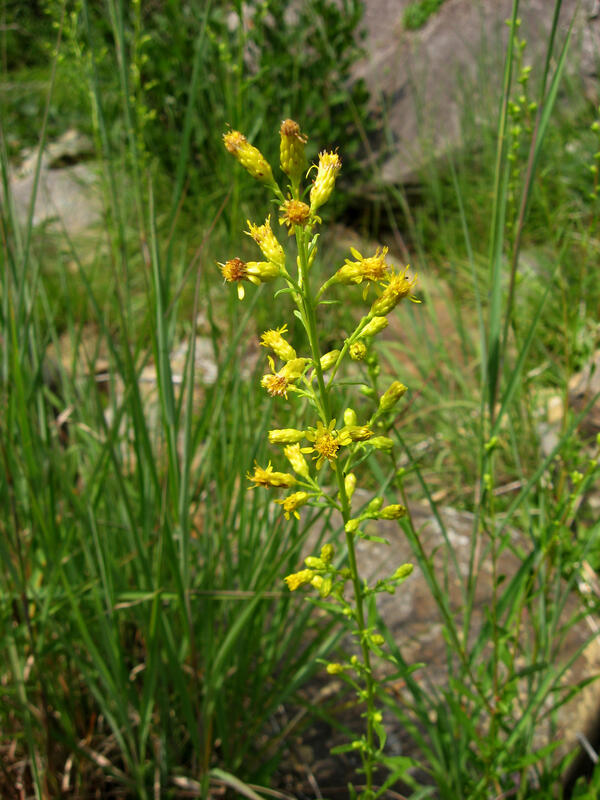
Perennial herb with 1 - 3 erect stems 14 - 32 inches (35 - 80 cm) tall, hairless and shallowly ribbed below the flower cluster; the base of the stem is somewhat woody and rises from a short rhizome. Leaves are alternate, erect or angled upwards; both leaf surfaces are hairless, the upper surface is dark green with only the midvein visible, the lower surface is pale with a raised midvein and a sharply contrasting network of dark green veins; margins are toothed above the middle and have coarse, claw-like hairs. The midstem and lower leaves are 4 - 6 inches long and 0.6 - 1.6 inch wide (10 - 15 cm long and 1.5 - 4 cm wide), slightly glandular (use 10x lens), widest above the middle, with a callused tip, long-tapering base, and a long, slightly winged leaf stalk. The uppermost leaves are much smaller, less than 2.4 inches long and 0.4 inch wide (3.5 - 6 cm long and 0.6 - 1 cm wide), becoming even smaller in the flower cluster, and have entire margins. A narrow flower cluster is held erect at the top of the stem; it has short branches bearing 1 - 5 small flower heads. Each flower head is surrounded at its base by a green, cup-like involucre about 0.5 inch (7 - 12 mm) high, the bracts with pale, papery borders and a narrow, green diamond at the tip; the bracts are covered with minute, sticky glands, visible with a 10x hand lens. There are 6 - 10 yellow ray flowers, about 0.1 inch (3 - 4 mm) long, and 11 - 16 yellow disc flowers per head. Fruits are dry, seed-like, 5-ribbed achenes tipped with short, white pappus bristles.
The Georgia population of Solidago arenicola occurs with Solidago erecta, which also has elongated flower clusters and most of its leaves located near the base of the stem. It differs from S. arenicola by its lack of minute, sticky glands on its leaves and involucral bracts, and by having leaves without stalks.
Solidago arenicola also closely resembles the rare species Solidago simulans, which is known from granite domes and outcrops in northeast Georgia. For more information about that species, see: https://georgiabiodiversity.org/portal/profile?group=plants&es_id=17265
Solidago arenicola most closely resembles Solidago racemosa, a species that occurs in Tennessee, Kentucky, Virginia, and West Virgina but not in Georgia.
Six species of Solidago are rare in Georgia:
Solidago arenicola (Black Warrior Goldenrod) occurs in bouldery and cobbled riversides in northwest Georgia. For more information, see: https://www.georgiabiodiversity.org/portal/profile?group=plants&es_id=34012
Solidago georgiana (Georgia Goldenrod) occurs in sandhills in east Georgia. For more information, see: https://www.georgiabiodiversity.org/portal/profile?group=plants&es_id=374034
Solidago porteri (Porter's Goldenrod) occurs in oak savannas, dry oak-pine woodlands, woodland edges, and disturbed areas in these habitats in the Piedmont. For more information, see: https://www.georgiabiodiversity.org/portal/profile?group=plants&es_id=22343
Solidago simulans (Cliffside Goldenrod) occurs on seepy granite domes and high-elevation cliffs in northeast Georgia. For more information, see: https://www.georgiabiodiversity.org/portal/profile?group=plants&es_id=17265
Solidago uliginosa var. uliginosa (Bog Goldenrod) occurs in mountain bogs in northeast Georgia. For more information, see: http://www.efloras.org/florataxon.aspx?flora_id=1&taxon_id=250067581
Solidago ulmifolia var. ulmifolia (Elmleaf Goldenrod) occurs in rocky mafic woodlands and calcareous glades in northwest Georgia. For more information, see: http://www.efloras.org/florataxon.aspx?flora_id=1&taxon_id=242417300
Bouldery and cobbled riversides that are frequently scoured by floods; shrubby floodplains.
Solidago arenicola is a perennial herb in the Aster family (Asteraceae). Like most members of the Aster family, its flower heads consist of a cup-like involucre of green phyllaries (involucral bracts), a whorl of colorful ray flowers, and a central disk of numerous small florets. The ray flowers of goldenrods are fertile, female only, and capable of producing seeds; the disk flowers are bisexual (having both female and male parts) and are also fertile and capable of producing seeds. No pollination studies have been published on Solidago arenicola, but goldenrods are typically pollinated by a wide variety of insects including bees, butterflies, flies, beetles, and wasps. Small, barbed bristles are attached to the top of the fruits and aid in seed dispersal by clinging to fur and feathers.
Surveys are best conducted during flowering (late August–October) and when river levels are at their lowest. Solidago arenicola occurs with Calamovilfa arcuata (Cumberland Sandreed), see: https://georgiabiodiversity.org/natels/profile?es_id=33734
Georgia, Alabama, and Tennessee. In Georgia, Solidago arenicola is documented in only one northwest Georgia county.
Alterations to flood frequency and intensity allow competing vegetation, especially trees and shrubs, to outcompete river scour and floodplain species such as Solidago arenicola; therefore, upstream impoundment, excessive sedimentation from bridge or road construction, and mining runoff are a threat. Invasion by Chinese Privet is especially a problem. Cattle grazing in riparian zones is also a threat. Changes in rainfall patterns related to global climate change are likely to have a severe impact on Solidago arenicola populations.
| Threat 1 | Threat 2 | Threat 3 | |
|---|---|---|---|
| General Threat | Residential & commercial development | Agriculture & aquaculture | Energy production & mining |
| Specific Threat | None | None | None |
Solidago arenicola is ranked S1 by the Georgia Department of Natural Resources, indicating that it is critically imperiled in the state. Only one population has been documented so far in Georgia; it occurs on conservation land.
Avoid hydrological changes, especially stream impoundment, in the watershed where Solidago arenicola occurs. Monitor the site for encroachment by woody and/or invasive plants, especially during drought years. Hand-clear woody plants if necessary. Monitor the site for the effects of climate change.
GADNR. 2019. Element occurrence record for Solidago arenicola. Georgia Department of Natural Resources, Wildlife Resources Division. Social Circle, Georgia.
Semple, J.C. 2019. Solidago arenicola, Southern Racemose Goldenrod. Astereae Lab, University of Waterloo, Waterloo, Ontario. https://uwaterloo.ca/astereae-lab/research/goldenrods/classification-and-illustrations/solidago-arenicola
Semple, J.C. and R.E. Cook. 2006. Species account for Solidago arenicola. Flora of North America North of Mexico, vol. 20. http://beta.floranorthamerica.org/Solidago_arenicola
Keener, B. R. and R. Kral. 2003. A new species of Solidago (Asteraceae: Astereae) from north central Alabama. Sida 20(4): 1589-1593. https://www.researchgate.net/publication/317671594_Keener_B_R_R_Kral_2003_A_New_Species_of_Solidago_Asteraceae_Astereae_from_North_Central_Alabama_Sida_20_1589-1593
NatureServe. 2019. Species account for Solidago arenicola. NatureServe Explorer. NatureServe, Arlington, Virginia. https://explorer.natureserve.org/Taxon/ELEMENT_GLOBAL.2.815837/Solidago_arenicola
Weakley, A.S. 2015. Flora of the southern and mid-Atlantic States. University of North Carolina Herbarium, University of North Carolina, Chapel Hill. http://www.herbarium.unc.edu/flora.htm
Linda G. Chafin
Linda G. Chafin, 17 December 2019: original account