


Loading profile. Please wait . . .
Calamovilfa arcuata K.E. Rogers
Cumberland Sandreed


Federal Protection: No US federal protection
State Protection: No Georgia state protection
Global Rank: G2G3
State Rank: S1
Element Locations Tracked in Biotics: Yes
SWAP 2015 Species of Greatest Conservation Need (SGCN): Yes
SWAP 2025 Species of Greatest Conservation Need (SGCN): Yes
2025 SGCN Priority Tier: Highest Conservation Concern
Element Occurrences (EOs) in Georgia: 1
Habitat Summary for element in Georgia: Riverside scour areas
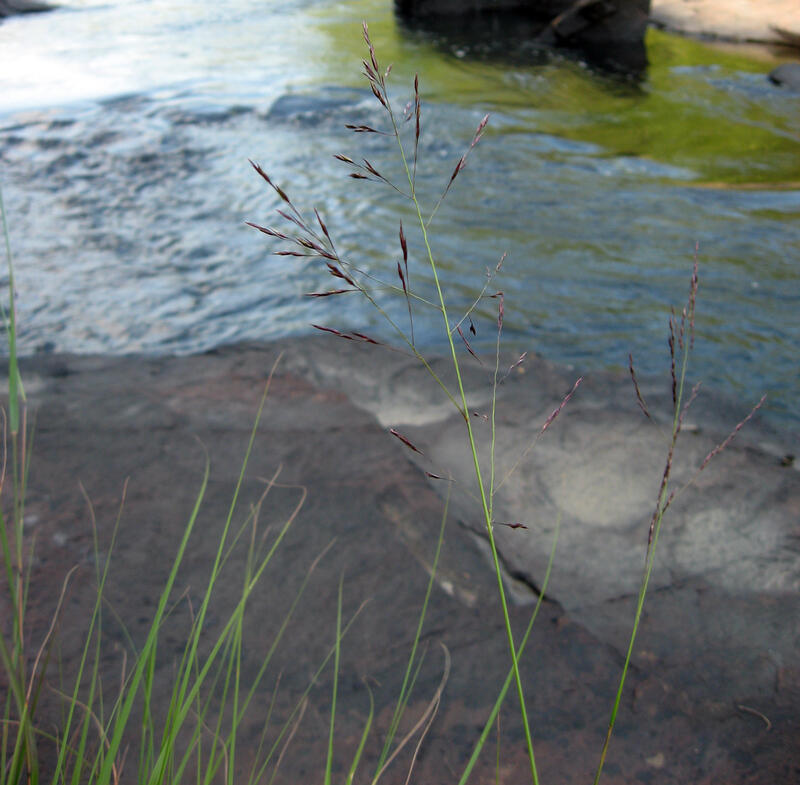
Perennial, warm-season bunch grass forming clumps up to 3 feet (1 meter) wide composed of many plants connected by short rhizomes. The stems are up 5 feet (1.5 meters) tall, erect, unbranched, and smooth except for long hairs at the nodes. The leaf blades are up to 34 inches (85 cm) long and less than 0.25 inch (1.5-6.5 mm) wide, with narrow, long-tapering tips and rough, white margins; the blade is hairy near the base and nearly smooth near the tip; the collar, ligule, and margins of the sheath are densely hairy; old dried leaf bases persist at the base of the plant and along the rhizomes. The large, open, purplish flower cluster at the top of each stem is 6-18 inches tall and 3-16 inches wide (15-45 cm tall and 8-40 cm wide) with many slender, upwardly angled or spreading branches, each branch with a patch of hairs at the base. The one-flowered spikelets are purplish and are about ¼ inch (6-7.4 mm) long, flattened, pointed, and without awns; the two glumes are curved (“arcuate”) and there is a distinctive patch of white hairs at the base of each floret.
Cumberland Sand-reed is the only species of Calamovilfa in Georgia. Purple-top (Tridens flavus) also has purplish spikelets but the branches within its flower cluster are distinctly downcurved and drooping; its spikelets have 4-8 florets and a thin coating of wax, leading to the other common name “greasy grass.” Smaller plants of Switch-grass (Panicum virgatum) may look similar; its stems are 1.5-10 feet (40-300 cm) tall, and the nodes are hairless. Johnson Grass (Sorghum halepense) also has reddish-purple spikelets, smooth stems, and hairy nodes and ligules. Its spikelets are grouped in 2s or 3s at the tip of a tiny branch, and the florets often (though not always) have a twisted awn. It is an invasive exotic species most often found in ruderal environments.
Cumberland Sand-reed is the only species of Calamovilfa in Georgia. More than 30 other grass species are rare in Georgia.
Cumberland Sand-reed grows in high-gradient portions of streams in streamside scour areas, gravel and cobble bars, and among streamside boulders.
Cumberland Sand-reed is wind-pollinated, and its seeds are dispersed by flowing water. It flowers in late summer, when stream flow is usually at its lowest and releases its seeds just before late fall rains resume. It is dependent on frequent scouring by flood waters to reduce competition from woody plants. Like many warm-season grasses, Calamovilfa is a C4 species: it uses a type of photosynthesis that allows it to reduce photorespiration and to conserve moisture.
Surveys are best conducted during flowering and fruiting, August–October. During other months of the growing season, it may be identified by the rough, white margins and hairy bases of the leaf blades; the densely hairy collar, ligule, and leaf sheath margins; and the old dried leaf bases persisting at the base of the plant.
Calamovilfa arcuata occurs in Georgia, Alabama, Tennessee, Kentucky, Arkansas, and Oklahoma. It is rare throughout its range.
Alterations to flood frequency and intensity allow competing vegetation, especially trees and shrubs, to outcompete Calamovilfa arcuata; therefore, upstream impoundment, excessive sedimentation from bridge or road construction, and mining runoff are a threat. Invasion by Chinese Privet is especially a problem. Cattle grazing in riparian zones is also a threat. Changes in rainfall patterns related to global climate change are likely to have a severe impact on Calamovilfa arcuata populations.
| Threat 1 | Threat 2 | Threat 3 | |
|---|---|---|---|
| General Threat | Climate change & severe weather | Residential & commercial development | Agriculture & aquaculture |
| Specific Threat | None | None | None |
Calamovilfa arcuata is ranked S1 by the Georgia Department of Natural Resources, indicating that it is critically imperiled in the state. The single population currently known in Georgia occurs in the Lula Lake Land Trust, a privately owned conservation-oriented preserve.
Avoid hydrological changes, especially stream impoundment, in the watershed where the species occurs. Monitor the site for encroachment by woody plants, especially during drought years. Hand-clear woody plants if necessary.
GADNR. 2019. Element occurrence records for Calamovilfa arcuata. Georgia Department of Natural Resources, Wildlife Resources Division. Social Circle, Georgia.
Kral, R. 1983. A report on some rare, threatened, or endangered forest-related vascular plants of the South. U.S. Dept. of Agriculture Forest Service Technical Publication R8-TP2, Athens, GA.
Missouri Botanical Garden. Calamovilfa arcuata. Missouri Botanical Garden Plant Finder. http://www.missouribotanicalgarden.org/PlantFinder/PlantFinderDetails.aspx?taxonid=285269&isprofile=0&.
NatureServe. 2019. Species account for Calamovilfa arcuata. NatureServe Explorer: an online encyclopedia of life, Version 7.1. NatureServe, Arlington, Virginia. Accessed 23 July 2019. http://explorer.natureserve.org/servlet/NatureServe?searchName=Calamovilfa+arcuata
Rogers, K. E. 1970. A new species of Calamovilfa (Gramineae) from North America. Rhodora 72(789): 72-80.
Rogers, K. E. 2019. Center for Plant Conservation National Collection Plant Profile: Calamovilfa arcuata. https://saveplants.org/national-collection/plant-search/plant-profile/?CPCNum=667. Accessed 23 July 2019.
Thieret, J.W. 2003. Calamovilfa arcuata, published in: Flora of North America, vol. 25, accessed at http://herbarium.usu.edu/webmanual on 26 February 2015. [website no longer available; abbreviated account at http://beta.semanticfna.org/Calamovilfa_arcuata]
Weakley, A.S. 2015. Flora of the southern and mid-Atlantic States. University of North Carolina Herbarium, University of North Carolina, Chapel Hill. http://www.herbarium.unc.edu/flora.htm
Linda G. Chafin
Linda G. Chafin, 30 July 2019: original account
