


Loading profile. Please wait . . .
Gymnopogon chapmanianus A.S. Hitchc.
Chapman's Skeleton Grass


Federal Protection: No US federal protection
State Protection: No Georgia state protection
Global Rank: G3
State Rank: S1
Element Locations Tracked in Biotics: Yes
SWAP 2015 Species of Greatest Conservation Need (SGCN): No
SWAP 2025 Species of Greatest Conservation Need (SGCN): Yes
2025 SGCN Priority Tier: High Conservation Concern
Element Occurrences (EOs) in Georgia: 2
Habitat Summary for element in Georgia: Sandy pinelands near Florida, perhaps with Ctenium floridanum
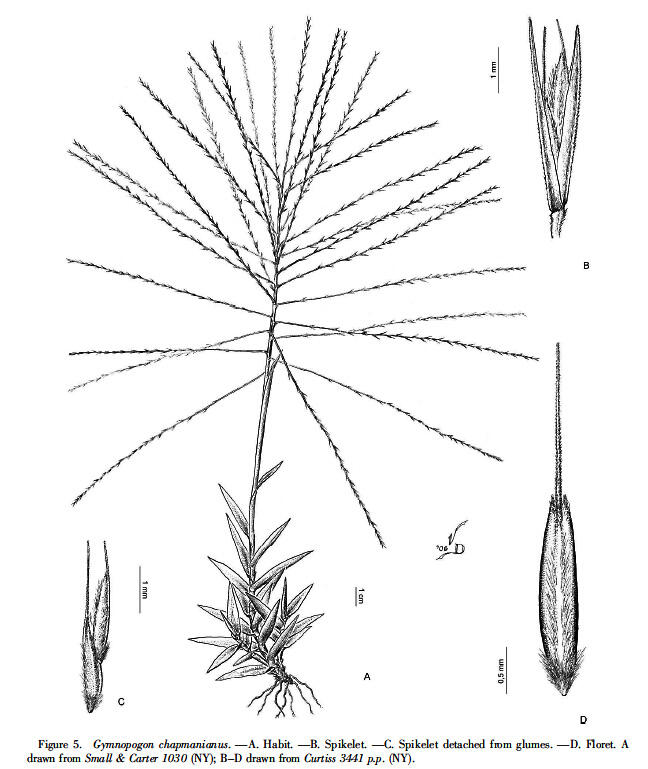
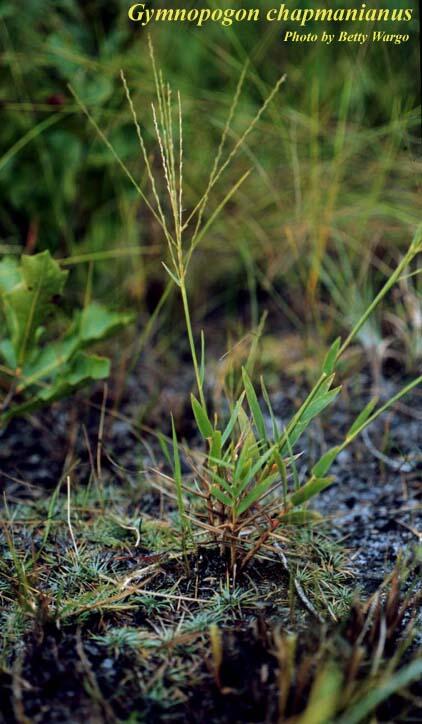
Perennial bunch grass rising from a knotty base. Stems 6 - 28 inches (15 - 70 cm) tall, erect or sprawling, yellowish-green, hairless. Leaf sheaths are hairless throughout. Leaf blades are 0.5 - 3.3 inch long and up to 0.3 inch wide (1.3 - 8.5 cm long, 2 - 8 cm wide), narrowly lance-shaped, stiff-textured, and distichous (in two rows on opposite sides of the stem); the bases of the leaves are heart-shaped and clasp the stem; the margins are rough with short hairs, otherwise the blade is hairless. Flower clusters are held at the top of the stem with numerous, widely spreading or upwardly angled branches 2 - 8 inches (5 - 20 cm) long, produced alternately along the main stem (rarely in pairs). Spikelets are more or less evenly spaced and pressed against each branch in two series. Each spikelet consists of two spreading, single-veined, purplish glumes up to 0.24 inch (6 mm) long and 1 - 4 florets (usually 2 or 3). Within each spikelet, 1 - 2 florets are bisexual and fertile, the others sterile. The lemmas of bisexual florets are 1.5 - 2.3 mm long, 3-veined, hairy, and usually tipped with a single bristle (awn) up to 2.2 mm long. Fruits are dry, seed-like, 1.2 - 1.5 mm long.
Eastern Skeleton Grass, Eastern Beard Grass (Gymnopogon ambiguus) occurs infrequently throughout Georgia in prairies, glades, dry pinelands, woodlands, and dry fields. Superficially, it is almost identical to Chapman’s Skeleton Grass. It may be taller, up to 3 feet (20 - 100 cm) tall with longer leaf blades, up to 4.7 inches (1.5 - 12 cm) long. The top of its leaf sheath is hairy. The spikelets look bristly because the awns on its lemmas are 4 - 12 mm long.
Gymnopogon species may be confused with members of the genus Chloris, but Chloris flower clusters consist of branches that originate from a single point at the top of the stem. Also Chloris leaves are not distichous.
Broad-leaved Beardgrass (Gymnopogon brevifolius, Georgia Special Concern) occurs in Longleaf Pine/scrub oak habitats in two of Georgia’s Fall Line counties. Its leaves are small: 0.4 - 3 inches (1 - 8 cm) long and less than 0.4 inch (0.2 - 1 cm) wide. The branches in the flower cluster are bare of spikelets for at least 1/3 their length. For more information, see: http://beta.floranorthamerica.org/Gymnopogon_brevifolius
Longleaf Pine woodlands and Slash Pine flatwoods in Georgia’s Coastal Plain in counties adjacent to Florida.
Chapman's Skeleton Grass is a warm-season grass, flowering and setting fruit August – November. As with most grasses, Chapman's Skeleton Grass is wind-pollinated, and its seeds are dispersed by wind, gravity, and small animals.
Surveys should be conducted during August – November when the plants are flowering and setting seed.
Georgia and Florida.
Longleaf Pine woodlands and Slash Pine flatwoods are threatened by conversion to pine plantations, pastures, and agriculture as well as residential and commercial development, Cogon Grass invasion, and fire suppression.
| Threat 1 | Threat 2 | Threat 3 | |
|---|---|---|---|
| General Threat | Residential & commercial development | Climate change & severe weather | None |
| Specific Threat | None | None | None |
Gymnopogon chapmanianus is ranked S1 by the Georgia Department of Natural Resources, indicating that it is critically imperiled in Georgia. Two populations have been documented in Georgia, one on conservation land.
Protect natural Longleaf and Slash Pine woodlands from conversion. Apply prescribed fire every 2 - 3 years preferably during the growing season. Eradicate Cogon Grass.
Cialdella, A.M. and F.O. Zuloaga. 2011. Taxonomic study of Gymnopogon (Poaceae, Chloridoideae, Cynodonteae). Annals of the Missouri Botanical Garden 98(3): 301-330. https://doi.org/10.3417/2009071
GADNR. 2019. Element occurrence records for Gymnopogon chapmanianus. Georgia Department of Natural Resources, Wildlife Resources Division. Social Circle, Georgia.
Smith, J.P. 2004. Species account for Gymnopogon chapmanianus. Flora of North America North of Mexico, vol. 25. http://beta.floranorthamerica.org/Gymnopogon_brevifolius
NatureServe. 2020. Species account for Gymnopogon chapmanianus. NatureServe Explorer: an online encyclopedia of life. NatureServe, Arlington, Virginia. http://explorer.natureserve.org/servlet/NatureServe?searchName= Gymnopogon+chapmanianus
Weakley, A.S. 2015. Flora of the southern and mid-Atlantic States. University of North Carolina Herbarium, University of North Carolina, Chapel Hill. http://www.herbarium.unc.edu/flora.htm
Linda G. Chafin
Linda G. Chafin, 14 April 2020: original account.