


Loading profile. Please wait . . .
Lycium carolinianum Walt.
Carolina Wolfberry


Federal Protection: No US federal protection
State Protection: No Georgia state protection
Global Rank: G4
State Rank: S1
Element Locations Tracked in Biotics: Yes
SWAP 2015 Species of Greatest Conservation Need (SGCN): Yes
SWAP 2025 Species of Greatest Conservation Need (SGCN): Yes
2025 SGCN Priority Tier: High Conservation Concern
Element Occurrences (EOs) in Georgia: 2
Habitat Summary for element in Georgia: Coastal sand spits
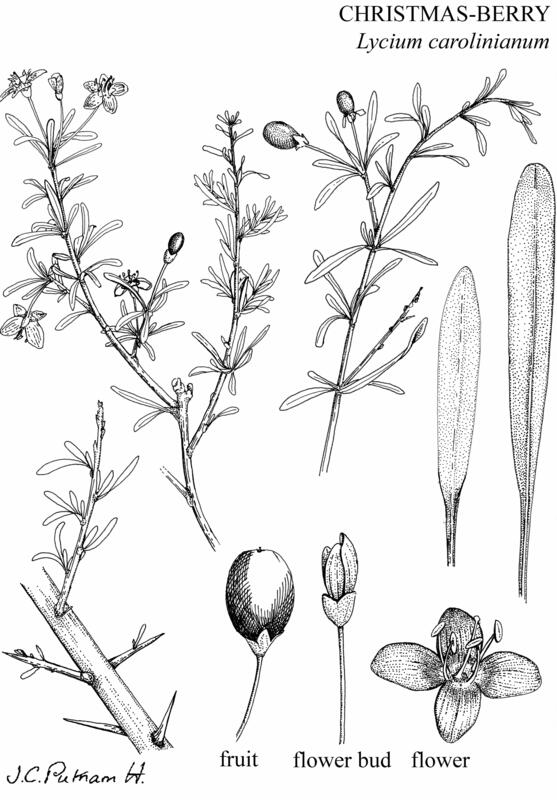
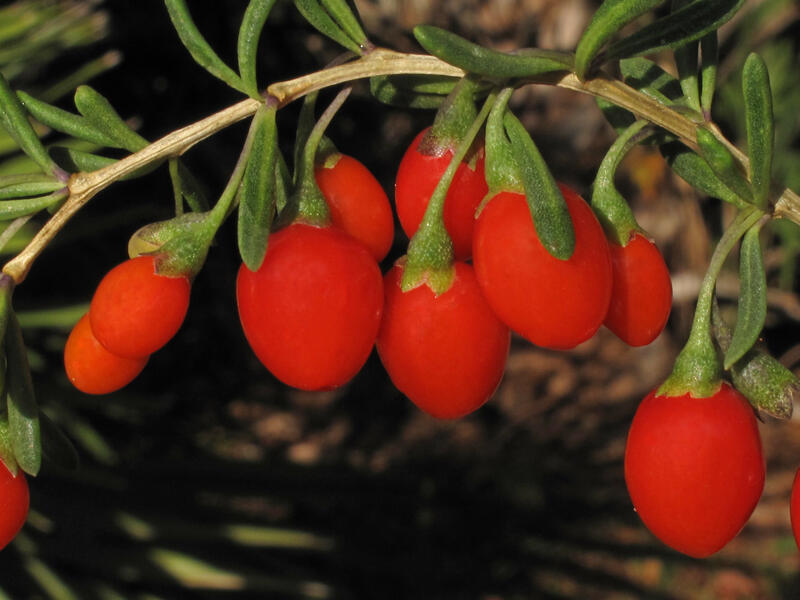
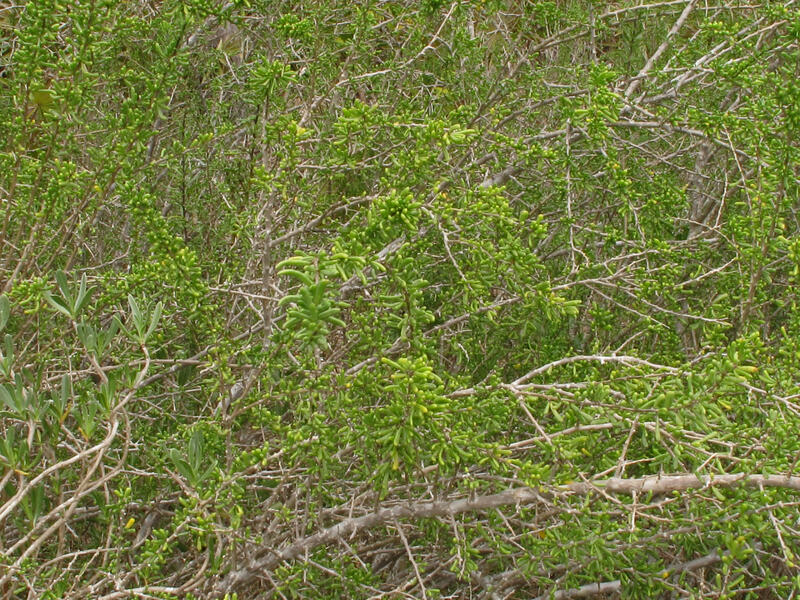
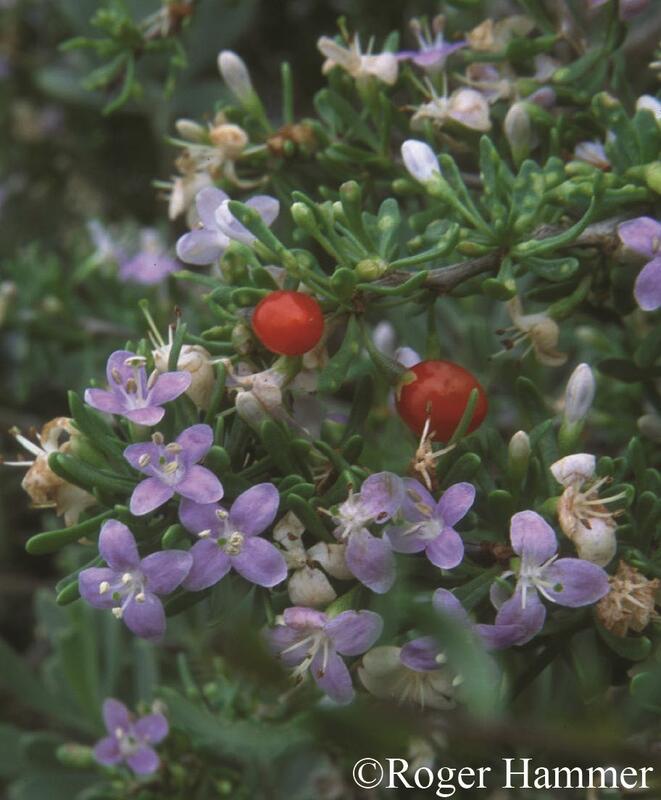
A sprawling shrub up to 10 feet (3 meters) tall, with rigid, clambering branches bearing short, buff-colored, thorn-tipped twigs. Leaves are up to 1 inch (2.5 cm) long, narrow at the base and slightly wider at the tips, round or flattened in cross-section, alternate but often in clusters, tardily deciduous or sometimes evergreen, succulent, strong-smelling when crushed. Flowers are up to 0.5 inch (1.2 cm) across, with 4 - 5 spreading lobes; blue, lavender, or white, with purple streaks; the flower stalk is up to 1 inch long. Fruit is a berry, up to 0.6 inch (0.8 - 1.5 cm) long, round or oval, red, with 4 persistent sepals.
Taken together, the flowers, fruits, succulent leaves, and thorn-tipped twigs of Christmasberry are distinctive.
False-willow (Baccharis angustifolia) has tan, brittle, upright stems (new growth is green) and needle-like leaves (but not in clusters), and downy, white flower heads that are showy in the fall. Its twigs are not thorn-tipped.
Beach elder (Iva imbricata) has fleshy leaves up to 0.5 inch (1.2 cm) wide; primarily a dune shrub, it rarely gets taller than 2 feet (60 cm) and has elongated spikes of fleshy, green flower heads.
None in Georgia.
Coastal sand spits, shell mounds, edges of salt marshes.
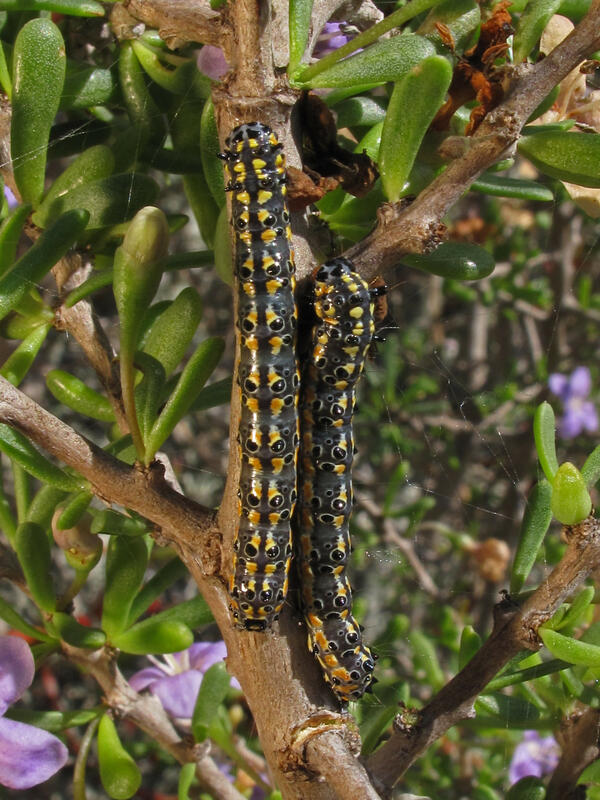
Lycium carolinianum is a sprawling shrub that reproduces sexually by seed and vegetatively by suckering from the base of the trunk and from root sprouts. Christmas-berry flowers are pollinated by bees, butterflies, and wasps. Its berries are an important wildlife food for many species, including some species of mammals (marsh rice rat, Oryzomys palustris) and birds such as whooping cranes (Grus americana) which eat large quantities of these berries as a winter food on crane refuges in Texas. Butterflies such as Great Southern White (Ascia monuste) and Gulf Fritillary (Agraulis vanillae) are known to nectar on the flowers. The moths of (Loxostege floridalis, see photo below) use the leaves as larval food. The leaves and fruits are toxic to humans and livestock.
Surveys are best conducted during flowering (September–October) and fruiting (November–December), but the thorn-tipped twigs and fleshy, clustered leaves are distinctive year-round.
Georgia, Florida, South Carolina, Alabama, Mississippi, Louisiana, Texas, and West Indies.
Clearing and destruction of habitat by coastal developers. Sea level rise related to global climate change.
| Threat 1 | Threat 2 | Threat 3 | |
|---|---|---|---|
| General Threat | Natural system modifications | Climate change & severe weather | None |
| Specific Threat | Other ecosystem modifications | Habitat shifting & alteration | None |
Lycium carolinianum is ranked S1 by the Georgia Department of Natural Resources, indicating that it is critically imperiled in Georgia. Two populations are known in Georgia, both on private land.
Protect salt marshes, dunes, and other coastal plant communities from development. Address climate change.
Butzler, R.E. 2006. Spatial and temporal patterns of Lycium carolinianum Walt., the Carolina Wolfberry, in the salt marshes of Aransas National Wildlife Refuge, Texas. M.S. Thesis, Texas A & M University. https://oaktrust.library.tamu.edu/bitstream/handle/1969.1/3758/etd-tamu-2006A-WFSC-Butzler.pdf?sequence=1&isAllowed=y
Butzler, R.E. and S.E. Davis. 2006. Growth patterns of Carolina wolfberry (Lycium carolinianum L.) in the salt marshes of Aransas National Wildlife Refuge, Texas, USA. Wetlands 26, article number: 845. https://link.springer.com/article/10.1672/0277-5212(2006)26[845:GPOCWL]2.0.CO;2
Chafin, L.G. 2007. Field guide to the rare plants of Georgia. State Botanical Garden of Georgia and University of Georgia Press, Athens.
FNPS. Lycium carolinianum, Christmas-berry species account. Florida Native Plant Society. https://www.fnps.org/plants/plant/lycium-carolinianum
Foote, L.E. and S.B. Jones, Jr. 1989. Native shrubs and woody vines of the southeast. Timber Press, Portland, Oregon.
Gilman, E.F. 1999. Lycium carolinianum fact sheet. University of Florida Cooperative Extension Service/IFAS. http://hort.ufl.edu/shrubs/LYCCARA.PDF
Godfrey, R.K. 1988. Trees, shrubs, and woody vines of northern Florida and adjacent Georgia and Alabama. University of Georgia Press, Athens.
Heppner, J.B. 1975. Biological notes on Loxostege floridalis (Pyralidae). Journal of the Lepidopterists’ Society 29(4): 236.
Lance, R. 2004. Woody plants of the southeastern United States: a winter guide. University of Georgia Press, Athens.
NatureServe. 2019. Lycium carolinianum comprehensive species report. NatureServe Explorer. Arlington, Virginia. http://explorer.natureserve.org/servlet/NatureServe?searchName=Lycium+carolinianum
Nelson, G. 1996. Shrubs and woody vines of Florida. Pineapple Press, Sarasota, Florida.
Nelson, J.T. 1996. Nutritional value of winter foods for whooping cranes. Wilson Ornithological Society Bulletin 108(4): 728. https://www.jstor.org/stable/pdf/4163752.pdf?refreqid=excelsior%3A36d9fafead1a6985cd920e2af7cbd2cb
Radford, A.E., H.E. Ahles, and C.R. Bell. 1968. Manual of the vascular flora of the Carolinas. University of North Carolina Press, Chapel Hill.
Weakley, A.S. 2007. Flora of the Carolinas, Virginia, Georgia, and surrounding areas. University of North Carolina Herbarium, Chapel Hill. http://www.herbarium.unc.edu/flora.htm
Linda G. Chafin
L. Chafin, May 2007: original account
K. Owers, Feb. 2010: added pictures
L. Chafin, Mar. 2020: updated original account.