


Loading profile. Please wait . . .
Helianthus verticillatus Small
Whorled Sunflower


Federal Protection: Listed Endangered
State Protection: Endangered
Global Rank: G1
State Rank: S1
Element Locations Tracked in Biotics: Yes
SWAP 2015 Species of Greatest Conservation Need (SGCN): Yes
SWAP 2025 Species of Greatest Conservation Need (SGCN): Yes
2025 SGCN Priority Tier: Highest Conservation Concern
Element Occurrences (EOs) in Georgia: 4
Habitat Summary for element in Georgia: Wet prairies over dolomite
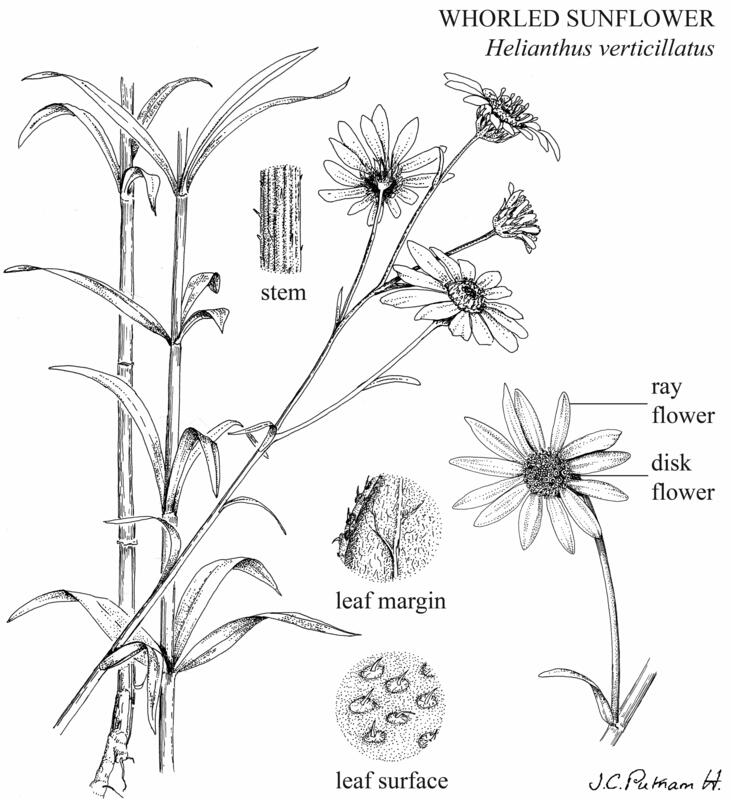
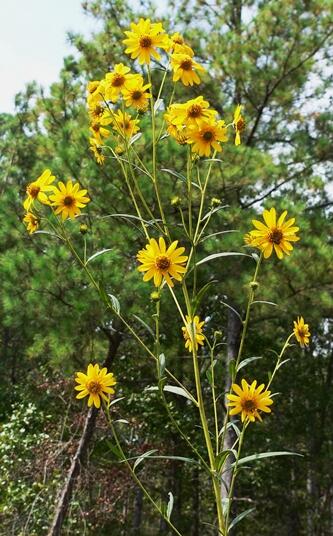
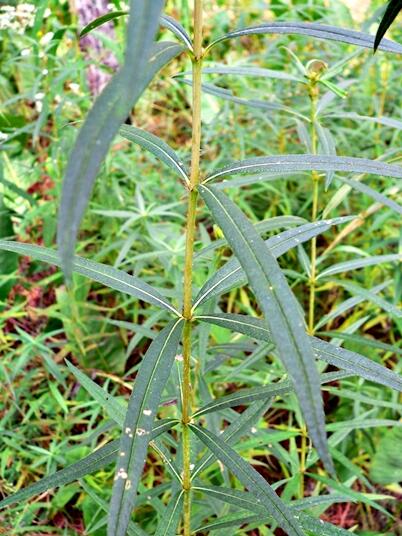
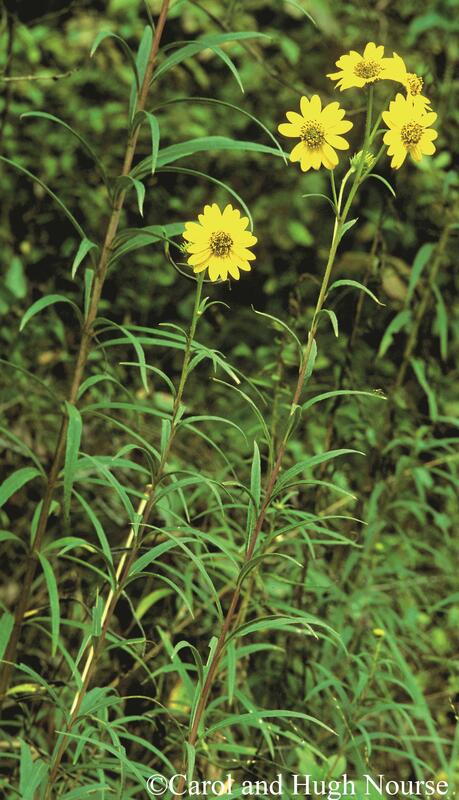
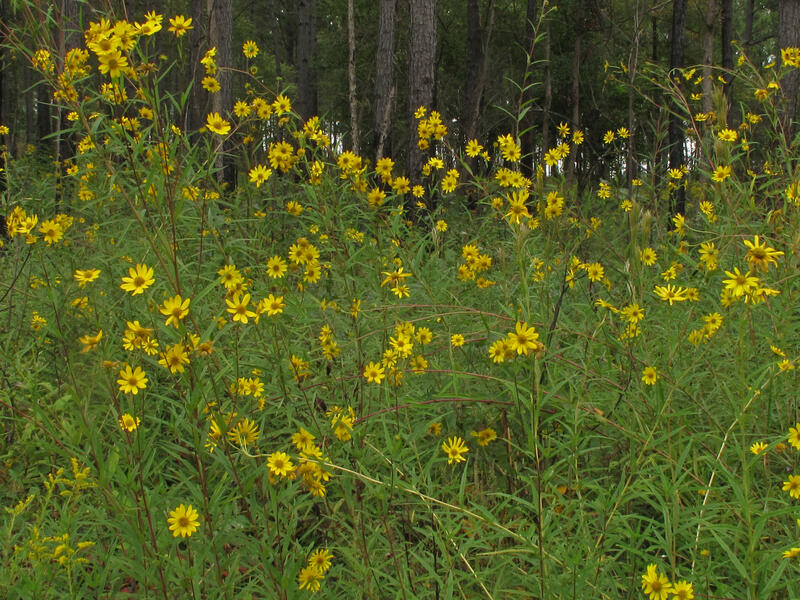
Perennial herb with leafy, hairless, waxy stems 6.5 - 10 feet (2 - 3 meters) tall. The leaves are 3 - 7.2 inches (7.5 - 18.5 cm) long and 0.3 - 1.2 inch (0.7 - 3 cm) wide, linear to lance-shaped, tapering to the base, with short or no leaf stalks; leaves are alternate near the top of the stem, opposite near the base, and in whorls of 3 - 6 leaves at mid-stem; both leaf surfaces are hairy and gland-dotted. The leaf margins are entire and minutely toothed. Flower heads are in a large, branched cluster at the top of the stem, each head with 10 - 19 (usually 13) yellow ray flowers, a central disk of many tiny yellow flowers with dark anthers bearing yellow appendages. A whorl of narrow, spreading, green, involucral bracts form a cup beneath the flowers and around the base of the head. Fruits are less than 0.2 inch long (4-5 mm), dry, seed-like, and tipped with pointed scales.
Whorled Sunflower is the only sunflower in northwest Georgia with a combination of leafy stems, whorled leaves, and yellow disk flowers. Narrow-leaved Sunflower (Helianthus angustifolius) has very narrow, opposite and alternate, roughly hairy leaves. Woodland Sunflower (H. divaricatus) has opposite leaves with rounded leaf bases. Small-headed Sunflower (H. microcephalus) has smaller flower heads and opposite, toothed leaves.
There are 6 rare species of Helianthus in Georgia:
Helianthus agrestis (Southeastern Sunflower) occurs in mucky, wet soils in open pine flatwoods in the Coastal Plain. For more information, see: http://explorer.natureserve.org/servlet/NatureServe?searchName=Helianthus%20agrestis
Helianthus glaucophyllus (Whiteleaf Sunflower) occurs in moist forests and woodlands in the Southern Appalachian mountains and foothills. For more information, see: https://www.georgiabiodiversity.org/portal/profile?group=plants&es_id=16054.
Helianthus heterophyllus (Wetland Sunflower) occurs in bBogs and wet pine savannas. For more information, see: http://www.efloras.org/florataxon.aspx?flora_id=1&taxon_id=250066885
Helianthus occidentalis (Barrens Sunflower) occurs in limestone glades and barrens with rocky or cherty soils. For more information, see: http://www.efloras.org/florataxon.aspx?flora_id=1&taxon_id=242416636
Helianthus smithii (Smith's Sunflower) occurs in dry upland woods in north Georgia. For more information, see: https://www.georgiabiodiversity.org/portal/profile?group=plants&es_id=20250
Helianthus verticillatus (Whorled Sunflower) occurs in wet prairies over dolomite in northwest Georgia. For more information, see: https://www.georgiabiodiversity.org/portal/profile?group=plants&es_id=21967
Wet, sunny prairie openings in floodplains and wet depressions in the Coosa Valley; often grows with prairie grasses such as Little Bluestem and Big Bluestem.
Whorled Sunflower was first described in 1898, based on plants collected in 1892 at a single site in Tennessee. The species was not seen again until 1994, when it was collected in Georgia’s Coosa Prairies. During much of the time between its description and re-discovery, Whorled Sunflower was thought to be a hybrid even though there was no evidence to support that speculation. Once the new populations were discovered and research carried out, it became clear that Whorled Sunflower is a distinct species. Whorled Sunflower is unusual, as rare plants go, in that it has relatively high levels of genetic diversity at both the population and species levels, suggesting that it may once have been more common.
Whorled Sunflower reproduces asexually by spread of rhizomes and sexually by seed. Its flowers are pollinated primarily by bees and butterflies, as are other members of this genus. Pollinators are attracted to the nectar produced inside the base of the disk flowers. Sunflowers, like most members of the Aster family, require cross-pollination to successfully produce seed.
Surveys are best conducted during flowering (late August–October).
Georgia, northeast Alabama, and southwest Tennessee. It is rare throughout its range. Reports of plants in Louisiana are in error.
Conversion of habitat to pine plantations, pasture, farmland, and development; ditching and draining of wetland habitat; logging and other mechanical clearing; fire suppression.
| Threat 1 | Threat 2 | Threat 3 | |
|---|---|---|---|
| General Threat | Agriculture & aquaculture | Natural system modifications | Transportation & service corridors |
| Specific Threat | None | None | None |
Helianthus verticillatus is ranked S1 by the Georgia Department of Natural Resources, indicating that it is imperiled in Georgia. It is listed as Endangered by the U.S. Fish and Wildlife Service and the State of Georgia. Four populations have been documented in Georgia’s Coosa Valley prairies; all are protected by a conservation agreement but require active fire management and monitoring for their long-term survival. Although there are thousands of stems of Whorled Sunflower in the Coosa Valley prairies, genetic testing has shown that most are clones and that there are only 20 - 40 genetically distinct individuals there.
Apply prescribed fire every 2 - 3 years to prairies; avoid logging, clearing, bedding, and other mechanical disturbances; avoid hydrologic alterations such as ditching, draining, and filling. Avoid herbicide use.
Allison, J.R. 1995. Prairies...in Georgia! Tipularia, Journal of the Georgia Botanical Society 10:2-8.
Allison, J.R. 1997. Rediscovery of the whorled sunflower, Helianthus verticillatus Small. ASB Bulletin 44: 143-144.
Center for Biological Diversity. 2010. Petition to list whorled sunflower (Helianthus verticillatus) as a federally endangered species. Candidate Petition Project, Center for Biological Diversity, Tucson, Arizona. https://www.biologicaldiversity.org/campaigns/candidate_project/pdfs/plants-non-Hawaiian-petition.pdf
Chafin, L.G. 2007. Field guide to the rare plants of Georgia. State Botanical Garden of Georgia and University of Georgia Press, Athens.
Ellis, J.R., K.E. Bentley, and D.E. McCauley. 2008. Detection of rare paternal chloroplast inheritance in controlled crosses of the endangered sunflower Helianthus verticillatus. Heredity 100 (6): 574-580. https://www.nature.com/articles/hdy200811
Ellis, J.R., C.H. Pashley, J.M. Burke, and D. E. McCauley. 2006. High genetic diversity in a rare and endangered sunflower as compared to a common congener. Molecular Ecology 15(9): 2345-2355. https://www.ncbi.nlm.nih.gov/pubmed/16842410
GADNR. 2020. Element occurrence records for Helianthus verticillatus. Georgia Department of Natural Resources, Wildlife Resources Division, Social Circle, Georgia.
Matthews, J.F., J.R. Allison, R.T. Ware, Sr., and C. Nordman. 2002. Helianthus verticillatus Small (Asteraceae) rediscovered and redescribed. Castanea 67(1): 13-24. https://www.jstor.org/stable/4034312?seq=1#metadata_info_tab_contents
NatureServe. 2019. Helianthus verticillatus comprehensive report. NatureServe Explorer. Arlington, Virginia. http://explorer.natureserve.org/servlet/NatureServe?searchName= Helianthus+verticillatus
Ranger, S. 1995. The strange sunflower from the Floyd prairies. Georgia Botanical Society Newsletter 68(1):1.
Schilling, E.E. 2006. Flora of North America, Vol. 21, Magnoliophyta: Asteridae, Part 8: Asteraceae, Part 3. Oxford University Press, New York. http://www.efloras.org/florataxon.aspx?flora_id=1&taxon_id=250066903
Science Daily. 2007. Student proves giant Whorled Sunflower's extreme rarity. ScienceDaily, 21 September 2007. https://www.sciencedaily.com/releases/2007/09/070911155503.htm
Small, J.K. 1898b. Studies in the botany of the southeastern United States, XIV. Bulletin of the Torrey Botanical Club 25: 465-482.
USFWS. 2019. Whorled Sunflower (Helianthus verticillatus) species profile and related documents. U.S. Fish and Wildlife Service. https://ecos.fws.gov/ecp0/profile/speciesProfile?sId=3375
Weakley, A.S. 2015. Flora of the southern and mid-Atlantic States. University of North Carolina Herbarium, University of North Carolina, Chapel Hill. http://www.herbarium.unc.edu/flora.htm
Linda G. Chafin
L. Chafin, Mar. 2007: original account.
K. Owers, Feb. 2010: added pictures.
G. Krakow, Apr. 2016: updated federal status and deleted WFWS candidate reference.
L. Chafin, Feb 2020: updated original account.