



Loading profile. Please wait . . .
Danthonia epilis Scribn.
Bog Oatgrass


Federal Protection: No US federal protection
State Protection: No Georgia state protection
Global Rank: G4
State Rank: S3?
Element Locations Tracked in Biotics: Yes
SWAP 2015 Species of Greatest Conservation Need (SGCN): Yes
SWAP 2025 Species of Greatest Conservation Need (SGCN): No
2025 SGCN Priority Tier:
Element Occurrences (EOs) in Georgia: 8
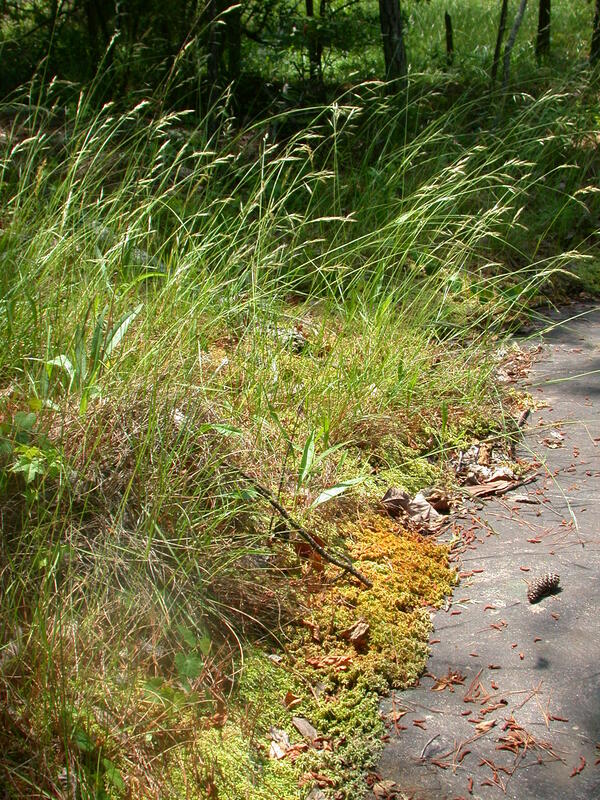
Habitat Summary for element in Georgia: Granite outcrop seeps
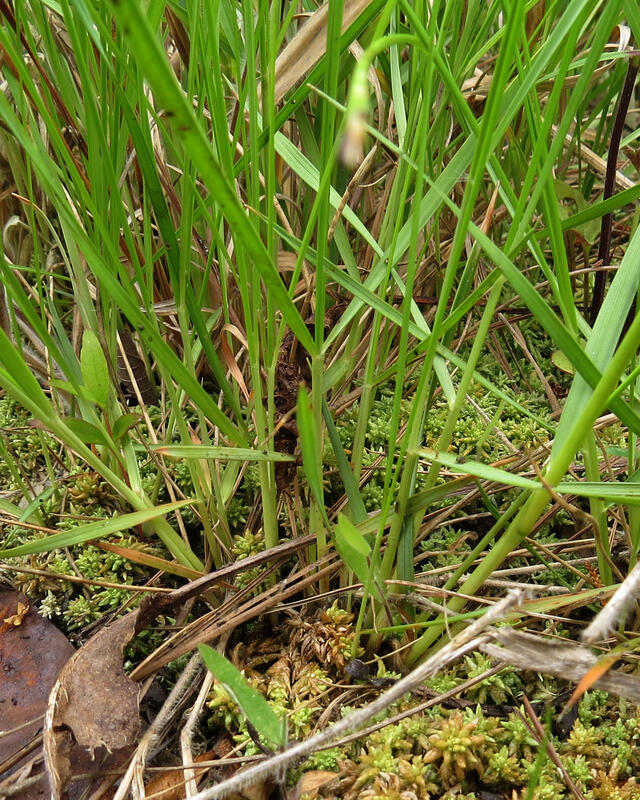
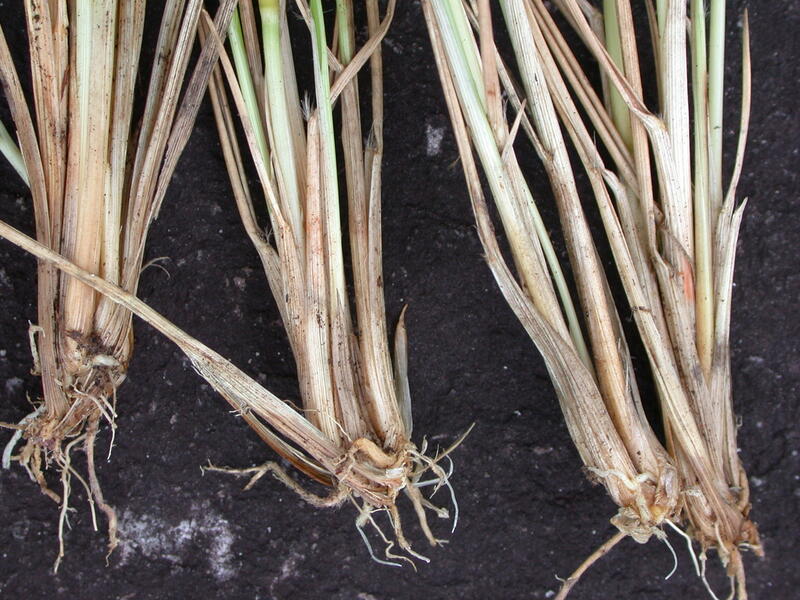
Perennial, cool-season, bunch grass with stems 20 - 47 inches (50 - 120 cm) tall; lower branches are angled sharply upward.. Most of the leaves are found near the base of the stem and all are alternate. Leaf sheaths are hairless and open to the base, leaf blades are 4 - 12 inches (10 - 30 cm) long, about 0.1 inch (2 - 4 mm) wide, usually angled sharply upward, and usually hairy on the top surface; the ligule is composed of short hairs. The inflorescence has roughly hairy branches and 5 - 30 spikelets. Spikelets are short-stalked and slightly flattened side-to-side. Each spikelet is 0.4 - 0.8 inch (1 - 2 cm) long. At the base of each spikelet is a pair of papery, hairless, pointed glumes that are 0.4 - 0.75 inch (1.1 - 1.9 cm) long; each glume has up to 7 conspicuous veins. There are 3 - 12 florets in each spikelet. Each floret has a lemma about 0.2 inch (4 - 6 mm) long, hairy only on the margins and at the base, with two tiny, slender teeth and an awn at the tip; the awn is about 0.5 inch (1.1 - 1.8 cm) long, twisted only once at the base and bent once above that. The floret has a thickened base (callus) with tufts of short, white hairs. (Unopened, self-pollinating florets lacking awns may be present in the lower leaf sheaths.) Seeds are (1.7 - 2.4 mm) long, oval, flattened, brown.
Bog Oat Grass was at one time considered to be a subspecies of Silky Oat Grass (Danthonia sericea), a common species found in dry woodlands forests, dry acidic cliffs and rock outcrops, and roadsides. Silky Oat Grass leaf sheaths and lemmas are shaggy-hairy, and the lemma awns are twisted at the base several times, forming a tiny pedestal.
Poverty Oat Grass (Danthonia spicata) is a common species found in dry woodlands, rock outcrops, and dry disturbed areas. It has smooth (occasionally hairy) leaf sheaths; its lemmas are usually hairy all over, and the lemma awn is less than 0.3 inch (0.8 cm) long. Old, curly leaf blades form a persistent, dried mat at the base of its stem that is recognizable year-round.
At least 30 grass species are rare in Georgia. For detailed information on some of these, see on this website: Calamagrostis porteri (Porter's Reed-grass), Ctenium floridanum (Florida Orange-grass), Dichanthelium hirstii (Hirst Brothers Panic Grass), Eriochloa michauxii var. michauxii (Michaux's Longleaf Cupgrass), Eustachys floridana (Florida Finger Grass), and Sporobolus teretifolius (Wire-leaf Dropseed).
In Georgia, Danthonia epilis is found on and around Piedmont granite outcrops. In other states, Danthonia epilis is found in peaty bogs in the Coastal Plain and mountains, and on granitic domes in the mountains.
Bog Oat Grass is a cool-season bunch grass that begins to grow actively in early spring. It flowers and sets seed in late spring, and seed dispersal occurs in early summer. The plants then go dormant during the hottest months and resume growth when temperatures cool in the fall; they will grow vegetatively until top-killed by frost. The seeds remain dormant throughout the summer, fall, and early winter and germinate in the late winter and early spring of the next year. Germination is relatively rapid, and the plants grow quickly to reproductive maturity. Bog Oat Grass also produces closed (cleistogamous) florets at the base of leaves near the bottom of the stem; closed flowers are self-pollinated and self-fertilized and produce seeds that grow into clones of the parent plant.
The typical flowers of Bog Oat Grass are wind-pollinated. Their seeds are dispersed by gravity and by small animals whose fur and feather readily pick up the long-awned seeds. Bog Oat Grass also reproduces vegetatively by sending up stems from the tips of short rhizomes, forming small clumps (“bunches”). All species of Danthonia are fire-tolerant and will re-sprout from rhizomes and crowns after a fire.
Bog Oat Grass is best searched for in the spring when this set of traits is most obvious: hairless leaf sheaths, lemmas hairy only on the margins and at the base, and awns twisted only once at the base below the bend.
Danthonia epilis occurs in pineland bogs from New Jersey south to South Carolina, in mountain bogs in Virginia (possibly) and North Carolina, in seeps around rock outcrops in the Cumberland Plateau and Blue Ridge of Tennessee and Alabama, and Piedmont granite outcrops in Georgia.
Bot Oat Grass populations in bogs in other states are threatened by wetland drainage and fire suppression. Piedmont and montane populations that occur on granitic outcrops and granite domes are threatened by foot and vehicle traffic, recreational overuse, trash dumping, and mining. Conversion and fragmentation of habitat throughout its range is a threat.
Danthonia epilis is ranked S1 by the Georgia Department of Natural Resources, indicating that it is critically imperiled in the state. Five populations have been documented in Georgia, only one on conservation land.
Protect Piedmont granite outcrops through conservation purchase and easement. Monitor sites for vehicle use and trash dumping and restrict access if needed. Conduct surveys of all Georgia outcrops for this easily overlooked species. Because of its close resemblance to other species of Danthonia, Bog Oat Grass may be overlooked and inadvertently damaged. Flagging of populations on conservation sites is recommended.
Covington, D. 2000. Danthonia spicata. In: Fire Effects Information System, U.S. Department of Agriculture, Forest Service, Rocky Mountain Research Station, Fire Sciences Laboratory. https://www.fs.fed.us /database/feis/plants/graminoid/danspi/all.html
GADNR. 2020. Element occurrence records for Danthonia epilis. Georgia Department of Natural Resources, Wildlife Resources Division. Social Circle, Georgia.
Darbyshire, S.J. 2003. Species account for Danthonia sericea. Flora of North America North of Mexico, vol. 25. http://beta.floranorthamerica.org/Danthonia_sericea
Lindauer, L.L. and J.A. Quinn. 1972. Germination ecology of Danthonia sericea populations. American Journal of Botany 59(9): 942-951.
Moloney, K. 1990. Shifting demographic control of a perennial bunchgrass along a natural habitat gradient. Ecology 71(3): 1133-1143.
NatureServe. 2019. Species account for Danthonia epilis. NatureServe Explorer: an online encyclopedia of life, Version 7.1. NatureServe, Arlington, Virginia. https://explorer.natureserve.org/Taxon/ELEMENT_GLOBAL.2.135282/Danthonia_epilis
Weakley, A.S. 2015. Flora of the southern and mid-Atlantic States. University of North Carolina Herbarium, University of North Carolina, Chapel Hill. http://www.herbarium.unc.edu/flora.htm
Linda G. Chafin
Linda G. Chafin, 5 November 2019: original account