



Loading profile. Please wait . . .
Sorex dispar Batchelder, 1911
Long-tailed Shrew


Federal Protection: No US federal protection
State Protection: No Georgia state protection
Global Rank: G4
State Rank: SU
Element Locations Tracked in Biotics: Yes
SWAP 2015 Species of Greatest Conservation Need (SGCN): Yes
SWAP 2025 Species of Greatest Conservation Need (SGCN): Yes
2025 SGCN Priority Tier: Data Deficient
Element Occurrences (EOs) in Georgia: 1
Habitat Summary for element in Georgia: Mountainous, forested areas (deciduous or evergreen) with loose talus
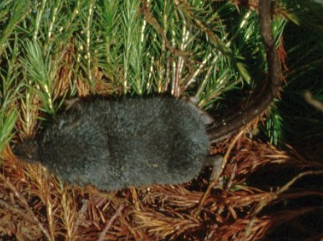
The rock shrew is a medium-sized soricid with a long tail. The total length is usually 103–136 mm and the tail is 46–67 mm (1.8-2.6 in) long. The hind foot length is 12–16 mm (.47-.63 in) and the average weight is 7.1 g (0.25 oz). They have reduced pinnae, which are concealed in pelage. Their dorsal pelage is slate gray and slightly more pale ventrally. The tail is usually very furry and rope-like though older individuals may lose tail hairs.
Rock shrews are often confused with the smoky shrew (S. fumeus) because both species have a similar size and coloration. However, the smoky shrew has a wider body and a shorter, bicolored tail. It is morphologically similar to other insectivores with the same habitat and range, including the northern short-tailed shrew (Blarina brevicauda), masked shrew (S. cinereus), and smoky shrew.
The rock shrew occurs in a wide variety of habitats, including grasslands, mixed deciduous/coniferous forests, spruce-fir forests, and freshwater wetlands. They prefer boggy habitats but are also common in marshes, meadows, upland forests and ideally areas with a mixture of herbaceous and shrubby vegetation. Forest cover associations include red spruce, Fraser fir, northern hardwood, cove hardwood, white pine and eastern hemlock.
Within these forests, it is found generally in mature stands that are cool, moist, and moss-covered, and in habitats associated with rockslides slopes at high elevations. In the northern and central Appalachians, the rock shrew can occur along small mountain streams and bogs. These moist and sheltered riparian zones can act as dispersal corridors.
They are found in elevations as low as 500 m on the Cumberland Plateau of Tennessee and Kentucky to 1,000 m and higher in the Allegheny Plateau, Northern Ridge and Valley in Virginia and throughout the Blue Ridge in Georgia, Tennessee, North Carolina and Virginia.
Rock shrews rimarily eat small invertebrates such as centipedes, beetles, and spiders.
The breeding season of the rock shrew extends from early spring to late summer but they can breed year-round. They typically have several litters throughout each year due to their short gestation period of 21-23 days. The litter size is between 2 to 5, with the young born helpless and unfurred. They are placed in a nest made of grasses and leaves usually about 10-20 cm in diameter and remain there until they are weaned 4 to 5 weeks later. They will then spend the next few weeks foraging with their mother before becoming independent. They are considered sexually mature in 60 days. They have a lifespan of approximately 2 years.
Rock shrews are active both day and night and do not become seasonally inactive. Due to their small size and active lifestyle, they forage day and night, consuming twice their body weight in food daily. They eat almost continuously, feeding mostly above ground. In order to avoid predation while foraging, rock shrews often feed at night and remain concealed under forest debris and underbrush. They also have a distinct musky odor that may serve as a deterrent. They are mostly solitary and can become aggressive with other individuals of the same species.
There has been a high trap success rate with Victor snap traps and pitfall traps in Talus slopes despite the difficulty in placing the traps in the rocky substrate.
The rock shrew occurs from southwestern North Carolina to Maine. It is a habitat specialist on high-elevation rocky areas and cool, moist forests. It is considered rare in many areas of the Southern Appalachians.
The species is listed as Least Concern federally due to its wide distribution. There are no major threats at present; however, there are adverse impacts to rock shrews from the reduction of eastern hemlock populations due to hemlock woolly adelgid (Adelges tsugae), global climate change, and human population growth and development.
The rock shrew has a global rank of Apparently Secure, although it is Vulnerable in Virginia and Imperiled in both North Carolina and Tennessee and Critically Imperiled in Kentucky. The Critically Imperiled status in Georgia is mostly due to the small range of this species in the state. Updated surveys are needed to better determine the current status of this species in the state.
The effects of management are unknown but it is hypothesized that any activities that reduce the moisture or shading on slopes and riparian zones would adversely affect the shrew habitat and population. Protection of colluvial rock habitats would benefit this species.
Aaron B. A., Donald T.S., 2008. A Population Crash of the Red-Backed Vole (Myodes gapperi) in Nova Scotia Inferred from Bycatch of the Long-Tailed Shrew (Sorex dispar). Northeastern Naturalist 4: 626
Bryan, H. D. 1991. The distribution, habitat, and ecology of shrews (Soricidae: Blarina, Sorex and Cryptotis) in Kentucky. Journal of the Tennessee Academy of Science 66:187–189.
Batchelder, C.F., 1896. An undescribed shrew of the genus Sorex. Proceedings of the Biological Society of Washington 10:133-134.
Rhymer, J.M., Barbay, J.M., Givens, H.L., 2004. Taxonomic Relationship between Sorex dispar and S. gaspensis: Inferences from Mitochondrial DNA Sequences. Journal of Mammalogy 2:331
Linzey, A.V. & Hammerson, G. 2008. Synaptomys cooperi. IUCN Red List of Threatened Species. Version 2009.2. International Union for Conservation of Nature.
Mengak, M. T., Castleberry, S. B., Campbell, J. W., & Mejia, J. D. 2010. Distribution and Status of Uncommon Mammals in the Southern Appalachian Mountains. Southeastern Naturalist 9(2): 275-302
Richmond, N.D., Grimm, W.C., 1950. Ecology and Distribution of the Shrew Sorex Dispar in Pennsylvania. Ecology 2:279
The rock shrew, Sorex dispar (Insectivora: Soricidae), in Georgia with comments on its conservation status in the southern Appalachians. BRIMLEYANA. 24: 1-5
Fabiola Clermont
F. Clermont, Dec. 2017: Original account
S. Krueger, March 2020: Edited for final review