


Loading profile. Please wait . . .
Lobelia boykinii Torr. & Gray ex A. DC.
Boykin's Lobelia


Federal Protection: No US federal protection
State Protection: No Georgia state protection
Global Rank: G2?
State Rank: S2?
Element Locations Tracked in Biotics: Yes
SWAP 2015 Species of Greatest Conservation Need (SGCN): Yes
SWAP 2025 Species of Greatest Conservation Need (SGCN): Yes
2025 SGCN Priority Tier: Highest Conservation Concern
Element Occurrences (EOs) in Georgia: 38
Habitat Summary for element in Georgia: Cypress ponds, sometimes with Oxypolis canbyi; Grady ponds; limesink depressions; wet savannas
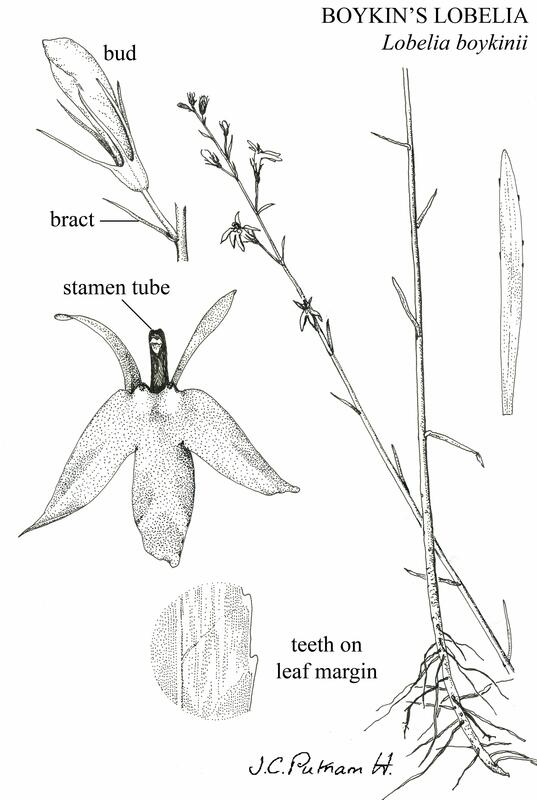
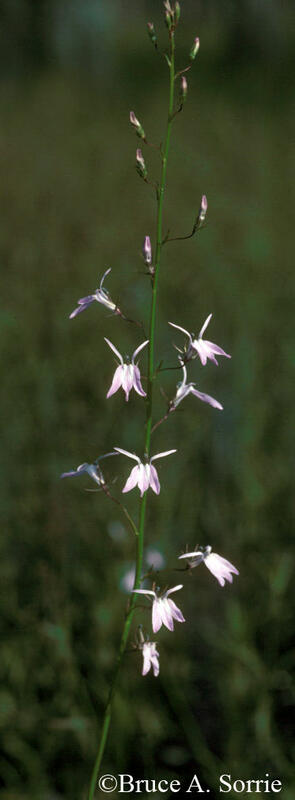
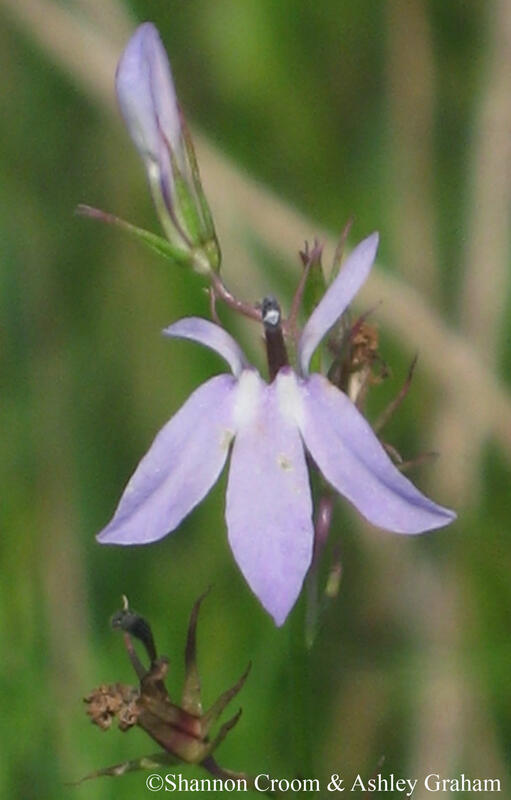
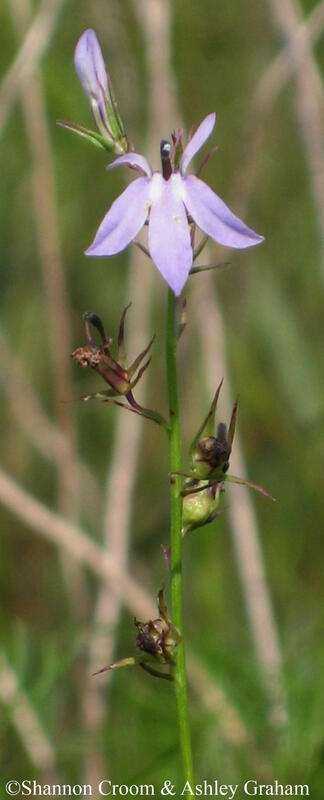
Perennial herb spreading by underground stems (rhizomes), with slender, erect, usually unbranched, hairless, aboveground stems 20 - 33 inches (50 - 85 cm) tall and often spongy at the base. Leaves are needle-like, up to 1 inch (2.5 cm) long and mostly less than 0.5 mm wide, hairless, sometimes with a few tiny callused teeth on the margins; the lower stem leaves, which may be a bit wider than 0.5 mm, are usually shed by flowering time. The flower cluster is held at the top of the stem, with 10 - 25 flowers per plant. The flowers are up to 0.5 inch (1.2 cm) long, white to pale blue with a white "eye" at the center, a 3-lobed lower lip, and 2 erect, narrow, pointed lobes; two small bumps (tubercles) are located at the base of the lip; the stamen tube is less than 0.2 inch (3 - 5 mm) long; the calyx segments are thread-like and hairless; the flower stalks are thread-like and about 0.4 inch (1 cm) long with 1 tiny bract at the base. The fruits are capsules about 0.1 inch (0.3 cm) across.
Canby’s Lobelia (Lobelia canbyi) also has narrow leaves but they are 1 - 4 mm wide, and its stems are sometimes branched just below the flower cluster, and are not spongy-thickened at the base; its flower stalk has 2 tiny bracts, one of them longer than the flower stalk.
Nuttall’s Lobelia (Lobelia nuttallii) also has narrow leaves but they are 1 - 4 mm wide, its stems are branched and not spongy at the base, and does not spread by underground stems.
None in Georgia.
Cypress - Black Gum depression ponds, limesink depression ponds, Carolina Bays, wet pine savannas and flatwoods, and wet ditches through these habitats.
Boykin’s Lobelia is a perennial herb that reproduces sexually by seed as well as vegetatively by the spread of underground stems (rhizomes); it is the only member of the genus Lobelia to produce rhizomes and form colonies. It is an obligate out-crosser, depending on cross-pollination of its flowers by insects in order to set fruit and produce seed; in one study, insect pollinators (primarily bees and bee flies) were scarce, probably due to pesticide applications in nearby fields. The loss of insect pollinators may lead to a greater dependence on vegetative reproduction and, as the size of the clonal colony increases, to a wider separation between genetically different individuals, thus reducing cross-pollination and genetic diversity.
Surveys are best conducted during flowering (May–July).
Georgia, Florida, Alabama, Mississippi, North Carolina, Delaware, and New Jersey. It is rare throughout its range.
Reduction of insect pollinators by pesticide spraying in fields near populations. Clearing, draining, and filling wetlands. Lowering of the water table by excessive withdrawal from the Floridan Aquifer for irrigation. Fire suppression. Destruction of wetland transition zones by building roads and firebreaks in ecotones. Changes in hydrology due to altered temperature and rainfall patterns related to climate change.
| Threat 1 | Threat 2 | Threat 3 | |
|---|---|---|---|
| General Threat | Biological resource use | Natural system modifications | Agriculture & aquaculture |
| Specific Threat | None | None | None |
Lobelia boykinii is ranked S2? by the Georgia Department of Natural Resources, indicating that it is probably imperiled in Georgia but needs additional field work before a definitive rank can be assigned. Thirty-five populations have been documented since 1902 but only 7 have been confirmed since 2000, most of these on conservation lands.
Establish pesticide-free buffers around populations. Protect depression wetlands from clearing, draining, and filling. Protect natural water table levels from excessive drawdown. Allow fires in adjacent uplands to periodically burn into and across wetlands. Avoid placing firebreaks in the transition zones between uplands and wetlands. Address changes in hydrology caused by global climate change.
Bates, R. 1996. The reproductive biology of Lobelia boykinii. M.S. thesis, University of North Carolina, Greensboro.
GADNR. 2020. Element occurrence records for Lobelia boykinii. Georgia Department of Natural Resources, Wildlife Resources Division, Social Circle, Georgia.
Godfrey, R.K. and J.W. Wooten. 1981. Aquatic and wetland plants of southeastern United States, Vol. 2, dicotyledons. University of Georgia Press, Athens.
Lacey, E.P., A. Royo, R. Bates, and D. Herr. 2001. Role of population dynamic models in biogeographic studies: an illustration from a study of Lobelia boykinii, a rare species endemic to the Carolina Bays. Castanea 66(1-2): 115-125.
McAvoy, W.A. and R.M. Wilson. 2014. Rediscovery of Lobelia boykinii (Campanulaceae) in Delaware. Phytoneuron 23:1-4.
NatureServe. 2019. Lobelia boykinii comprehensive report. NatureServe Explorer. Arlington, Virginia. http://explorer.natureserve.org/servlet/NatureServe?searchName=Lobelia+boykinii
Radford, A.E., H.E. Ahles, and C.R. Bell. 1968. Manual of the vascular flora of the Carolinas. University of North Carolina Press, Chapel Hill.
Royo, A. 1998. Demographic modeling of Lobelia boykinii, a rare plant species endemic to the Carolina Bays. M.S. Thesis, University of North Carolina, Greensboro.
Royo, A.A., R. Bates and E.P. Lacey. 2008. Demographic constraints in three populations of Lobelia boykinii, a rare wetland endemic. Journal of the Torrey Botanical Society 135(2): 189-199. https://bioone.org/journals/the-journal-of-the-torrey-botanical-society/volume-135/issue-2/07-RA-039.1/Demographic-constraints-in-three-populations-of-Lobelia-boykinii--a/10.3159/07-RA-039.1.short
Weakley, A.S. 2015. Flora of the southern and mid-Atlantic States. University of North Carolina Herbarium, University of North Carolina, Chapel Hill. http://www.herbarium.unc.edu/flora.htm
Linda G. Chafin
L. Chafin, May 2007: original account
K. Owers, Feb. 2010: added pictures
L. Chafin, Mar. 2020: updated original account