

Loading profile. Please wait . . .
Sideroxylon alachuense L.C. Anderson
Silver Buckthorn


Federal Protection: No US federal protection
State Protection: No Georgia state protection
Global Rank: G1
State Rank: S1
Element Locations Tracked in Biotics: Yes
SWAP 2015 Species of Greatest Conservation Need (SGCN): No
SWAP 2025 Species of Greatest Conservation Need (SGCN): Yes
2025 SGCN Priority Tier: Highest Conservation Concern
Element Occurrences (EOs) in Georgia: 3
Habitat Summary for element in Georgia: Sandy hammocks; islands in Okefenokee Swamp; shell middens
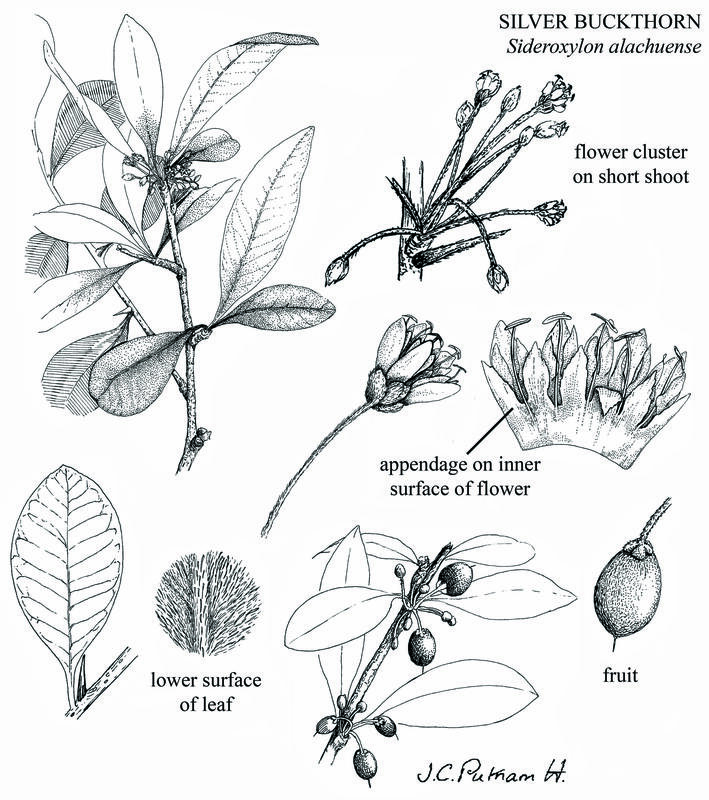
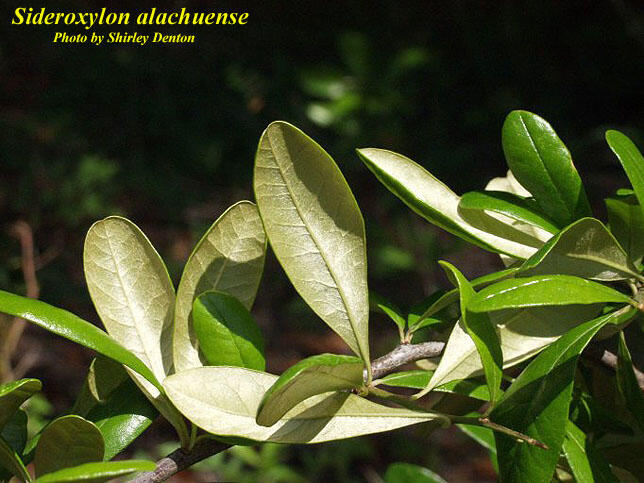
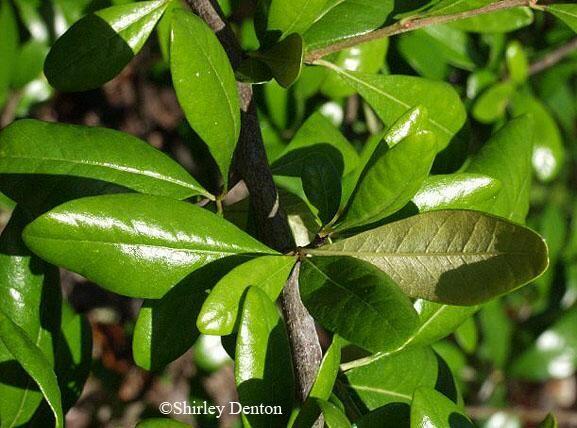
Shrub up to 32 feet (10 m) tall, though usually about 10 feet (3 m), with crooked, thorny, nearly hairless branches and twigs. Twigs of the current season are light colored, silvery or green, with sharp, green thorns that develop into short spur-shoots. Leaves are 1.6 - 2.4 inches (4 - 6 cm) long and 0.6 - 1.2 inch (1.6 - 3 cm) wide, alternate, tardily deciduous; the leaf tips are blunt, rounded, or notched; the upper surface is dark green and heavily veined, the lower surface is silvery (shiny white) due to a smooth, dense covering of hairs; drought-stressed plants have tawny hairs on the lower surface instead of white. Flower clusters are held on the tips of spur shoots with 6 - 20 flowers. Flowers have 5 or 6 white petals, each with a stamen and appendage attached to the inner surface. Fruits are berries about 0.5 inch (1 - 1.3 cm) long, shiny, black, and oval to oblong.
Wooly Buckthorn (Sideroxylon lanuginosa) and the common form of Tough Buckthorn (S. tenax) have brown, hairy twigs and leaves with scruffy, rusty-brown hairs on lower surfaces. Tough Buckthorn plants growing on shell middens may have silvery twigs and leaves; they closely resemble and may be intermediate forms of Silver Buckthorn or hybrids between the two. Wooly Buckthorn flowers have 4 - 6 petals. Tough Buckthorn flowers have 4 - 5 petals and flowers in June.
Big-fruited Buckthorn (Sideroxylon macrocarpum) occurs in the Coastal Plain in dry Longleaf Pine woods with and oak understory. For more information, see: https://www.georgiabiodiversity.org/portal/profile?group=plants&es_id=20327
Thorne’s Buckthorn (Sideroxylon thornei) occurs in the Coastal Plain in forested limesink depressions and in swamps over limestone. For more information, see: https://www.georgiabiodiversity.org/portal/profile?group=plants&es_id=16690
Sandy hammocks, maritime forests on calcareous bluffs, and shell middens on barrier islands.
Silver Buckthorn reproduces both sexually by seed as well as vegetatively by the spread of horizontal rhizomes that send up shoots. Its flowers are mildly fragrant and probably attract a variety of insect pollinators. Although pollination studies have not been conducted for this species, most buckthorns are capable of both cross- and self-pollination. The large fruit is fleshy and attractive to animals, especially birds, which disperse the seeds. Silver Buckthorn is tardily deciduous, dropping its leaves in late winter and then quickly leafing out again. As with all buckthorns, it has two types of growth: rapid primary growth producing long shoots with relatively large leaves, and slower-growing spur shoots which produce short stems crowded with nodes, smaller leaves, and flower clusters.
Surveys are best conducted during flowering (mid-late July) and fruiting (late summer). The most distinctive feature of silver buckthorn – the silvery hairs on the lower leaf surface – may be altered by drought conditions which seem to result in leaves with grayish or tawny hairs.
Georgia and Florida.
Development and clearing of coastal hammocks and maritime forests.
| Threat 1 | Threat 2 | Threat 3 | |
|---|---|---|---|
| General Threat | Climate change & severe weather | Residential & commercial development | Natural system modifications |
| Specific Threat | None | None | None |
Sideroxylon alachuense is ranked S1 by the Georgia Department of Natural Resources, indicating that the species is critically imperiled in Georgia. There are 3 populations in Georgia, all occur on public conservation lands.
Protect coastal hammocks and maritime forests from clearing and development.
Anderson, L.C. 1997. Sideroxylon alachuense, a new name for Bumelia anomala (Sapotaceae). Sida 17(3): 565-567. https://www.jstor.org/stable/41967244?seq=1#metadata_info_tab_contents
Anderson, L.C. 2000. Status survey of Silver Buckthorn: report to the Georgia Department of Natural Resources, Wildlife Resources Division, Social Circle.
Clark, R.B. 1942. A revision of the genus Bumelia in the United States. Annals of the Missouri Botanical Garden 29(3): 155-182. https://www.jstor.org/stable/2394316?seq=1#metadata_info_tab_contents
Ellisens, W.J. and J.M. Jones. 2009. Sideroxylon alachuensis species account. Flora of North America, Vol. 8. http://beta.floranorthamerica.org/Sideroxylon_alachuense
GADNR. 2020. Element occurrence records for Sideroxylon alachuensis. Georgia Department of Natural Resources, Wildlife Resources Division, Social Circle, Georgia.
Godfrey, R.K. 1988. Trees, shrubs, and woody vines of northern Florida and adjacent Georgia and Alabama. University of Georgia Press, Athens.
NatureServe. 2020. Sideroxylon alachuensis species account. NatureServe Explorer. NatureServe, Arlington, Virginia. https://explorer.natureserve.org/Taxon/ELEMENT_GLOBAL.2.146807/Sideroxylon_alachuense
Nelson, G. 1996. Shrubs and woody vines of Florida. Pineapple Press, Sarasota, Florida.
Pennington, T.D. 1990. Sapotaceae. Flora Neotropica Monograph 52: 1-770. https://www.jstor.org/stable/4393816?seq=1#metadata_info_tab_contents
Weakley, A.S. 2015. Flora of the southern and mid-Atlantic States. University of North Carolina Herbarium, University of North Carolina, Chapel Hill. http://www.herbarium.unc.edu/flora.htm
Linda G. Chafin
L. Chafin, Aug. 2008: original account
K. Owers, Feb. 2010: added pictures
L. Chafin, May 2020: updated original account.