


Loading profile. Please wait . . .
Colinus virginianus (Linnaeus, 1758)
Northern Bobwhite



Federal Protection: No US federal protection
State Protection: No Georgia state protection
Global Rank: G4G5
State Rank: S3S4
Element Locations Tracked in Biotics: Yes
SWAP 2015 Species of Greatest Conservation Need (SGCN): Yes
SWAP 2025 Species of Greatest Conservation Need (SGCN): Yes
2025 SGCN Priority Tier: Moderate Conservation Concern
Element Occurrences (EOs) in Georgia: 0
Habitat Summary for element in Georgia: Early successional habitat, open pine savanna
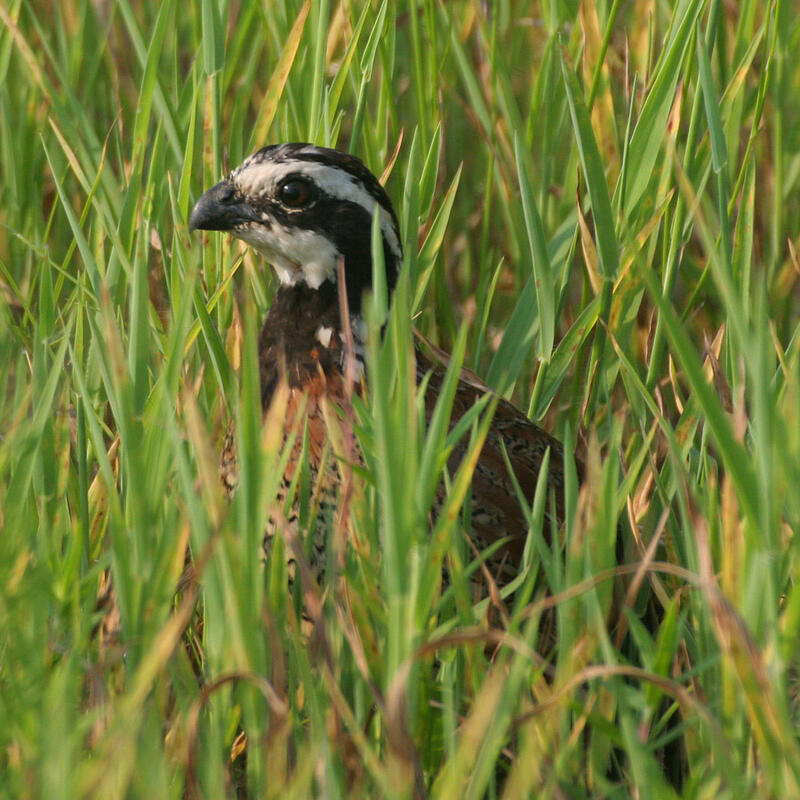
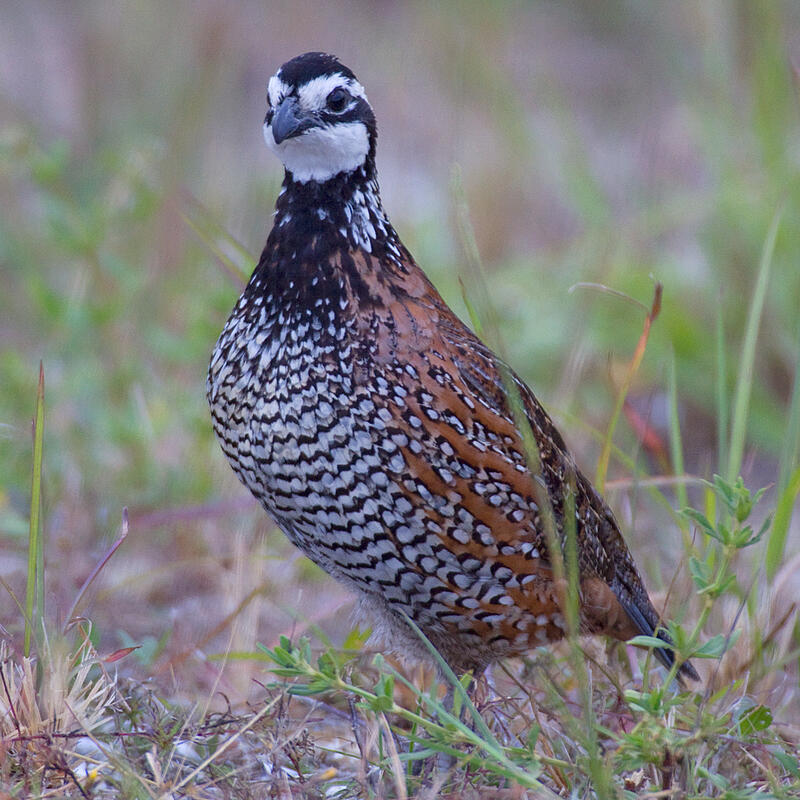
The northern bobwhite is a stout medium-sized gamebird with a small head relative to its body and relatively short grayish legs. The male has a striking face with a broad chestnut brown stripe edged with dark gray or black running from the base of the bill through the eye to the nape of the neck. Below this stripe is a clean white chin, above a broad white stripe. The crown has a distinct crest, at least when the bird is excited and is chestnut with a thin dark edge where it meets the white stripe. On the upper chest are dark vertical bars highlighted by thin gray edges and white spots. The upper chest and back are a pale rufous color. The lower back and upper wings near the body are buff with dark markings while the tail and most of the upper wings are gray. Broad vertical streaks of dark rufous alternate with thin white streaks on the flanks and short whitish horizontal streaks interrupted by thin rufous streaks cover the stomach and abdomen. The female has similar patterns on the flanks, stomach, and abdomen with the streaking running up the breast. Wing and tail coloration is similar with a little more brown mixed in. The most obvious difference in color and pattern is in the face. She has buff color where the male has white and the brown crown does not form a crest.
There are no species similar in appearance. However, bobwhites are regularly reared in captivity and stocked onto private lands to hunt, so occasionally you may encounter captively reared birds. Often these individuals will be tame or much less wary than wild bobwhites.
In Georgia, the bobwhite uses pine savanna, old fields, edges of agricultural fields, grasslands and other habitats where ground layer vegetation is dominated by clumped native warm season grasses, annual and perennial forbs (particularly legumes), and a patchwork of briar and shrub thickets.
Bobwhites are opportunistic feeders with adults eating mainly seeds of grasses and forbs and leaves of succulent green plants much of the time. Over 650 seed foods have been documented across this bird’s range. Seeds of legumes, ragweed (Ambrosia spp.), crops such as corn, soybeans, and wheat, pines, and acorns are preferred in fall and winter, while grass seeds, fruits such as blackberries, cherries, and plums are eaten in summer. In addition, insects make up about 5-20% of the adult bird’s summer diet. Chicks eat arthropods and other insects exclusively until about 6 weeks of age when they start to gradually convert to seeds and other plant material.
In Georgia, the breeding season starts in late February or early March and runs through October, with the most important months for nesting May through August. Both adults select the nest site together and help build the nest, which is a scrape in the ground lined with dead vegetation, often grasses and pine needles. Grasses and forbs are often woven into a canopy over the nest to conceal it from predators. Construction takes about 5 days. It is usually located close to brood rearing habitat, which consists of erect forbs and grasses that are canopied above but open at ground level. Preferred nest sites are usually less than 15 m from openings in areas where ground vegetation is comprised of native clump grasses and other herbaceous vegetation of medium to sparse density. Twelve to 15 eggs are laid at approximately 1-day intervals with incubation starting after the last egg is laid. Incubation lasts 22-24 days and all eggs hatch within about one day of each other. Interestingly, females incubate about 70-80% of the nests while males incubate about 20-30% of the nests, but both sexes only infrequently incubate the same nest. Young are precocial and able to walk and feed themselves almost immediately after hatching but need to be brooded for about two weeks since they are unable to regulate their body temperature. Feathers grow quickly after hatching and young are able to fly by two weeks of age; however, they are unable to fully thermoregulate until about 30 days after hatching. About 30% of birds that successfully hatch their first clutch may attempt a second nest. Young usually remain with their parents through late winter. Predation on bobwhites is high during the nesting season and in fall. Birds generally have a short lifespan but compensate for this with high reproductive output (e.g., large clutches, possibly two broods). Flocks of bobwhites known as coveys form in fall and are maintained through winter.
Point counts during the breeding season that use passive listening methods and fall covey counts are the best survey methods to gauge the population status on regional as well as local scales. The Wildlife Resources Division presently does monitoring of this type on public and private lands across the Piedmont and Coastal Plain.
This species occurs in suitable habitat across most of the eastern U. S. except the northern New England states and much of the northern Midwest. It also can be found in eastern and southern Mexico, Cuba, the Bahamas, and portions of the island of Hispaniola.
Prior to European settlement, this quail species probably was scarce throughout much of the eastern deciduous forest, including the Piedmont and mountains of Georgia. Densities likely were highest across the 8.5 million ha of fire-maintained longleaf pine forest that stretched across Georgia’s Coastal Plain, near Native American settlements with low-intensity agriculture, and in areas recently impacted by fire and other natural disturbances.
During the Breeding Bird Atlas surveys (1994-2001), the bobwhite was found throughout the state except at higher elevations in the Blue Ridge and in the Okefenokee Swamp where there is limited suitable habitat. It was most abundant in the Upper Coastal Plain and in the western portion of the Lower Coastal Plain, where commercial row crop farming is most prevalent and where substantial amounts of habitat are intensively managed for this species.
The greatest threat to northern bobwhite populations is the loss of quality habitat due to a variety of land-use changes, including: “clean” farming practices that reduce the amount of grassy or brushy fencerow habitat, conversion of farmland and native rangeland to exotic grass pastures, increased acreage in closed-canopy woodlands and densely-stocked pine plantations, decreased use of prescribed fire, increased urbanization, habitat fragmentation, and heavy use of pesticides.
| Threat 1 | Threat 2 | Threat 3 | |
|---|---|---|---|
| General Threat | Natural system modifications | Agriculture & aquaculture | Residential & commercial development |
| Specific Threat | Fire & fire suppression | Annual & perennial non-timber crops | Housing & urban areas |
Breeding Bird Survey (BBS) data show that northern bobwhite populations in Georgia declined by 5.4% annually from 1966-2015. Annual declines of nearly 3.5% were seen survey-wide during the same period. Burleigh (1958) reported the bobwhite quail as common throughout Georgia, even in the mountains, but probably most numerous south of the Fall Line. In the early 1950s, Jenkins (1953) estimated quail densities (birds per 40 ha) for Georgia as follows: Lookout (Cumberland) Plateau 8 to 10; Mountains less than 5; Piedmont 10 to 15; and Upper and Lower Coastal Plain 10 to 12. He indicated that higher densities occurred in all regions in association with agriculture or intensive quail habitat management.
In 1999, the Georgia Department of Natural Resources launched the Bobwhite Quail Initiative to test the feasibility of landscape level bobwhite quail habitat restoration. This program provides private landowners with technical assistance and financial incentives to restore habitat for quail and associated species in certain counties in the Upper Coastal Plain. A significant increase in quail numbers has occurred in many areas where this program has been implemented.
In Georgia, the bobwhite most likely will never return to the high population densities of the late 1800s to mid-1900s. However, with foresight and planning, quail habitat needs can be integrated with forestry and agriculture to maintain viable populations. Providing large blocks (800 ha or larger) of suitable habitat offers the highest probability for sustaining these populations
Brennan, L. A. 1999. Northern Bobwhite (Colinus virginianus). In The Birds of North America, No. 397 (A. Poole and F. Gill, eds.). The Birds of North America, Inc., Philadelphia, PA.
Burleigh, T. D. 1958. Georgia Birds. University of Oklahoma Press, Norman.
Thackston, R. E. 2010. Northern Bobwhite (Colinus virginianus) Pp.80-81 in T. M. Schneider, G. Beaton, T. S. Keyes, and N. A. Klaus, eds. The Breeding Bird Atlas of Georgia. University of Georgia Press, Athens.
Elliott, C. 1974. Prince of Game Birds: The Bobwhite Quail. Georgia Department of Natural Resources, Atlanta, GA.
Guthery, F. S., M. J. Peterson, and R. R. George. 2000. Viability of northern bobwhite populations. Journal of Wildlife Management 64:646-662.
Jenkins, J. H. 1953. The Game Resources of Georgia. Georgia Game and Fish Commission, Atlanta, GA. Federal Aid Project W-1-R.
Johnsgard, P. A. 1973. Grouse and Quails of North America. University of Nebraska Press, Lincoln.
Rosene, W. 1969. The Bobwhite Quail: Its Life and Management. Rutgers University Press, New Brunswick, NJ.
Sauer, J. R., D. K. Niven, J. E. Hines, D. J. Ziolkowski, Jr, K. L. Pardieck, J. E. Fallon, and W. A. Link. 2017. The North American Breeding Bird Survey, Results and Analysis 1966 - 2015. Version 2.07.2017 USGS Patuxent Wildlife Research Center, Laurel, MD.
Simpson, R. C. 1976. Certain Aspects of the Bobwhite Quail’s Life History and Population Dynamics in Southwest Georgia. Georgia Department of Natural Resources, Atlanta, GA. Technical Bulletin WL-1.
Stoddard, H. L. 1931. The Bobwhite Quail: Its Habits, Preservation and Increase. Charles Scribner’s Sons, New York, NY.
Thackston, R. E., and M. Whitney. 2001. Bobwhite Quail in Georgia: History, Biology and Management. Georgia Department of Natural Resources, Wildlife Resources Division, Game Management Section, Social Circle, GA.
Reggie E. Thackston and Todd M. Schneider
R. Thackston, 2010. Breeding Bird Atlas species account
T. Schneider, Nov 7, 2019: Modified and edited text
T. Schneider, Dec. 2019: Added photos