



Loading profile. Please wait . . .
Ludwigia spathulata Torr. & Gray
Southern Water-purslane


Federal Protection: No US federal protection
State Protection: No Georgia state protection
Global Rank: G2
State Rank: S2?
Element Locations Tracked in Biotics: Yes
SWAP 2015 Species of Greatest Conservation Need (SGCN): Yes
SWAP 2025 Species of Greatest Conservation Need (SGCN): Yes
2025 SGCN Priority Tier: Highest Conservation Concern
Element Occurrences (EOs) in Georgia: 15
Habitat Summary for element in Georgia: Sinkhole and cypress-gum ponds; granite and quartzite outcrops
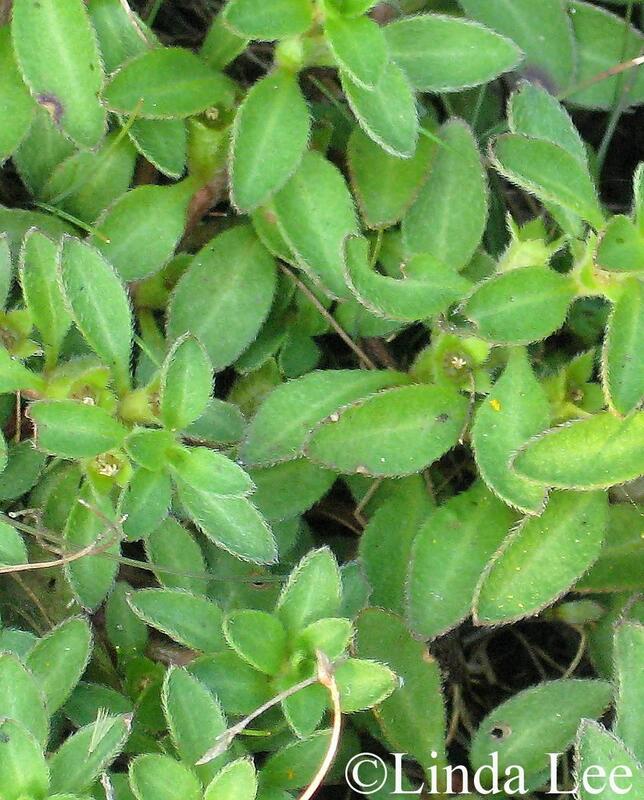
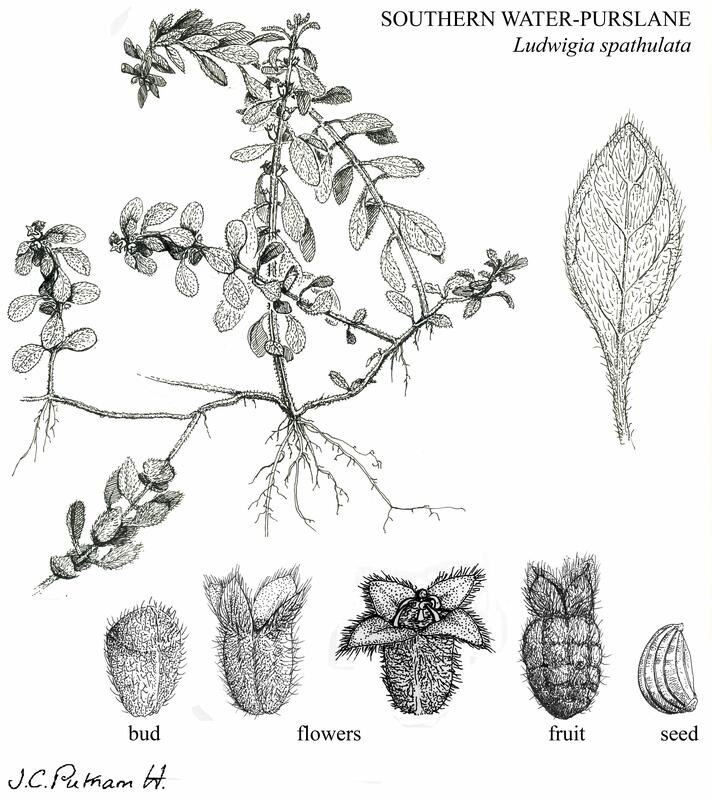
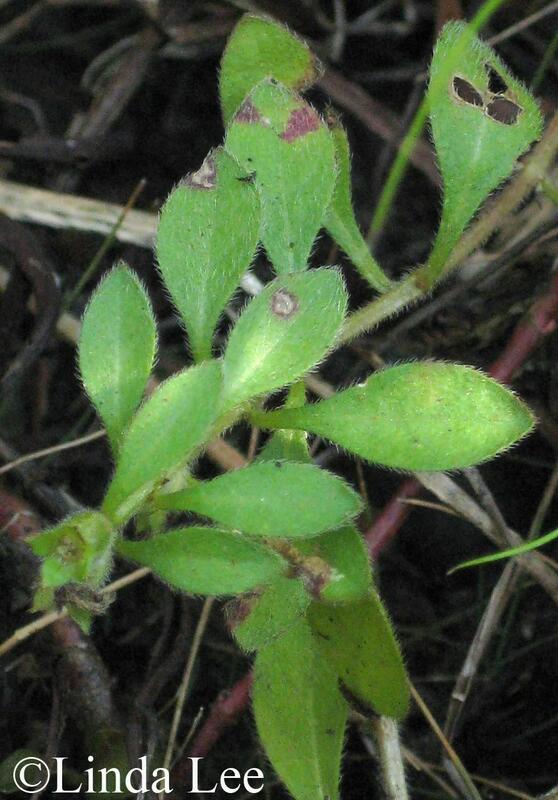
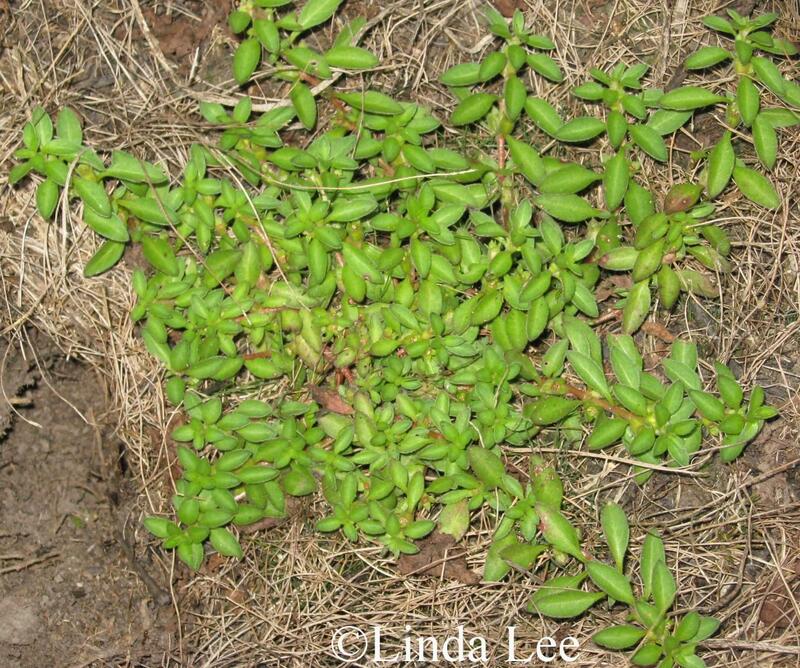
Perennial herb with very hairy stems, creeping and rooting at the nodes, sometimes forming mats. Its leaves are usually less than 0.7 inch (0.9 - 1.7 cm) long and less than 0.4 inch (0.3 - 0.9 cm) wide at the widest point, oval with rounded tips, narrowed abruptly to the base, opposite, very hairy. The flowers are held singly in the angle between leaf and stem, with 4 hairy, green sepals less than 0.1 inch (1.7 mm) long and 4 stamens; there are no petals and no flower stalk. Fruits are hairy, 4-sided capsules less than 0.2 inch (2.5 - 4.5 mm) long.
Common Water-purslane (Ludwigia palustris) and Creeping Seedbox (Ludwigia repens) also form creeping mats in wetlands; both have more or less hairless stems, leaves, and fruits. Creeping Seedbox flowers have 4 yellow petals; Common Water-purslane has no petals. Pond Seedbox (Ludwigia arcuata) also forms mats of creeping stems; its fruits are on stalks 0.6 - 1.4 inch (1.5 - 3.5 cm) long and its petals are 0.3 - 0.4 inch (0.7 - 1.1 cm) long.
Long Beach Seedbox (Ludwigia brevipes) occurs on pond shores and in interdunal swales and coastal marshes in the Coastal Plain. For more information, see: https://www.georgiabiodiversity.org/portal/profile?group=plants&es_id=16252
Exposed shores and bottoms of Pond Cypress - Swamp Black Gum depression ponds and limesink depression ponds in the Coastal Plain; granite outcrop pools in the Piedmont.
Southern Water-purslane probably spreads primarily by vegetative reproduction, rooting from nodes on the creeping stems. Most species of Ludwigia are pollinated by bees and flies, but the lack of petals on the flowers of this species suggests that it is self-pollinating.
Surveys are best conducted during flowering and fruiting (June–October).
Georgia, Alabama, Florida, South Carolina, and North Carolina. It is rare throughout its range.
Clearing, draining, and filling of wetlands. Fire suppression in surrounding uplands and fire exclusion from wetlands. Construction of roads and firebreaks in wetland ecotones. Lowering of the water table by excessive removal of water from the aquifer for irrigation and other purposes. Disturbance to granite outcrops by dumping, off-road-vehicle use, quarrying, and development.
| Threat 1 | Threat 2 | Threat 3 | |
|---|---|---|---|
| General Threat | Natural system modifications | Climate change & severe weather | Invasive & other problematic species, genes & diseases |
| Specific Threat | None | None | None |
Ludwigia spathulata is ranked S2? by the Georgia Department of Natural Resources, indicating that it is probably imperiled in Georgia but that there are not sufficient data to make a definitive ranking. Fourteen populations have been documented in Georgia: nine in Coastal Plain depression ponds are protected; five in Piedmont granite outcrop pools. Only two populations have been confirmed in the last twenty years.
Protect depression wetlands from clearing, draining, and filling. Protect natural water table levels from excessive drawdown. Allow fires in adjacent uplands to periodically burn into and across wetlands. Avoid placing firebreaks in the transition zones between uplands and wetlands. Protect granite outcrops from dumping, off-road vehicle use, development, and other disturbances.
GADNR. 2020. Element occurrence records for Ludwigia spathulata. Georgia Department of Natural Resources, Wildlife Resources Division, Social Circle, Georgia.
Godfrey, R.K. and J.W. Wooten. 1981. Aquatic and wetland plants of southeastern United States, Vol. 2, dicotyledons. University of Georgia Press, Athens.
NatureServe. 2019. Ludwigia spathulata comprehensive report. NatureServe Explorer. Arlington, Virginia. http://explorer.natureserve.org/servlet/NatureServe?searchName=Ludwigia+spathulata
Peng, C-I., C.L. Schmidt, P.C. Hoch, and P.H. Raven. 2005. Systematics and evolution of Ludwigia Section Dantia (Onagraceae). Annals of the Missouri Botanical Garden 92(3): 307-359. https://www.jstor.org/stable/pdf/40035477.pdf?refreqid=excelsior%3Adff87b784692c089b35a0a8a1a86b892
Radford, A.E., H.E. Ahles, and C.R. Bell. 1968. Manual of the vascular flora of the Carolinas. University of North Carolina Press, Chapel Hill.
Weakley, A.S. 2015. Flora of the southern and mid-Atlantic States. University of North Carolina Herbarium, University of North Carolina, Chapel Hill. http://www.herbarium.unc.edu/flora.htm
Linda G. Chafin
L. Chafin, May 2007: original account
K. Owers, Feb. 2010: added pictures
L. Chafin, March 2020: updated original account