


Loading profile. Please wait . . .
Hypericum buckleii M.A. Curtis
Blue Ridge St. John's-wort


Federal Protection: No US federal protection
State Protection: No Georgia state protection
Global Rank: G3
State Rank: S1
Element Locations Tracked in Biotics: Yes
SWAP 2015 Species of Greatest Conservation Need (SGCN): No
SWAP 2025 Species of Greatest Conservation Need (SGCN): Yes
2025 SGCN Priority Tier: High Conservation Concern
Element Occurrences (EOs) in Georgia: 7
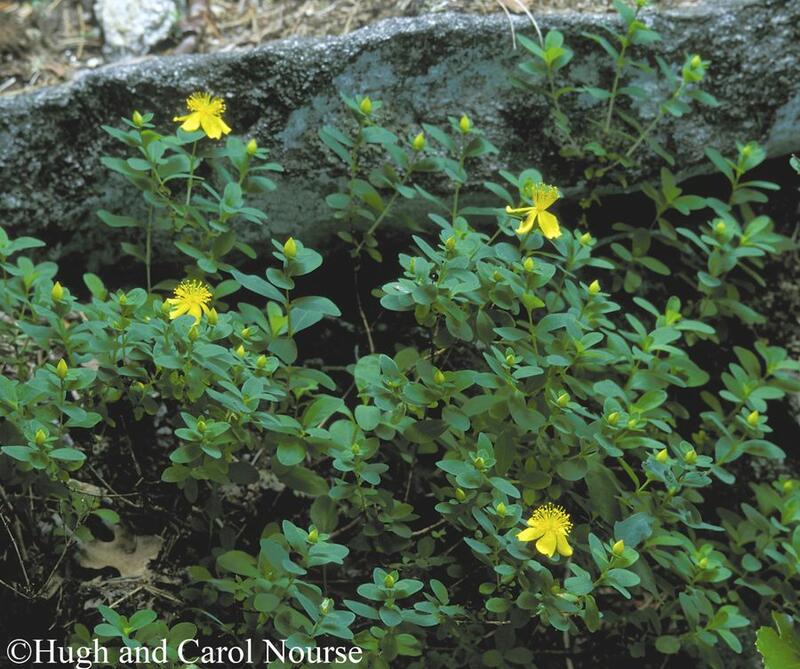
Habitat Summary for element in Georgia: High elevation rocky crevices
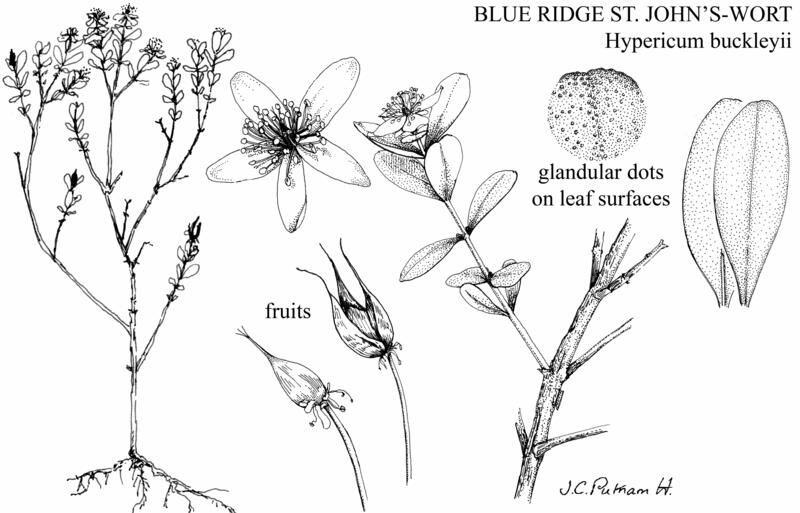
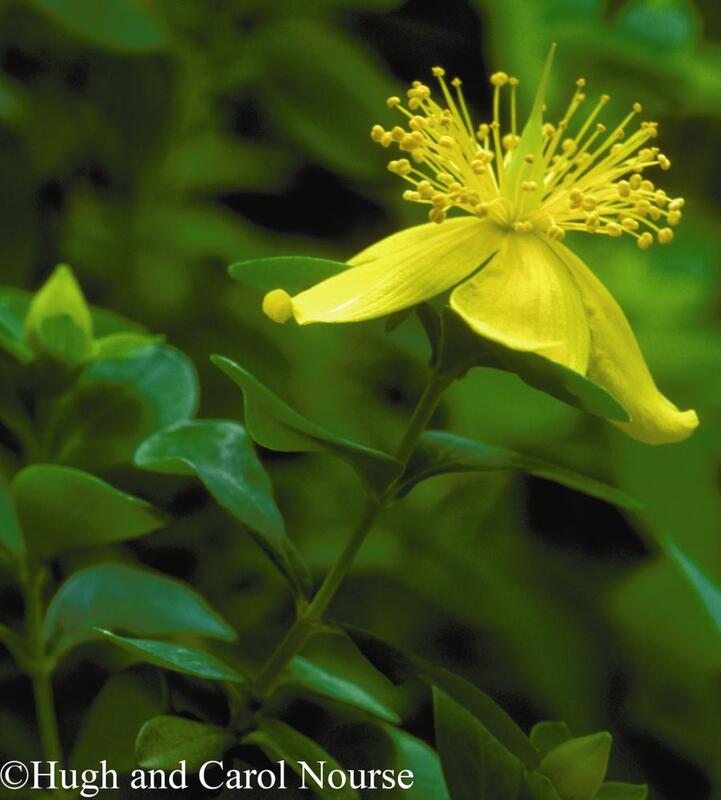
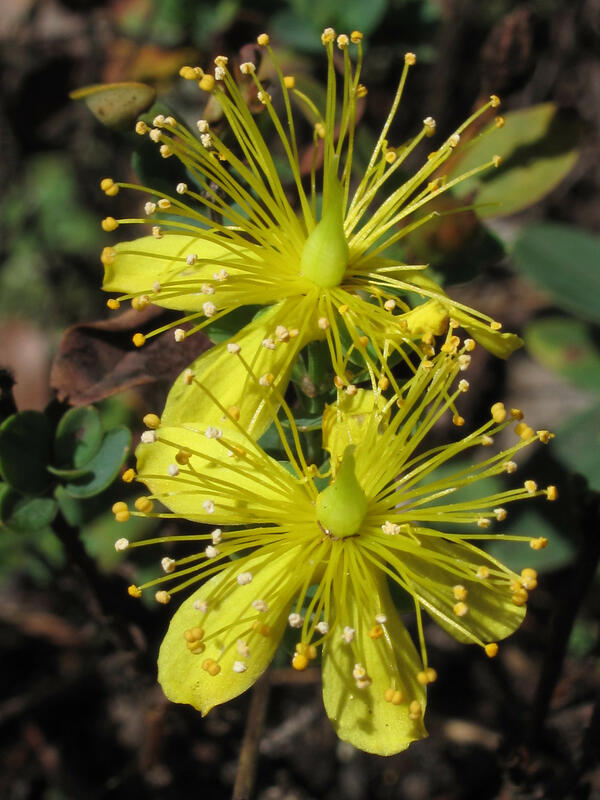
Mat-forming shrub up to 12 inches (30 cm) tall. Its leaves are up to 1 inch (0.4 - 2.5 cm) long and 0.5 inch (0.2 - 1.2 cm) wide, opposite, oval with rounded tips and tapering bases; the leaves are covered with translucent (not black) glandular dots, best seen when the leaf is held up to the light; the base of the leaf does not have a narrow groove or notch between the base of the leaf and the top of the leaf stalk. The flowers are about 1 inch (2.5 cm) across, usually solitary or in small clusters at the tips of branches; the 5 petals are bright yellow, and the stamens are numerous and showy. The fruit is an oval, pointed capsule, 0.3- 0.5 inch (0.8 - 1.2 cm) long.
St. Andrew’s-cross (Hypericum stragulum) is also a low, matted shrub; its flowers have 4 petals and its leaves are grooved/notched across the base and usually widest above the middle.
Lloyd’s St. John’s-wort (H. lloydii) is a mat-forming shrub found around Piedmont granite outcrops and Altamaha Grit outcrops; it has 4-angled stems and narrow, inrolled leaves with a narrow groove at the base of the leaf blade.
Hypericum adpressum (Bog St. John's-wort) occurs in open, shallow depression ponds, marshes, bogs, and sunny edges of cypress ponds in Georgia's Coastal Plain. For more informatin, see: https://www.georgiabiodiversity.org/portal/profile?group=plants&es_id=18837
Hypericum denticulatum (St. John’s-wort) occurs in bogs, seeps, and moist pine savannas in Georgia’s southeast Coastal Plain. For more information, see: http://www.efloras.org/florataxon.aspx?flora_id=1&taxon_id=250100871
Hypericum dolabriforme (Glade St. John’s-wort) occurs in limestone glades and woodlands in northwest Georgia. For more information, see: http://www.efloras.org/florataxon.aspx?flora_id=1&taxon_id=250100863
Hypericum erythreae (Georgia St. John’s-wort) occurs in pitcherplant bogs, wet savannas, and open roadside ditches and powerline rights-of-way through these habitats in Georgia’s Coastal Plain. For more information, see: https://www.georgiabiodiversity.org/portal/profile?group=plants&es_id=17453
Hypericum sphaerocarpum (Barrens St. John’s-wort) occurs in limestone glades and Coosa Valley prairies in northwest Georgia. For more information, see: https://www.illinoiswildflowers.info/prairie/plantx/rf_stjohnwortx.htm
Hypericum buckleii (sometimes spelled Hypericum buckleyii) occurs on high elevation rock outcrops and balds in the Blue Ridge Mountains.
Blue Ridge St. John’s-wort reproduces sexually by seed as well as vegetatively by the spread of underground stems (rhizomes). No studies of the reproductive biology of Blue Ridge St. John’s-wort have been published, but its flowers are likely pollinated by bees who are attracted to its showy flowers and abundant pollen since, like most members of this genus, Blue Ridge St. John’s-wort probably does not produce nectar. It is probably self-incompatible and depends on insect visitors to effect cross-pollination in order to produce fruit.
Surveys are best conducted during flowering (June–August) but the low, matted shrubs with opposite leaves and/or twigs, growing in high-elevation rock crevices, are distinctive all year.
Blue Ridge Mountains of Georgia, South Carolina, and North Carolina.
Clearing or logging on or around outcrops; trail and camp construction and foot traffic through its habitat.
| Threat 1 | Threat 2 | Threat 3 | |
|---|---|---|---|
| General Threat | Residential & commercial development | Climate change & severe weather | None |
| Specific Threat | None | None | None |
Hypericum buckleii is ranked S1 by the Georgia Department of Natural Resources, indicating that it is critically imperiled in Georgia. Seven populations have been documented in Georgia, all on Chattahoochee National Forest land, and are somewhat protected by their rugged habitat.
Avoid trampling and trail and camp construction through populations. Direct foot traffic away from plants on outcrops. Avoid logging near rock outcrops.
Chafin, L.G. 2007. Field guide to the rare plants of Georgia. State Botanical Garden of Georgia and University of Georgia Press, Athens.
Foote, L.E. and S.B. Jones, Jr. 1989. Native shrubs and woody vines of the southeast. Timber Press, Portland, Oregon.
GADNR. 2020. Element occurrence records for Hypericum buckleii. Georgia Department of Natural Resources, Wildlife Resources Division, Social Circle, Georgia.
Lance, R. 2004. Woody plants of the southeastern United States: a winter guide. University of Georgia Press, Athens.
NatureServe. 2019. Hypericum buckleii comprehensive report. NatureServe Explorer. Arlington, Virginia. http://explorer.natureserve.org/servlet/NatureServe?searchName= Hypericum+buckleii
Radford, A.E., H.E. Ahles, and C.R. Bell. 1968. Manual of the vascular flora of the Carolinas. University of North Carolina Press, Chapel Hill.
Robson, N.K.B. 2015. Hypericum buckleii species account. Flora of North America, Vol. 6. Oxford University Press. http://www.efloras.org/florataxon.aspx?flora_id=1&taxon_id=242416675
Weakley, A.S. 2015. Flora of the southern and mid-Atlantic States. University of North Carolina Herbarium, University of North Carolina, Chapel Hill. http://www.herbarium.unc.edu/flora.htm
Wilbur, R.L. 1995. The orthography of the name of a southeastern endemic shrub Hypericum buckleii M. A. Curtis. Castanea 60(2): 166-167. https://www.jstor.org/stable/4033816?seq=1#metadata_info_tab_contents
Wiser, S.K. 1994. High-elevation cliffs and outcrops of the Southern Appalachians: vascular plants and biogeography. Castanea 59(2): 85-116. https://www.jstor.org/stable/4033723
Linda G. Chafin
L. Chafin, Mar. 2007: original account
K. Owers, Feb. 2010: added pictures
L. Chafin, Feb 2020: updated original account.