


Loading profile. Please wait . . .
Paronychia patula Shinners
Pineland Nailwort


Federal Protection: No US federal protection
State Protection: No Georgia state protection
Global Rank: G3G4
State Rank: SH
Element Locations Tracked in Biotics: Yes
SWAP 2015 Species of Greatest Conservation Need (SGCN): No
SWAP 2025 Species of Greatest Conservation Need (SGCN): No
2025 SGCN Priority Tier:
Element Occurrences (EOs) in Georgia: 1
Habitat Summary for element in Georgia: Dry pinelands; sandhills
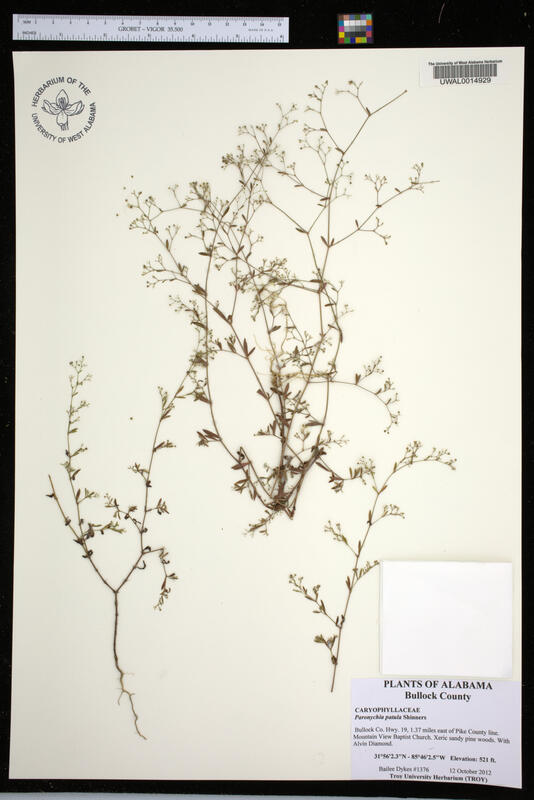
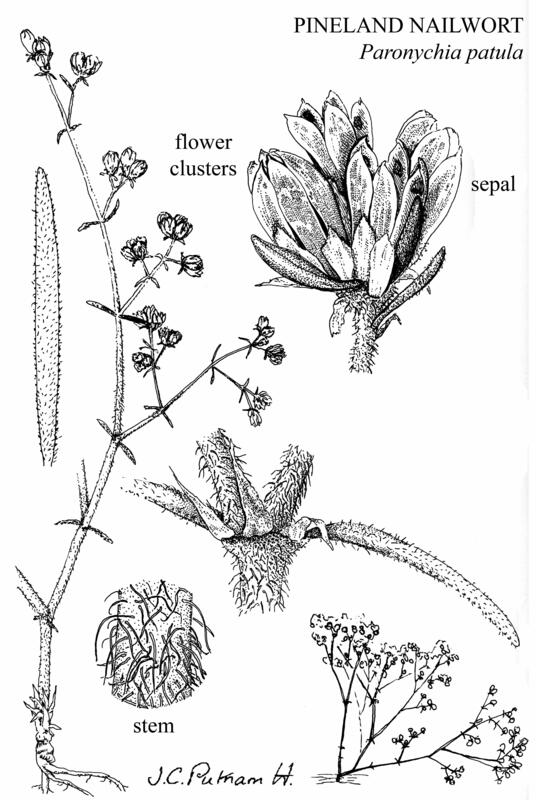
Annual or rarely short-lived perennial herb with spreading to semi-erect stems up to 20 inches (50 cm) long; the stems branch dichotomously but unevenly and are covered uniformly with down-pointing hairs. The leaves are needle-like, less than 0.8 inch (2 cm) long and less than 0.1 inch (3 mm) wide, opposite, with a blunt tip and sparse hairs. Flower clusters are loosely branched, not in tight "squares," with 15 - 50+ very small flowers. The flowers have 5 tiny, papery sepals less than 1.2 mm long, reddish-brown with white margins and a tiny point at the tip (the sepals are not hooded or rounded); the sepals are very hairy on the lower half; there are no petals. Fruits are minute (0.4 - 0.6 mm), rounded, and smooth. Magnification of 10x is needed to see the flower features.
Several species of Paronychia occur in sandhills, scrub, and other dry habitats in Georgia’s Coastal Plain.
American Nailwort (Paronychia americana) is an erect plant with spherical flower clusters; its sepals have rounded, hooded tips; its stem is hairless or has curly hairs on one side of the stem only.
Sand Squares (Paronychia rugelii) is an erect plant. Its flower clusters are held at the tips of symmetrically forked branches, therefore the clusters form tight “squares” when seen from above.
Dune Whitlow-wort (Paronychia baldwinii) and Coastal-plain Nailwort (Paronychia herniarioides) are sprawling, mat-forming plants with green flowers.
Silverling (Paronychia argyrocoma, Special Concern) occurs on sandstone and granite outcrops in the mountains and Piedmont. For more information, see: http://www.efloras.org/florataxon.aspx?flora_id=1&taxon_id=250012462
Yellow Nailwort (Paronychia virginica) occurs on magnesium-rich, ultramafic rock outcrops in Columbia County. For more information, see: https://www.georgiabiodiversity.org/portal/profile?group=plants&es_id=20414
Dry pinelands, sandhills, and sandy river banks.
Little is known about the biology of Paronychia patula except that it is an annual (or rarely short-lived perennial) plant that reproduces sexually. Reproduction in a closely related Florida scrub species, Paronychia chartacea ssp. chartacea, that occupies very dry, infrequently fire-maintained habitats, has been studied with these results: this plant forms a persistent belowground seed bank and recruits seed from the bank after a fire; seeds may be dispersed by ants; about 30% of individuals survived more than one growing season and often flowered twice; seedling recruitment was highest in large, bare patches of sandy soil, but moderate amounts of litter accumulation and shrub encroachment did not effect survivorship. Whether any of these findings apply to Paronychia patula is not known.
Surveys are best conducted during flowering (July–September) when plants are most conspicuous.
Georgia, Alabama, and Florida.
Conversion of habitat to pine plantations, developments, pastures, and fields.and agriculture. Disturbance to ground cover by mechanical clearing and site preparation. Fire suppression and encroachment by woody shrubs.
Paronychia patula is ranked SH by the Georgia Department of Natural resources, indicating that it has not been seen in Georgia in many decades. It was documented on private land in Decatur County, near the Florida border, in the 1950s but has not been seen since.
Protect sandhills and flatwoods from conversion to pine plantations and developments. Apply prescribed fire every 2 - 3 years, preferably during the growing season. Conduct surveys to determine the current status of this species in Georgia.
Hartman, R.L., J.W. Thieret, and R.K. Rabeler. 2005. Paronychia patula species account. Flora of North America, Vol. 5. Oxford University Press, New York. http://www.efloras.org/florataxon.aspx?flora_id=1&taxon_id=250060690
NatureServe. 2019. Paronychia patula comprehensive report. NatureServe Explorer. Arlington, Virginia. http://explorer.natureserve.org/servlet/NatureServe?searchName=Paronychia+patula
Schafer, J.L., E.S. Menges, P.F. Quintana-Ascencio, and C.W. Weekley. 2010. Effects of time-since-fire and microhabitat on the occurrence and density of the endemic Paronychia chartacea ssp. chartacea in Florida scrub and along roadsides. American Midland Naturalist 163(2): 294-310. https://bioone.org/journals/The-American-Midland-Naturalist/volume-163/issue-2/0003-0031-163.2.294/Effects-of-Time-Since-Fire-and-Microhabitat-on-the-Occurrence/10.1674/0003-0031-163.2.294.full
Weakley, A.S. 2015. Flora of the southern and mid-Atlantic States. University of North Carolina Herbarium, University of North Carolina, Chapel Hill. http://www.herbarium.unc.edu/flora.htm
Linda G. Chafin
L. Chafin, Feb. 2009: original account
K. Owers, Feb. 2010: added pictures
L. Chafin, Mar. 2020: updated original account