


Loading profile. Please wait . . .
Rhynchospora solitaria Harper
Autumn Beaksedge


Federal Protection: No US federal protection
State Protection: Endangered
Global Rank: G1
State Rank: S1
Element Locations Tracked in Biotics: Yes
SWAP 2015 Species of Greatest Conservation Need (SGCN): Yes
SWAP 2025 Species of Greatest Conservation Need (SGCN): Yes
2025 SGCN Priority Tier: Highest Conservation Concern
Element Occurrences (EOs) in Georgia: 5
Habitat Summary for element in Georgia: Wet, sandy, peaty depressions
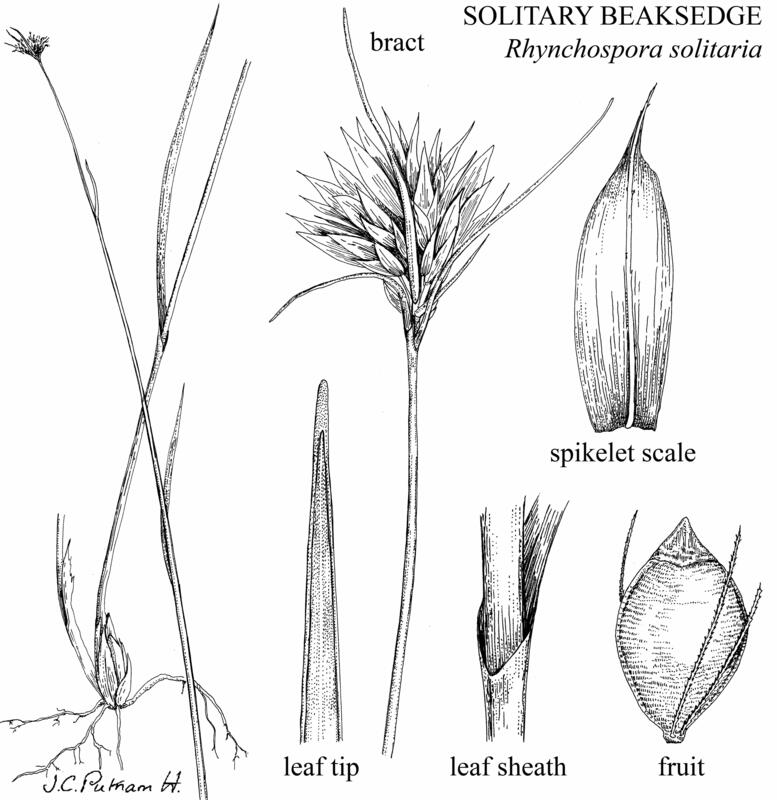
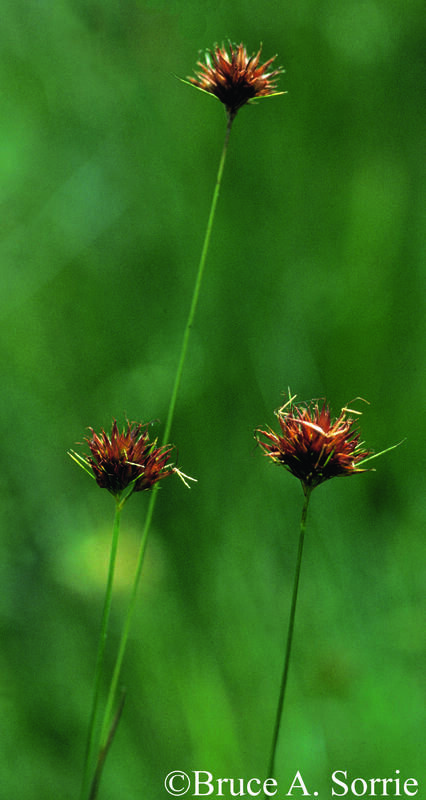
Perennial, grass-like herb, solitary or forming small tufts of stems. Stems 20 - 24 feet (50 - 60 cm) tall, erect, very slender, round. Leaves 1.5 - 2.4 inches (4 - 6 cm) long and about 0.1 inch (2.5 - 3 mm) wide, flat with a short taper to a more or less blunt tip, widely spaced along the stem, few or none rising from the base of the plant. Flower cluster 0.5 inch (1.5 cm) wide, solitary at the top of the stem, each cluster with many narrow, pointed spikelets and wiry, green bracts slightly longer than the cluster. Spikelets are about 0.25 inch (6 - 7 mm) long, bristly, orange-brown. Fruits 1 - 2 per spikelet, 2 mm long including the pointed tip, brown, seed-like, oval, covered with fine lines, and with minute pits near the achene margin; 3 - 4 fragile, barbed bristles, as long as or longer than the fruit, are attached to the base of the fruit. Beaksedge species are difficult to identify in the field; 10x or higher magnification is needed to examine spikelets and fruits.
Fringed Beaksedge (Rhynchospora ciliaris) also has minute pits on the achene margin and leaves with a short taper to a more or less blunt tip. However, its basal leaves are 4 - 6 mm wide, in a basal rosette, with long hairs on the leaf margins and leaf midveins; its fruits have 6 bristles that are less than half the length of the achene.
Fifteen species of beaksedge are rare in Georgia. For more information, see:
Northern White Beaksedge (Rhynchospora alba) http://beta.floranorthamerica.org/Rhynchospora_alba
Bearded Beaksedge (Rhynchospora crinipes) https://www.georgiabiodiversity.org/portal/profile?group=plants&es_id=20946
Georgia Beaksedge (Rhynchospora culixa) https://www.georgiabiodiversity.org/portal/profile?group=plants&es_id=17285
Decurrent Beaksedge (Rhynchospora decurrens) https://www.georgiabiodiversity.org/portal/profile?group=plants&es_id=21032
Fernald's Beakrush (Rhynchospora fernaldii) https://www.georgiabiodiversity.org/portal/profile?group=plants&es_id=20462
Harper's Beaksedge (Rhynchospora harperi) https://www.georgiabiodiversity.org/portal/profile?group=plants&es_id=17092
Many-bristled Beaksedge (Rhynchospora macra) https://www.georgiabiodiversity.org/portal/profile?group=plants&es_id=19539
Feather-bristle Beaksedge (Rhynchospora oligantha) http://beta.floranorthamerica.org/Rhynchospora_oligantha
Clonal Thread-leaved Beak (Rhynchospora pleiantha) https://www.georgiabiodiversity.org/portal/profile?group=plants&es_id=19634
Spotted Beaksedge (Rhynchospora punctata) https://www.georgiabiodiversity.org/portal/profile?group=plants&es_id=20475
Long-beak Beaksedge (Rhynchospora scirpoides) http://beta.floranorthamerica.org/Rhynchospora_scirpoides
Solitary Beaksedge (Rhynchospora solitaria) https://www.georgiabiodiversity.org/portal/profile?group=plants&es_id=21235
Chapman's Beakrush (Rhynchospora stenophylla) http://beta.floranorthamerica.org/Rhynchospora_stenophylla
Thorne’s Beaksedge (Rhynchospora thornei) https://www.georgiabiodiversity.org/portal/profile?group=plants&es_id=22487
Torrey's Beaksedge (Rhynchospora torreyana) http://beta.floranorthamerica.org/Rhynchospora_torreyana
Wet, lower slopes of grassy, sunny hillside seeps and streamhead seepage bogs.
Solitary Beaksedge is a perennial herb that reproduces sexually as well as vegetatively by producing lateral offshoots from the base of the plant. All beaksedge flowers are wind-pollinated; their fruits are dispersed by water and gravity, and also by animals, assisted by the tiny, barbed bristles at the base of the fruit which attach to fur and feathers.
Surveys are best conducted during fruiting (September–October). Mature fruits are needed for identification.
Georgia, and one population in South Carolina.
Fire suppression, logging and clearcutting in wetlands, conversion of habitat to pine plantations, disruption of hydrologic connection between upland sandhills and seepage slopes by roads, firebreaks, and other disturbances.
| Threat 1 | Threat 2 | Threat 3 | |
|---|---|---|---|
| General Threat | Agriculture & aquaculture | Natural system modifications | Transportation & service corridors |
| Specific Threat | None | None | None |
Rhynchospora solitaria is ranked S1 by the Georgia Department of Natural Resources, indicting that it is critically imperiled in the state. It is listed by the State of Georgia as Endangered. Four populations have been discovered since 1900, but only one occurs on conservation land.
Apply prescribed fire every 2 - 3 years during the growing season. Avoid placing roads and firebreaks in wetlands and wetland ecotones. Avoid clearcutting or other mechanical disturbances to the soil or herb layer. Preserve hydrologic connection between upland pine forests and seepage areas.
Bridges, E.L. and S.L. Orzell. 1992. The rediscovery of Rhynchospora solitaria Harper (Cyperaceae) in Georgia. Phytologia 72(5): 369-372. https://tinyurl.com/yat8mvo4
Chafin, L.G. 2007. Field guide to the rare plants of Georgia. State Botanical Garden of Georgia and University of Georgia Press, Athens.
Kral, R. 2003. Rhynchospora solitaria species account. Flora of North America, Vol. 23. http://beta.floranorthamerica.org/Rhynchospora_solitaria
Godfrey, R.K. and J.W. Wooten. 1979. Aquatic and wetland plants of southeastern United States, Vol. 1, monocotyledons. University of Georgia Press, Athens.
Harper, R.M. 1901. On a collection of plants made in Georgia in the summer of 1900. Bulletin of the Torrey Botanical Club 28: 454-484. https://www.jstor.org/stable/2478593?seq=1#metadata_info_tab_contents
Harper, R.M. 1904. Explorations in the Coastal Plain of Georgia during the season of 1902. Bulletin of the Torrey Botanical Club 31(1): 9-27. https://www.jstor.org/stable/2478750?seq=1#metadata_info_tab_contents
NatureServe. 2020. Rhynchospora solitaria species account. NatureServe Explorer. Arlington, Virginia. https://explorer.natureserve.org/Taxon/ELEMENT_GLOBAL.2.157762/Rhynchospora_solitaria
Sorrie, B.A. 1998. Noteworthy collections: Georgia. Castanea 63(4): 496-500. https://www.jstor.org/stable/4034002?seq=2#metadata_info_tab_contents
Weakley, A.S. 2015. Flora of the southern and mid-Atlantic States. University of North Carolina Herbarium, University of North Carolina, Chapel Hill. http://www.herbarium.unc.edu/flora.htm
Linda G. Chafin
L. Chafin, Aug. 2008: original account
K. Owers, Feb. 2010: added pictures
L. Chafin, Apr. 2020: updated original account