


Loading profile. Please wait . . .
Lachnocaulon beyrichianum Sporleder ex Koern.
Southern Bogbutton


Federal Protection: No US federal protection
State Protection: No Georgia state protection
Global Rank: G4
State Rank: S1?
Element Locations Tracked in Biotics: Yes
SWAP 2015 Species of Greatest Conservation Need (SGCN): Yes
SWAP 2025 Species of Greatest Conservation Need (SGCN): Yes
2025 SGCN Priority Tier: High Conservation Concern
Element Occurrences (EOs) in Georgia: 7
Habitat Summary for element in Georgia: Flatwoods
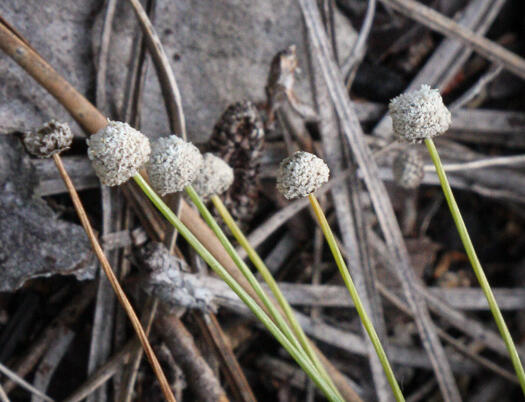
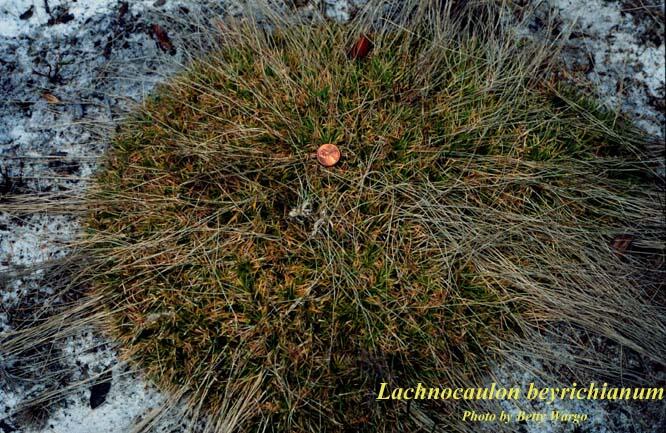
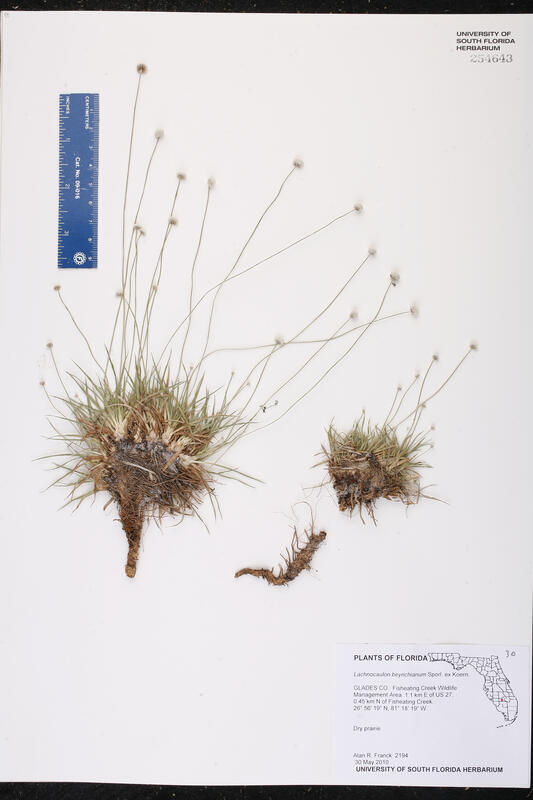
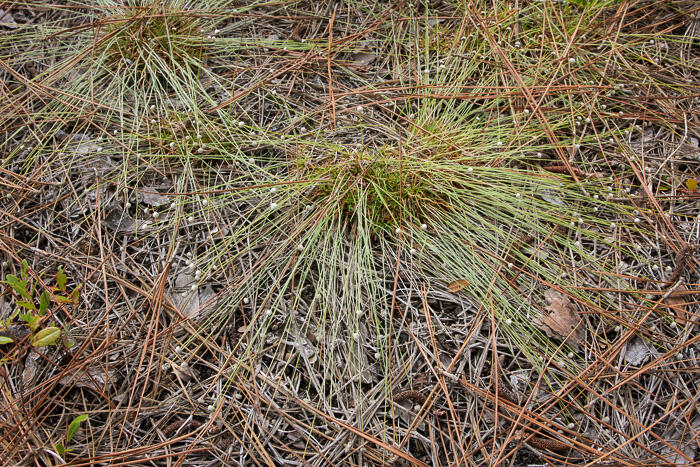
Perennial herb, forming mats, low domes, or clumps of leaf rosettes. The roots are dark, thin, and branching from a thick, semi-woody rootstock. Leaves are 0.6 - 1.6 inch (1.5 - 4 cm) long, narrow, linear, grayish-green, hairy, with very pointed (almost folded) tips. Flower stalks are 6 - 9 inches (15 - 23 cm) long, twisted, very hairy near the base, less so or even hairless near the top; the base of the stalk is loosely wrapped by a sheath that is shorter than, or equal in length to, the leaves. Mature flower heads are less than 0.2 inch (0.5 cm) across, round or slightly flattened, brownish- or grayish-white, tightly packed with many separate female and male flowers that are about 0.2 mm long. Seeds are tiny, glossy, and red-brown, appearing smooth with 10x magnification (a fine network of crisscrossing ribs are visible at higher magnification).
All species of Bog-buttons in the genus Lachnocaulon have hairy flower stalks and leaves, which distinguish them from Hatpins and Pipeworts in the genus Eriocaulon.
Brown Bog-button (Lachnocaulon minus) also has grayish-brown heads, but its flower stalks are only 2.4 - 6 inches (6 - 15 cm) tall.
Common Bog-button (Lachnocaulon anceps) has larger flower heads, about 0.4 inch (0.4 - 0.7 cm) across; its flower stalks have long, cottony hairs from top to bottom, the leaves are also very hairy, and the seeds are pale to dark brown, not glossy.
Yellow Pipewort (Syngonanthus flavidulus) has pale, spongy, unbranched roots and yellowish flower heads.
Dwarf Hatpins (Eriocaulon koernickianum) occurs on Piedmont granite outcrops. For more information, see: https://www.georgiabiodiversity.org/portal/profile?group=plants&es_id=16333
Dry to moist pine flatwoods, wet depressions in sandhills and scrub, transition zones between sandy rims and wet areas in Carolina Bays.
Southern Bog-button is a perennial herb that reproduces sexually by seed as well as vegetatively by producing offshoots from the base of the plant, thus forming clumps or mats of several plants. Each flower head contains both female and male flowers. Although little is known about reproduction in this species, the flowers of other species of Bog-button are wind- and, occasionally, insect-pollinated. The seeds are dispersed by gravity and water.
Surveys are best conducted during flowering (May–August) when the color of the flower heads is obvious.
Coastal Plain of Georgia, Florida, South Carolina, and North Carolina. It is imperiled throughout its range.
Conversion of habitat to pine plantations, agriculture, and pasture. Ditching and draining of wetlands. Fire suppression. Changes in hydrology due to altered temperature and rainfall patterns related to climate change.
| Threat 1 | Threat 2 | Threat 3 | |
|---|---|---|---|
| General Threat | Agriculture & aquaculture | Natural system modifications | Climate change & severe weather |
| Specific Threat | Wood & pulp plantations | None | None |
Lachnocaulon beyrichianum is ranked S1? by the Georgia Department of Natural Resources, indicating that the species is likely critically imperiled in Georgia but that more information is needed to make a final ranking. Six populations are known, only one on conservation land.
Apply prescribed fire every 2 - 3 years. Avoid plowing firebreaks through wetlands. Protect wet pinelands and sandhills from conversion to pine plantations. Restore natural hydrology to pinelands. Address climate change.
Chafin, L.G. 2007. Field guide to the rare plants of Georgia. State Botanical Garden of Georgia and University of Georgia Press, Athens.
GADNR. 2020. Element occurrence records for Lachnocaulon beyrichianum. Georgia Department of Natural Resources, Wildlife Resources Division, Social Circle, Georgia.
Godfrey, R.K. and J.W. Wooten. 1979. Aquatic and wetland plants of southeastern United States, Vol. 1, monocotyledons. University of Georgia Press, Athens.
Kral, R. 2000. Lachnocaulon beyrichianum species account. Flora of North America, Vol. 22. Oxford University Press, New York. http://www.efloras.org/florataxon.aspx?flora_id=1&taxon_id=222000199
Kral, R. 1966. Eriocaulaceae of continental North America north of Mexico. Sida 2(4):285-332. https://www.jstor.org/stable/41966293
NatureServe. 2019. Lachnocaulon beyrichianum comprehensive report. NatureServe Explorer. Arlington, Virginia. http://explorer.natureserve.org/servlet/NatureServe?searchName=Lachnocaulon+beyrichianum
Weakley, A.S. 2015. Flora of the southern and mid-Atlantic States. University of North Carolina Herbarium, University of North Carolina, Chapel Hill. http://www.herbarium.unc.edu/flora.htm
Linda G. Chafin
L. Chafin, Apr. 2007: original account.
K. Owers, Feb. 2010: added pictures.
L. Chafin, March 2020: updated original account.