


Loading profile. Please wait . . .
Platanthera peramoena (Gray) Gray
Purple Fringeless Orchid


Federal Protection: No US federal protection
State Protection: No Georgia state protection
Global Rank: G5
State Rank: S1
Element Locations Tracked in Biotics: Yes
SWAP 2015 Species of Greatest Conservation Need (SGCN): Yes
SWAP 2025 Species of Greatest Conservation Need (SGCN): Yes
2025 SGCN Priority Tier: High Conservation Concern
Element Occurrences (EOs) in Georgia: 7
Habitat Summary for element in Georgia: Wet meadows, openings among bottomland hardwoods
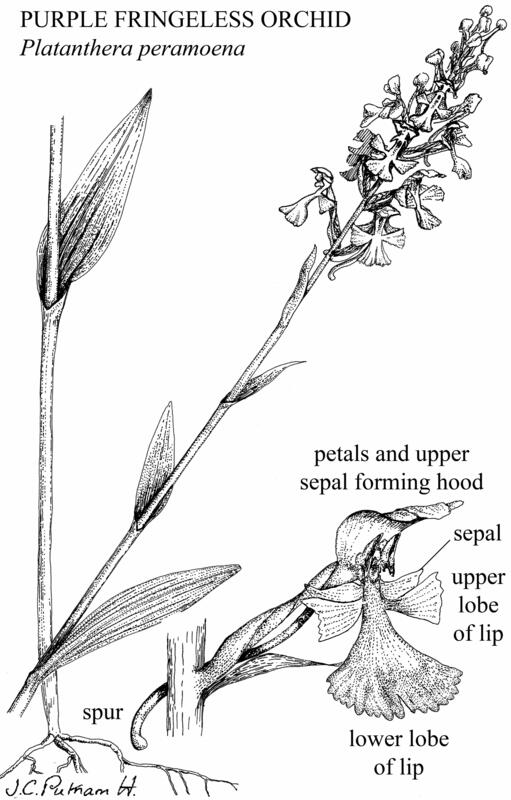
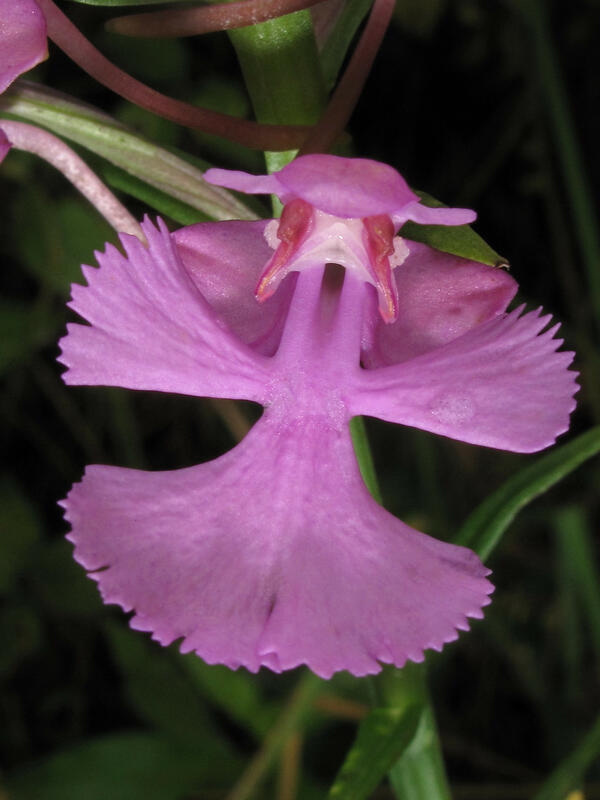
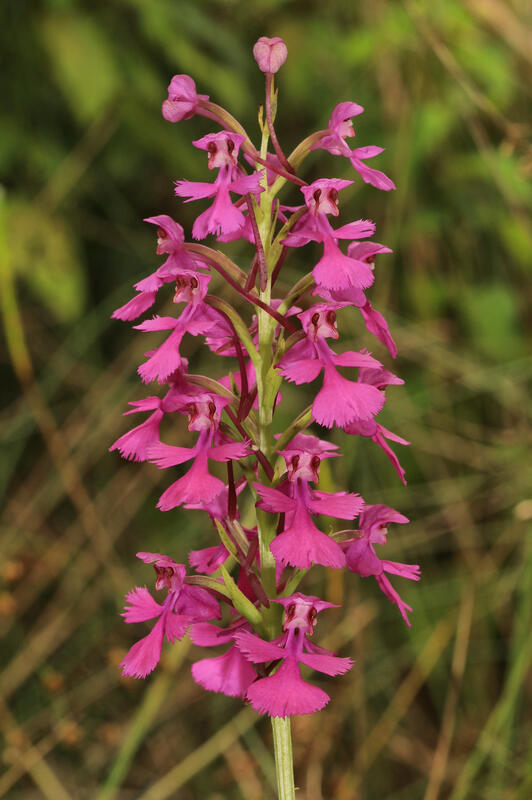
Perennial herb with green, hairless, erect stem 1 - 3.4 feet (35 - 105 cm) tall, with 2 - 5 leaves scattered along the stem. Leaves are 2.7 - 10.6 inches (7 - 27 cm) long and 0.5 - 2 inches (1.2 - 5 cm) wide, sheathing the stem and gradually decreasing in size to the flower cluster. Flowers are rose-purple or lavender-pink, held in a cylindrical cluster at the top of the stem. The flower is about 1 inch (2.5 cm) long, not including the spur. The sepals are oval with pointed tips, bent slightly backward. The lateral petals are oval with rounded, slightly toothed tips. The lip petal has 3 large, finely toothed (but not deeply fringed) lobes, the outer lobes are widely spreading, the middle lobe is much wider and notched as well as finely toothed. The spur, a backward extension of the lip petal, is 0.8 - 1.2 inch (2 - 3 cm) long. The fruit is a slender, oval capsule, 0.5 - 1 inch (1.3 - 2.3 cm) long.
There are three Platanthera species with purple flowers in north Georgia, all of which are rare in Georgia. Purple Fringeless Orchid is distinguished by its toothed, but not deeply fringed, lip. The other two species are:
Large Purple Fringed Orchid (Platanthera grandiflora, Special Concern) occurs in wet thickets and seepy areas along rocky streams in Georgia's Blue Ridge. For more information, see: https://www.georgiabiodiversity.a2hosted.com/portal/profile?group=plants&es_id=16572
Small Purple Fringed Orchid (Platanthera psycodes, Special Concern) occurs in streamside thickets, north-facing coves, and boulderfields in Georgia's Blue Ridge. For more information, see "Similar Species" at https://www.georgiabiodiversity.a2hosted.com/portal/profile?group=plants&es_id=16572
Ten species of Platanthera are rare in Georgia. For more information, see: https://www.georgiabiodiversity.org/portal/element_lists?group=plant).
Moist meadows, sunny bogs in the backwaters of lakes, moist openings among bottomland hardwood forests.
Purple Fringeless Orchid is pollinated by moths and butterflies, whose long tongues are adapted for probing the long, nectar-containing spurs of Platanthera flowers. During the process of probing for nectar, sticky packets of pollen adhere to the front of the insects’ heads and are brushed off onto the stigmas of flowers that are subsequently visited. Flowers must be cross-pollinated for fruit to set. Each fruit contains thousands of dust-like seeds that are dispersed by wind and gravity. The seeds contain no stored food reserves (endosperm), and must land on a patch of soil containing a specific fungus that provides nutrients for germination and subsequent plant growth.
Surveys are best conducted during flowering (late June–early August).
Georgia, north to New Jersey and Illinois, and west to Missouri and Arkansas.
Destruction of wetland habitat by ditching, draining, filling, and off-road vehicle use. Plant poaching. Digging by feral hogs. Invasion by exotic pest plants.
| Threat 1 | Threat 2 | Threat 3 | |
|---|---|---|---|
| General Threat | Agriculture & aquaculture | Residential & commercial development | Natural system modifications |
| Specific Threat | None | None | None |
Platanthera peramoena is ranked S1 by the Georgia Department of Natural Resources, indicating that it is critically imperiled in Georgia.Seven populations have been documented in Georgia, three in the Chattahoochee National Forest, another on state conservation land.
Protect bogs and other mountain wetlands from off-road vehicles, draining, and logging. Prosecute plant poachers. Eradicate feral hogs. Remove exotic plants from the species' habitats.
Argue, C.L. 2012. The pollination biology of North American orchids: volume 1, North of Florida and Mexico, Part II: subfamily Orchidoideae (part one), Chapter 8, Platanthera. Springer Science+Business Media, LLC. https://link.springer.com/content/pdf/10.1007%2F978-1-4614-0592-4.pdf
Brown, P.M. and S.N. Folsom. 2004. Wild orchids of the southeastern United States, north of peninsular Florida. University Press of Florida, Gainesville.
Chafin, L.G. 2007. Field guide to the rare plants of Georgia. State Botanical Garden of Georgia and University of Georgia Press, Athens.
Drake, J. 2013. Fringed orchids of the southeastern United States: a guide to the genus Platanthera. Breath o’ Spring, Inc. P.O. Box 2957, Suwanee, Georgia 30024.
GADNR. 2020. Element occurrence records for Platanthera peramoena. Georgia Department of Natural Resources, Wildlife Resources Division, Social Circle, Georgia.
Hapeman, J.R. 1997. Pollination and floral biology of Platanthera peramoena. Lindleyana 12(1): 19-25.
Horn, D., T. Cathcart, T.E. Hemmerly, and D. Duhl. 2005. Wildflowers of Tennessee, the Ohio Valley, and the southern Appalachians. Lone Pine Publishing, Auburn, Washington.
Luer, C.A. 1975. The native orchids of the United States and Canada, excluding Florida. New York Botanical Garden, New York.
McKeever, S. 2001. Some native orchids of the southeastern United States. Tipularia 16: 22-31.
NatureServe. 2019. Platanthera peramoena comprehensive report. NatureServe Explorer. Arlington, Virginia. http://explorer.natureserve.org/servlet/NatureServe?searchName=Platanthera+peramoena
Sheviak, C.J. 2003. Platanthera peramoena species account. Flora of North America, Vol. 26. Oxford University Press, New York. http://www.efloras.org/florataxon.aspx?flora_id=1&taxon_id=242101849
Weakley, A.S. 2015. Flora of the southern and mid-Atlantic States. University of North Carolina Herbarium, University of North Carolina, Chapel Hill. http://www.herbarium.unc.edu/flora.htm
Linda G. Chafin
L. Chafin, Jul. 2008: original account
K. Owers, Feb. 2010: added pictures
L. Chafin, Mar. 2020: updated original account