


Loading profile. Please wait . . .
Najas filifolia Haynes
Narrowleaf Naiad


Federal Protection: No US federal protection
State Protection: Endangered
Global Rank: G3
State Rank: S1
Element Locations Tracked in Biotics: Yes
SWAP 2015 Species of Greatest Conservation Need (SGCN): Yes
SWAP 2025 Species of Greatest Conservation Need (SGCN): Yes
2025 SGCN Priority Tier: High Conservation Concern
Element Occurrences (EOs) in Georgia: 3
Habitat Summary for element in Georgia: Lakes
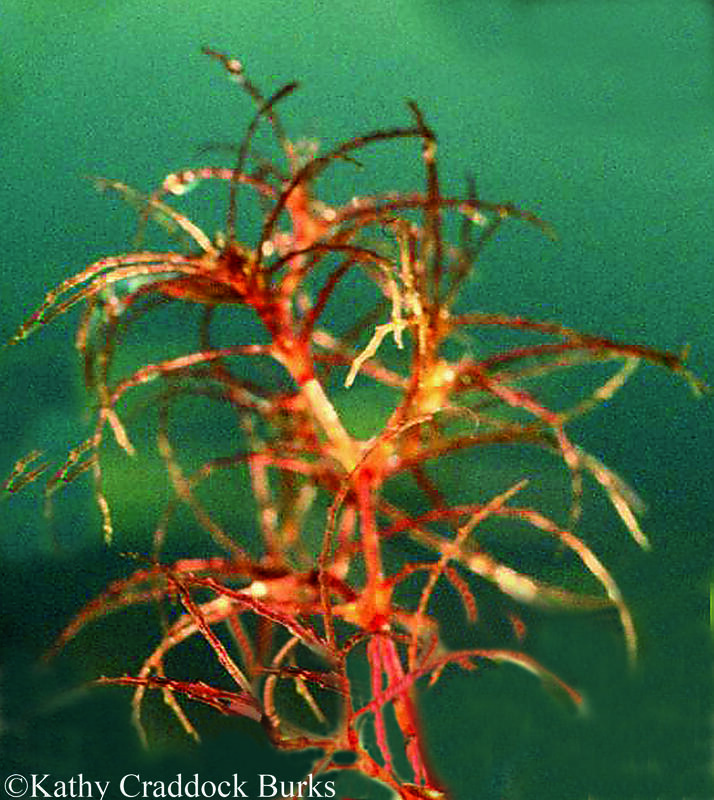
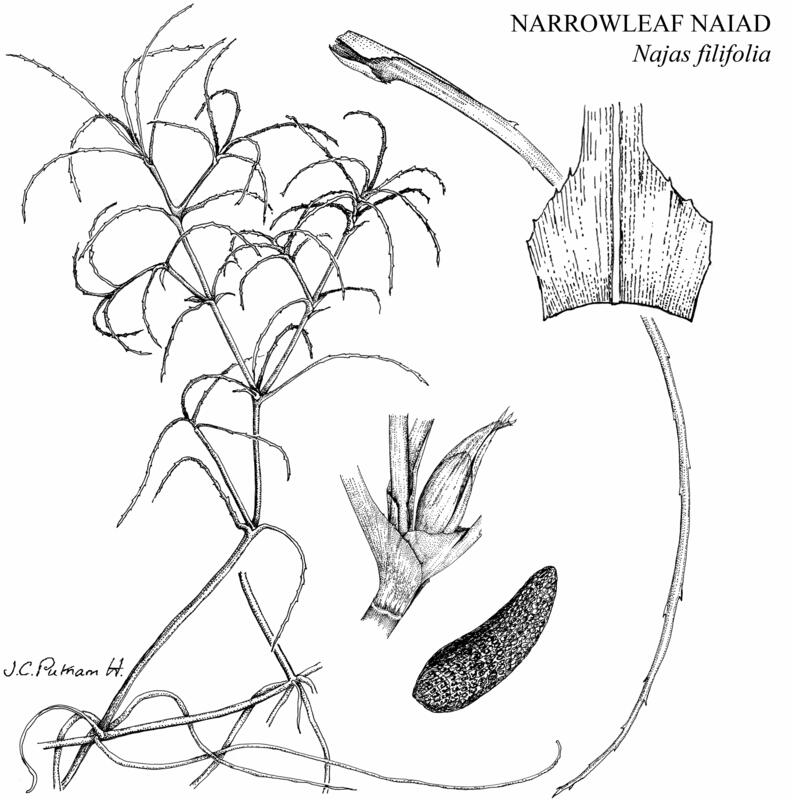
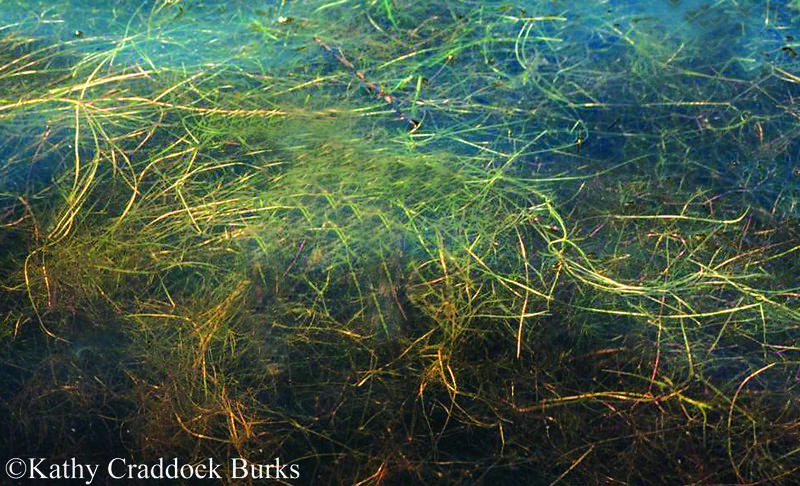
Submerged aquatic herb with smooth, slender, red-brown, much-branched, non-spiny stems 2.8 - 9 inches (7 - 22 cm) long. The leaves are 0.3 - 1 inch (0.8 - 2.6 cm) long, very narrow, orange-red to greenish-brown, translucent, clustered at the tips of branches, curved downwards, with 5 - 9 soft, non-spiny teeth on each side of the leaf; the leaf base expands into a sheath that is much wider than the leaf, its edge curved and only slightly toothed. Flowers are tiny, held singly in the angle between leaf and stem; female flowers are produced on the lower stem, male flowers on the upper stem. Female flowers consist of 1 ovary and a 4-lobed stigma; male flowers consist of 1 stamen enclosed in a 4-lobed bract. Seeds are about 0.1 inch (0.3) long, strongly curved or crescent-shaped; the seed coat is bumpy with 20 rows of rectangular pits.
Narrowleaf Naiad is the only Najas species with crescent-shaped fruits.
Spiny-leaf Naiad (Najas minor) has stiffly down-curved leaves with spiny teeth; the leaf sheath is strongly toothed; the seed is pitted and tapered at both ends but not strongly curved.
Southern Naiad (Najas guadalupensis) leaves are scattered along the stems and are not down-curved; the leaves have tiny, barely visible teeth; its seed is oval.
None in Georgia.
Sand-bottomed ponds and lakes, usually tannin-stained.
Narrowleaf Naiad is an annual herb that reproduces sexually and possibly asexually through stem fragmentation. It is monoecious – female and male structures occur in separate flowers on the same plant. Male flowers release pollen underwater; the pollen is heavier than water and slowly sinks or is moved by water currents, occasionally contacting a female flower. Naiads are important food sources for ducks and other waterfowl.
Plants are most conspicuous mid-summer–fall; flowers and fruits are present August–October. Seeds are important for identification.
Georgia and Florida, where it is also rare.
Pollution, sedimentation, and degradation of ponds. Altering natural water levels. Competition from exotic, invasive water plants. Drawdown of water table by irrigation wells. Use of herbicides in ponds and surrounding areas.
| Threat 1 | Threat 2 | Threat 3 | |
|---|---|---|---|
| General Threat | Residential & commercial development | Agriculture & aquaculture | Energy production & mining |
| Specific Threat | None | None | None |
Najas filifolia is ranked S2 by the Georgia Department of Natural Resources, indicating that it is imperiled in Georgia. Three populations have been documented in Georgia, none on conservation lands. Only 1 population has been confirmed since 1948.
Prevent pollution and sediment runoff into lakes. Protect natural hydrology of lakes and ponds by preventing excessive ground water withdrawal. Allow fires in uplands to burn into edges of ponds. Eradicate aquatic pest plants but avoid use of herbicides in ponds with this species.
Burks, K.C. 1995. Noteworthy collections: Florida – Najas filifolia. Castanea 60(2): 169-170. https://www.jstor.org/stable/4033818?seq=1#metadata_info_tab_contents
Chafin, L.G. 2007. Field guide to the rare plants of Georgia. State Botanical Garden of Georgia and University of Georgia Press, Athens.
GADNR. 2020. Element occurrence records for Najas filifolia. Georgia Department of Natural Resources, Wildlife Resources Division, Social Circle, Georgia.
Godfrey, R.K. and J.W. Wooten. 1979. Aquatic and wetland plants of southeastern United States, Vol. 1, monocotyledons. University of Georgia Press, Athens.
Haynes, R.R. 2000. Najas filifolia species account. Flora of North America, Vol. 22. Oxford University Press, New York. http://www.efloras.org/florataxon.aspx?flora_id=1&taxon_id=222000254
Haynes, R.R. 1985. A new species of Najas (Najadaceae) from the southeastern U.S.A. Brittonia 37(4): 392-393. https://www.jstor.org/stable/2806556?seq=1#metadata_info_tab_contents
Haynes, R.R. 1979. Revision of North and Central American Najas (Najadaceae). Sida 8: 34-56. https://www.jstor.org/stable/41966550?seq=1
Haynes, R.R. 1977. The Najadaceae in the southeastern United States. Journal of Arnold Arboretum 58: 161-170. https://www.jstor.org/stable/43782006?seq=1#metadata_info_tab_contents
NatureServe. 2019. Najas filifolia comprehensive report. NatureServe Explorer. Arlington, Virginia. http://explorer.natureserve.org/servlet/NatureServe?searchName= Najas+filifolia
Weakley, A.S. 2015. Flora of the southern and mid-Atlantic States. University of North Carolina Herbarium, University of North Carolina, Chapel Hill. http://www.herbarium.unc.edu/flora.htm
Linda G. Chafin
L. Chafin, Jul 2008: original account
K. Owers, Feb 2010: added pictures
L. Chafin, Mar 2020: updated original account