


Loading profile. Please wait . . .
Silphium mohrii Small
Mohr's Rosinweed


Federal Protection: No US federal protection
State Protection: No Georgia state protection
Global Rank: G3?Q
State Rank: S1?
Element Locations Tracked in Biotics: Yes
SWAP 2015 Species of Greatest Conservation Need (SGCN): Yes
SWAP 2025 Species of Greatest Conservation Need (SGCN): Yes
2025 SGCN Priority Tier: High Conservation Concern
Element Occurrences (EOs) in Georgia: 15
Habitat Summary for element in Georgia: Rocky hardwood forests
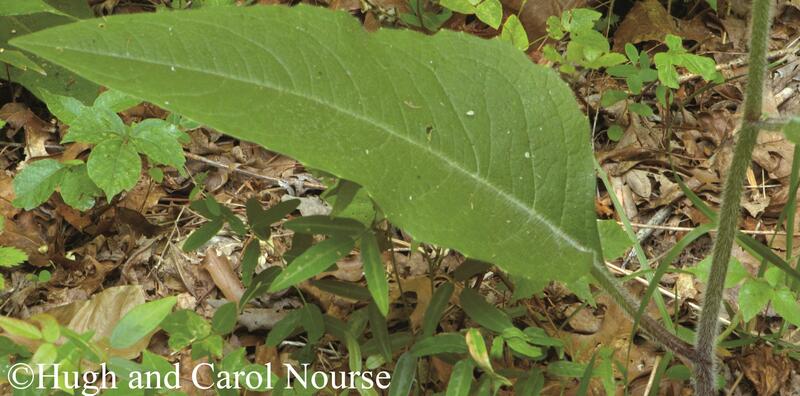
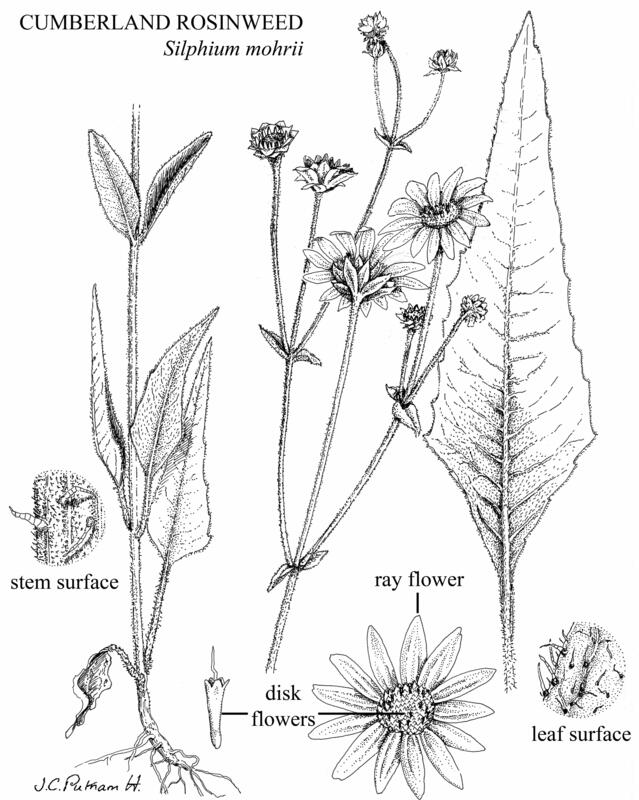
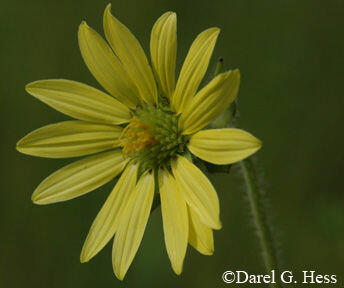
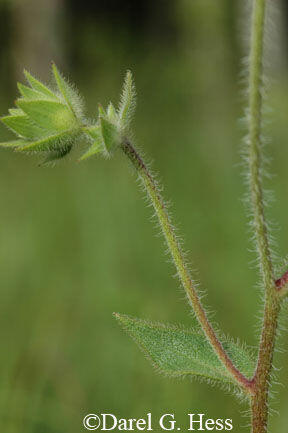
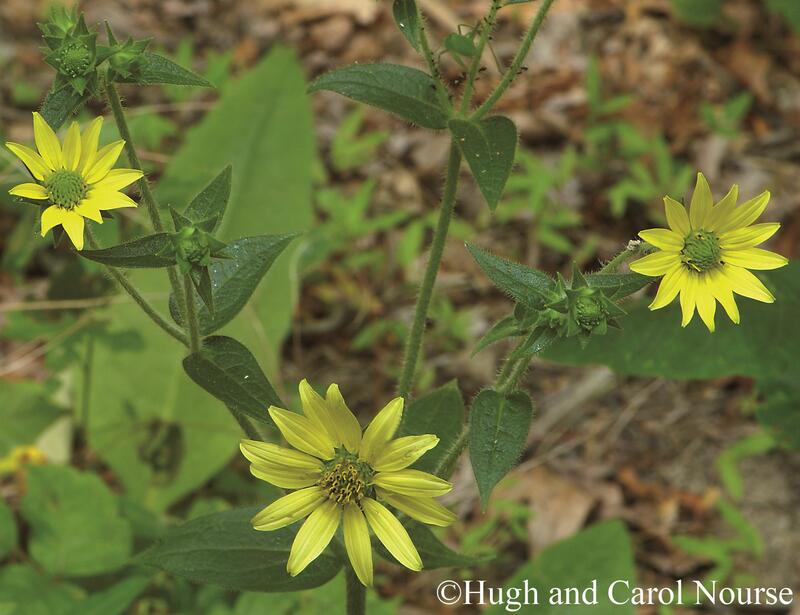
Perennial herb with a very hairy, leafy stem 1.5 - 5 feet (40 - 160 cm) tall, branched near the top. The lower leaves are up to 10 inches (26 cm) long and 5.5 inches (14 cm) wide, lance-shaped with long-pointed tips and rounded or tapered bases, very hairy, the margins sometimes toothed. The leaf stalk is up to 6 inches (15 cm) long. The stem leaves become gradually smaller up the stem, and are oval, opposite or alternate, and lacking a leaf stalk. The flower heads have 10 - 20 pale yellow ray flowers up to 0.8 inch (2 cm) long; 40 - 85 small, yellow disk flowers; and 2 or 3 whorls of pointed, green involucral bracts (phyllaries). Fruits are 6 - 10 mm long, dry, seed-like, winged, produced at the base of the ray flowers.
Cumberland Rosinweed is distinguished from most other Silphium species in northwest Georgia by its very hairy, leafy stems and large, hairy basal leaves. Starry Rosinweed (Silphium asteriscus) is also hairy but, by flowering time, its leaves are primarily on the stem, the basal leaves having withered early in the year.
Rosinweed (Silphium radula, Special Concern) occurs in rocky hardwood forests in northwest Georgia. It was last seen in Georgia in Catoosa County in 1948. It is also very hairy, but has 16 - 35 ray flowers per head. For more information, see: http://beta.floranorthamerica.org/Silphium_radula
Sunny, grassy roadsides and rights-of-way. In other parts of its range, it occurs in prairies, fence rows, and other clearings in sandy, usually limestone-based soils.
Cumberland Rosinweed is a perennial herb that reproduces sexually by seed. The heads of Cumberland Rosinweed, like the heads of most members of the composite family, contain both ray flowers and disk flowers. Unlike most composites, however, the ray flowers of rosinweed are female and fertile, and produce seeds, while the disk flowers are male only and do not produce seeds. As a result, each head produces fewer than 20 fruits in a ring around the outside of the head. Pollination studies for this species have not been published but other rosinweeds are pollinated by long-tongued bees, butterflies, and skippers, and are visited and perhaps pollinated by a variety of other insects. The seeds of rosinweeds are flattened and slightly winged and are probably dispersed by the wind.
Surveys are best conducted during flowering (June–August) or fruiting (August–September); freshly fruiting heads will usually have 13 fruits, one at the base of each withered ray flower (disk flowers do not produce fruits).
Georgia, Alabama, and Tennessee.
| Threat 1 | Threat 2 | Threat 3 | |
|---|---|---|---|
| General Threat | Biological resource use | Human intrusions & disturbance | Natural system modifications |
| Specific Threat | None | None | None |
Silphium mohrii ir ranked S1? by the Georgia Department of Natural Resources, indicating that the species is imperiled in Georgia, but that more information is needed to make a definitive ranking. Ten populations have been documented in Georgia, only two on conservation lands.
Protect hardwood forests from development and clearcutting. Use prescribed fire to create openings in forests. Monitor sites for invasion by exotic pest plants.
Chafin, L.G. 2007. Field guide to the rare plants of Georgia. State Botanical Garden of Georgia and University of Georgia Press, Athens.
Cronquist, A. 1980. Vascular flora of the southeastern United States, Vol. 1, Asteraceae. University of North Carolina Press, Chapel Hill.
Clevinger, J.A. 2006. Flora of North America, Vol. 21. Oxford University Press, New York. http://beta.floranorthamerica.org/Silphium_mohrii
Horn, D., T. Cathcart, T.E. Hemmerly, and D. Duhl. 2005. Wildflowers of Tennessee, the Ohio Valley, and the southern Appalachians. Lone Pine Publishing, Auburn, Washington.
NatureServe. 2020. Species account for Silphium mohrii. NatureServe Explorer. Arlington, Virginia. https://explorer.natureserve.org/Taxon/ELEMENT_GLOBAL.2.159562/Silphium_mohrii
Small, J.K. 1897. Studies in the botany of the southeastern United States, XII. Bulletin of the Torrey Botanical Club 24(11): 487-496. https://www.jstor.org/stable/2478069?seq=1#metadata_info_tab_contents
Weakley, A.S. 2015. Flora of the southern and mid-Atlantic States. University of North Carolina Herbarium, University of North Carolina, Chapel Hill. http://www.herbarium.unc.edu/flora.htm
Linda G. Chafin
L. Chafin, Aug. 2008: original account
K. Owers, Feb. 2010: added pictures
L. Chafin, May 2020: updated original account