


Loading profile. Please wait . . .
Berberis canadensis P. Mill.
American Barberry


Federal Protection: No US federal protection
State Protection: Endangered
Global Rank: G3G4
State Rank: S1
Element Locations Tracked in Biotics: Yes
SWAP 2015 Species of Greatest Conservation Need (SGCN): Yes
SWAP 2025 Species of Greatest Conservation Need (SGCN): Yes
2025 SGCN Priority Tier: High Conservation Concern
Element Occurrences (EOs) in Georgia: 7
Habitat Summary for element in Georgia: Cherty, thinly wooded slopes
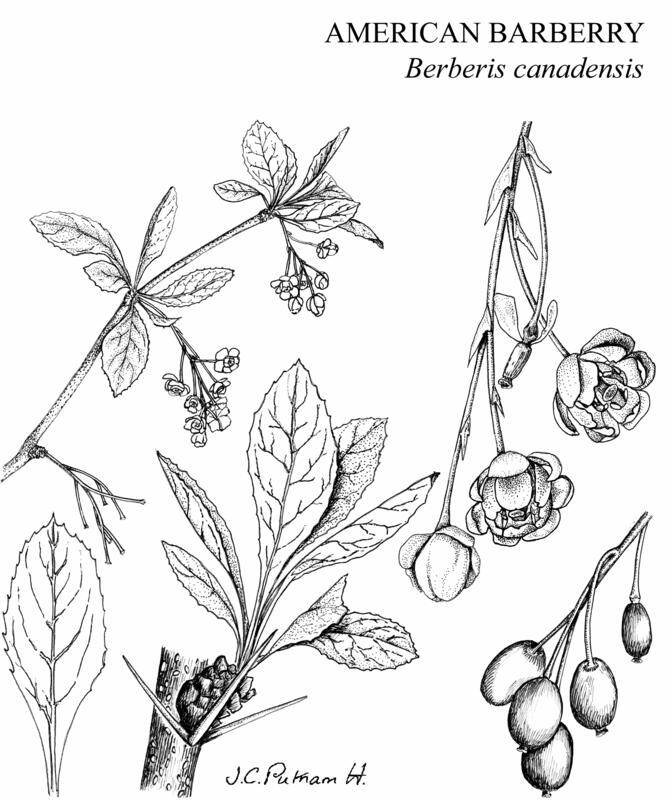
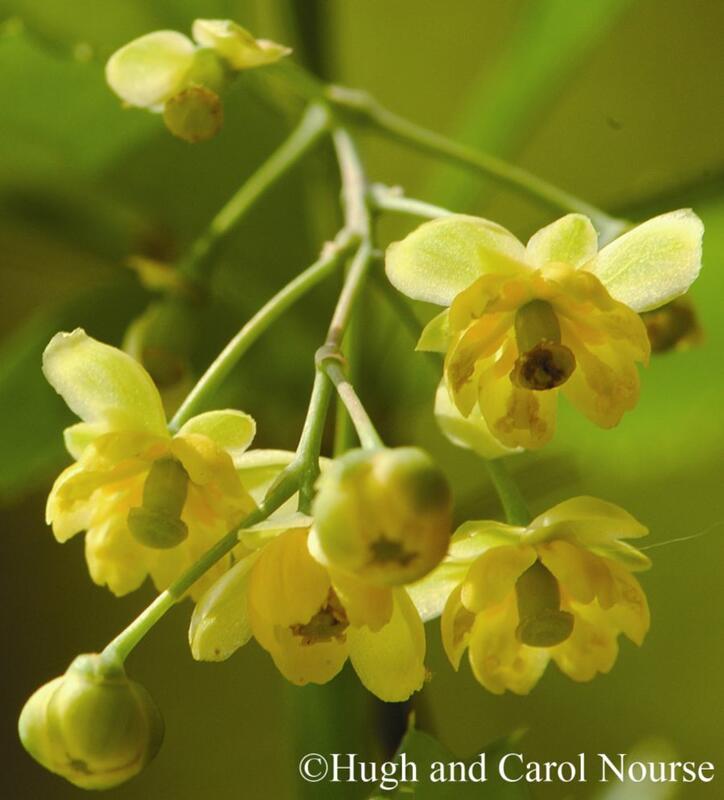
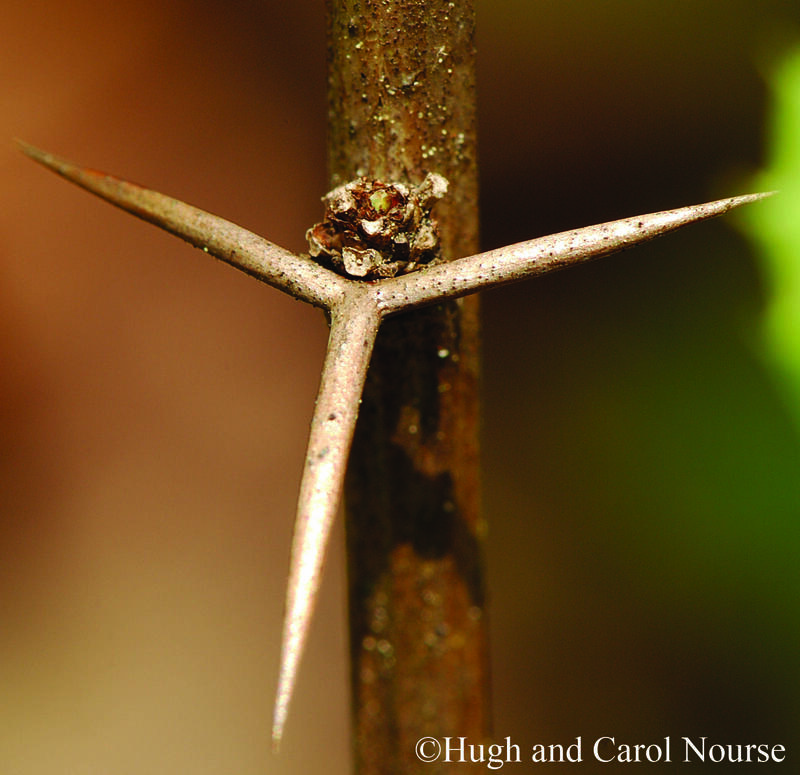
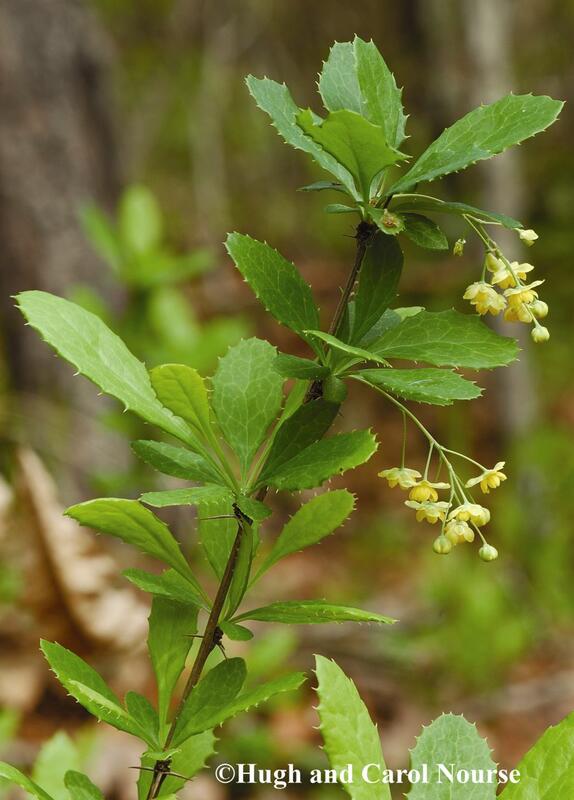
Deciduous shrub 1.5 - 6.5 feet (0.4 - 2 m) tall, forming colonies by the spread of underground stems; outer bark of 2-year old branches is brownish-red, the inner bark yellow. Thorns are 3-pronged. Leaves are clustered on stubby short shoots that branch from the main stems; each leaf is 0.7 - 3 inches (1.8 - 7.5 cm) long and 0.3 - 1.3 inches (0.8 - 3.3 cm) wide, oval with a rounded tip and tapering base; leaf margins are toothed, and each tooth is tipped with a short bristle. Flower clusters are drooping, with 3 - 12 yellow flowers per cluster. Flowers have 6 sepals, 6 petals with notched tips, and 6 stamens. Fruits are 0.4 inch (1 cm) long, round or oval, red, and juicy.
Japanese Barberry (Berberis thunbergii), an exotic pest plant, has leaves with smooth edges, with no teeth or bristles; its thorns have only one prong (rarely 3), and the flowers are usually single (occasionally in flat-topped clusters).
European Barberry (Berberis vulgaris) was once widely planted but was largely eradicated because of stem rust; the bark on 2-year old branches is gray, leaves have prominent veins, flower clusters have 10 - 20 flowers, and petals are rounded, not notched, at the tip.
None in Georgia.
Sunny patches in dry, open woods, often over limestone, shale, or mafic rock.
American Barberry spreads vegetatively by underground stems (rhizomes), sometimes forming large colonies. It also reproduces sexually, producing berries in the fall. Seeds are dispersed by both birds and mammals. All barberry species are alternate hosts for the black stem rust fungus (Puccinia graminis) that kills wheat, barley, oats, rye, and other cultivated grasses; the fungus spends part of its life cycle on these grasses and part of it on barberries. In an effort to control the fungus, U.S. government agricultural officials initiated a barberry eradication program in the 1920s that has nearly extirpated the once common American Barberry from the eastern U.S.
Plants are most conspicuous during flowering (April–May) and fruiting (September–October), but the presence of short shoots, thorns, and bristly leaves is diagnostic throughout the growing season.
Once widespread throughout the eastern U.S., only 50 populations remain in 10 states: Georgia, Tennessee, South Carolina, North Carolina, Virginia, West Virginia, Kentucky, Missouri, Illinois, and Indiana.
Government eradication programs, invasion by exotic pest plants, lack of fire in dry woodlands.
| Threat 1 | Threat 2 | Threat 3 | |
|---|---|---|---|
| General Threat | Natural system modifications | Residential & commercial development | Agriculture & aquaculture |
| Specific Threat | None | None | None |
Berberis canadensis is ranked S1 by the Georgia Department of Natural Resources, indicating that it is critically imperiled in the state. It is listed as Endangered by the State of Georgia. One natural population has been observed in the last 60 years; it occurs on private land in Bartow County. A safeguarding population was planted in 2010 on state-owned conservation land.
Use prescribed fire or hand-clearing to create sunny openings in dry woodlands. Control exotic pest plants. Research alternatives to barberry eradication programs for control of wheat rust fungus.
Chafin, L.G. 2007. Field guide to the rare plants of Georgia. State Botanical Garden of Georgia and University of Georgia Press, Athens.
FNA. 1997. Berberis canadensis species account. Flora of North America, Vol. 3. Oxford University Press, New York. http://beta.floranorthamerica.org/Berberis_canadensis
Foote, L.E. and S.B. Jones, Jr. 1989. Native shrubs and woody vines of the southeast. Timber Press, Portland, Oregon.
GADNR. 2019. Element occurrence records for Berberis canadensis. Georgia Department of Natural Resources, Wildlife Resources Division, Social Circle, Georgia.
Gleason, H.A. and A. Cronquist. 1991. Manual of vascular plants of northeastern United States and adjacent Canada, 2nd edition. New York Botanical Garden, New York.
Hill, S.R. 2003. Conservation assessment for American Barberry (Berberis canadensis). U.S. Forest Service, Threatened and Endangered Species Program. Milwaukee, Wisconsin. https://www.researchgate.net/publication/32963858_Conservation_Assessment_for_American_Barberry_Berberis_Canadensis_Mill
NatureServe. 2019. Berberis canadensis comprehensive report. NatureServe Explorer. Arlington, Virginia. http://explorer.natureserve.org/servlet/NatureServe?searchName=Berberis%20canadensis
Radford, A.E., H.E. Ahles, and C.R. Bell. 1968. Manual of the vascular flora of the Carolinas. University of North Carolina Press, Chapel Hill.
Weakley, A.S. 2015. Flora of the southern and mid-Atlantic States. University of North Carolina Herbarium, University of North Carolina, Chapel Hill. http://www.herbarium.unc.edu/flora.htm
Wikipedia. 2020. Stem rust. https://en.wikipedia.org/wiki/Stem_rust
Linda G. Chafin
L. Chafin, Feb. 2007: original account
K. Owers, Jan. 2010: updated status and ranks, added pictures
L. Chafin, Jan. 2020: updated original account.