



Loading profile. Please wait . . .
Platanthera integra (Nutt.) Gray ex Beck
Yellow Fringeless Orchid


Federal Protection: No US federal protection
State Protection: No Georgia state protection
Global Rank: G3G4
State Rank: S1
Element Locations Tracked in Biotics: Yes
SWAP 2015 Species of Greatest Conservation Need (SGCN): Yes
SWAP 2025 Species of Greatest Conservation Need (SGCN): Yes
2025 SGCN Priority Tier: High Conservation Concern
Element Occurrences (EOs) in Georgia: 15
Habitat Summary for element in Georgia: Wet savannas, pitcherplant bogs
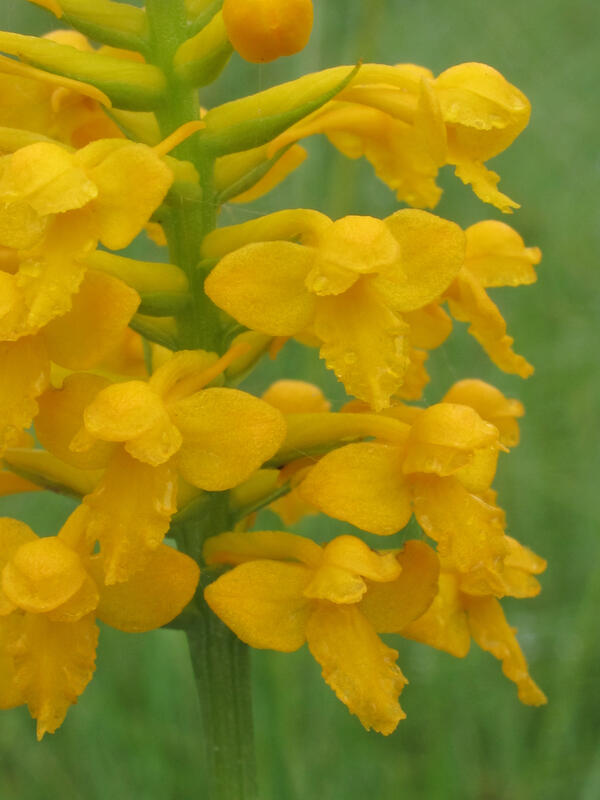
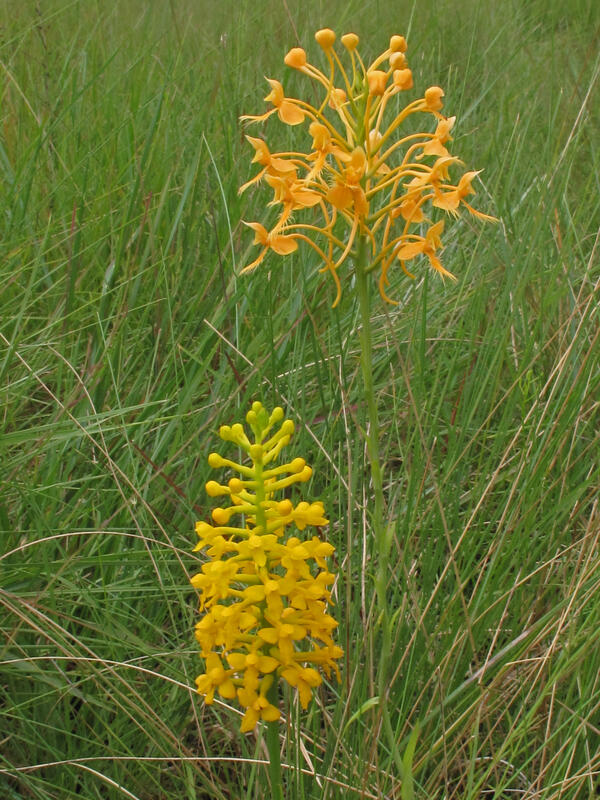
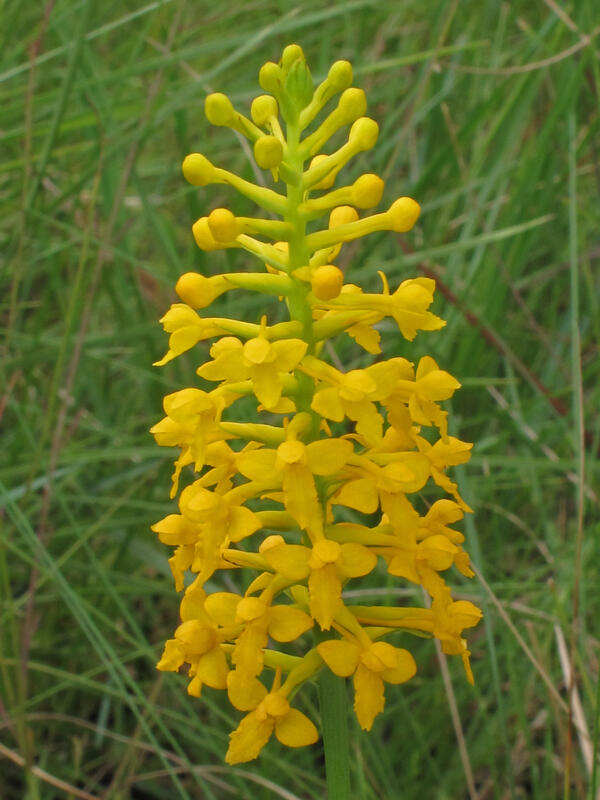
Perennial herb with erect, hairless stems 8 - 30 inches (20–75 cm) tall. The leaves are 1.7 - 12.5 inches (4.5 - 32 cm) long and 0.4 - 1 inch (1 - 3 cm) wide, 1 - 3 in number (not including small bracts near the top of the stem), alternate, lance-shaped, deciduous, with sheathing bases. The flower cluster is up to 4 inches (2 - 10 cm) tall, with many orange flowers closely spiraled around the top of the stem. The upper sepal and two small petals overlap to form a hood over the top of the flower. The oval lateral sepals are widely spreading. The lip petal is less than 0.2 inch (3-5 mm) long, oval to oblong in shape, projecting downward or forward, with ragged (but not fringed) edges. The nectar-producing spur, a backward extension of the lip petal, is usually less than 0.4 inch (5-10 mm mm) long. The fruits are narrow capsules less than 0.4 inch (5 - 11 mm) long.
There are three other orange-flowered Platanthera species in Georgia’s Coastal Plain: Platanthera chapmanii, Platanthera ciliaris, and Platanthera cristata. All three have deeply fringed lip petals.
There are 10 rare species of Platanthera in Georgia. For information on each of these, see: https://www.georgiabiodiversity.org/portal/element_lists?group=plant
Sunny, wet savannas, prairies, flatwoods, pitcherplant bogs, and seepage slopes in the Coastal Plain.
Yellow Fringeless Orchid is a perennial herb that reproduces sexually. Its flowers are pollinated by a bumblebee (Bombus pensylvanicus) and perhaps other insects. As this long-tongued bee probes the spur to collect nectar, a sticky mass of pollen (called a pollinarium) attaches to its eye. Pollination occurs when a pollinarium is transferred to a flower on another plant – the flowers must be cross-pollinated for fruit to set. Each fruit contains thousands of dust-like seeds that are wind-dispersed and contain no stored food reserves (endosperm). Seeds must land on a patch of soil containing specific fungi that provide nutrients for germination and subsequent plant growth.
Yellow Fringeless Orchid blooms August through September. Surveys must be conducted during flowering to distinguish this species from other species of Platanthera.
Florida west to southeastern Texas and north in the Coastal Plain to North Carolina, with disjunct populations in the Coastal Plain of New Jersey, the Eastern Highland Rim of Tennessee, and in low-elevation bogs in the Blue Ridge of North Carolina.
Yellow Fringeless Orchid is threatened by hydrological disturbances such as ditching, draining, and filling in its wet savannah/bog habitat. It is also threatened by fire suppression, conversion of habitat to pine plantations or development, and invasion by exotic pests such as feral hogs and Cogon Grass. Changes in hydrology due to altered temperature and rainfall patterns related to climate change are likely to negatively effect this species.
| Threat 1 | Threat 2 | Threat 3 | |
|---|---|---|---|
| General Threat | Human intrusions & disturbance | Natural system modifications | Invasive & other problematic species, genes & diseases |
| Specific Threat | None | None | None |
Fifteen populations of Yellow Fringeless Orchid have been documented in Georgia since 1926. However, only three have been confirmed recently; all three are on privately owned land.
Apply prescribed fire every 2 - 3 years during the growing season. Avoid logging and bedding or other mechanical disturbance of soils and ground vegetation in savannas and bogs. Avoid draining, ditching, or plowing firebreaks in wetlands. Monitor populations for invasion of Cogon Grass or other invasive plants.
Argue, C.L. 2012. The pollination biology of North American orchids: Volume 1, North of Florida and Mexico, Part II: subfamily Orchidoideae (part one), Chapter 8, Platanthera. Springer Science+Business Media, LLC. https://link.springer.com/content/pdf/10.1007%2F978-1-4614-0592-4.pdf
Brown, P.M. and S.N. Folsom. 2004. Wild orchids of the southeastern United States, north of peninsular Florida. University Press of Florida, Gainesville.
Catling, P.M. and V.R. Catling 1991. A synopsis of breeding systems and pollination in North American orchids. Lindleyana 6: 187-210.
GADNR. 2019. Element occurrence records for Platanthera integra. Georgia Department of Natural Resources, Wildlife Resources Division. Social Circle, Georgia.
Hapeman, J. R. and K. Inoue. 1997. Plant-pollinator Interactions and floral radiation in Platanthera (Orchidaceae). Chapter 15 in Givnish, T.J., Sytsma, K.J. (eds.). Molecular Evolution and Adaptive Radiation. Cambridge University Press. pp. 433–454. Accessed 12 June 2019. https://courses.botany.wisc.edu/botany_400/papers/Hapeman.pdf
NatureServe. 2019. Species account for Platanthera integra. NatureServe Explorer: an online encyclopedia of life, Version 7.1. NatureServe, Arlington, Virginia. Accessed 12 June 2019. http://explorer.natureserve.org/servlet/NatureServe?searchName=Platanthera+integra
North American Orchid Conservation Center. 2019. Species account for Platanthera integra. Accessed 11 June 2019. https://goorchids.northamericanorchidcenter.org/species/platanthera/integra/
Sheviak, C.J. 2002. Species account for Platanthera integra. Flora of North America North of Mexico, vol. 26. Accessed 12 June 2019. http://www.efloras.org/florataxon.aspx?flora_id=1&taxon_id=242101826
Weakley, A.S. 2015. Flora of the southern and mid-Atlantic States. University of North Carolina Herbarium, University of North Carolina, Chapel Hill. http://www.herbarium.unc.edu/flora.htm
Linda G. Chafin
Linda G. Chafin, 12 June 2019: original account