


Loading profile. Please wait . . .
Schoenolirion albiflorum (Raf.) R.R. Gates
White Sunnybell


Federal Protection: No US federal protection
State Protection: No Georgia state protection
Global Rank: G3
State Rank: S1?
Element Locations Tracked in Biotics: Yes
SWAP 2015 Species of Greatest Conservation Need (SGCN): Yes
SWAP 2025 Species of Greatest Conservation Need (SGCN): Yes
2025 SGCN Priority Tier: High Conservation Concern
Element Occurrences (EOs) in Georgia: 4
Habitat Summary for element in Georgia: Wet savannas
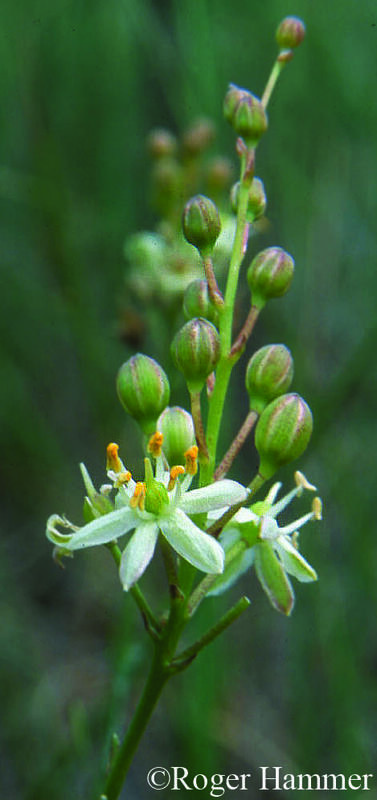
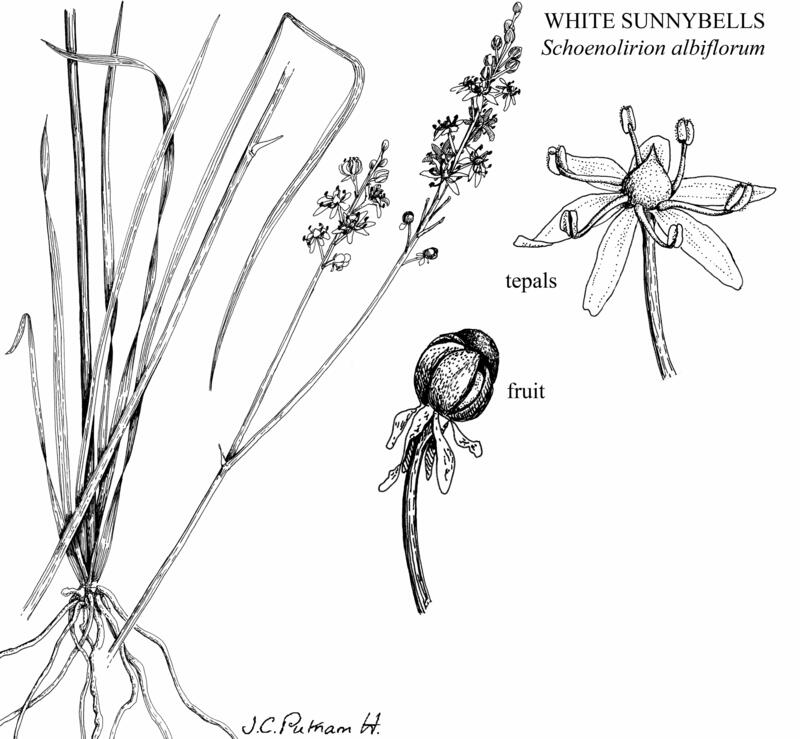
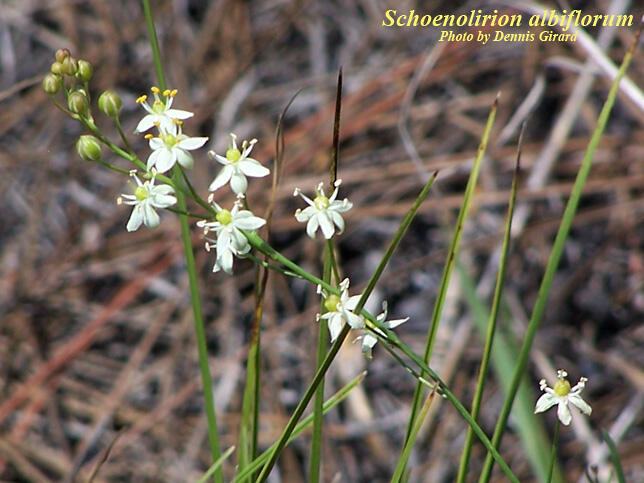
Perennial herb rising from a vertical, underground rhizome (not a bulb). The leaves are 10 - 28 inches (26 - 72 cm) long, and about 0.1 inch (2 - 4 mm) wide, shorter than the flower stalk, with a groove running the length of the blade; the leaf base is not fleshy; old, fibrous leaf bases persist at the base of the plant. The flower cluster is held at the top of a leafless stalk and has 1 - 6 branches. Flowers are less than 0.4 inch (1 cm) across, with a green ovary, 6 stamens, and 6 white tepals (3 petals + 3 sepals), each with a green stripe on the underside. Fruits are flattened, 3-lobed capsules with 1 - 2 seeds per lobe.
Texas Sunny-bells (Schoenolirion wrightii) occurs in Alabama and westward; it has fleshy leaf bases enclosing a bulb and white flowers in a narrow, unbranched cluster, with the flowers on short stalks.
Yellow sunny-bells (Schoenolirion croceum) resembles Texas Sunny-bells but has yellow flowers; it occurs mainly on and around Piedmont granite outcrops.
None in Georgia.
Coastal Plain wet pine or cypress savannas.
White Sunnybell is a perennial herb that reproduces sexually. Its flowers require cross-pollination to set fruit and produce seeds, and are visited by a variety of insects – bees, beetles, wasps, moths, and butterflies – but are most likely pollinated by solitary bees. The flowers reward pollinators with nectar. The upper, growing point of the rhizome, which produces the leaves and flower stalk, extends upward each year at the same time that the lower portion decays, thus maintaining an overall rhizome length of 2 - 3 inches (5 - 7.5 cm). Roots emerge from the top of the rhizome and are contractile, working like springs to pull the growing rhizome back underground and to anchor the plant in the soil.
Surveys are best conducted during flowering (late May–early June).
Georgia and Florida.
Conversion of habitat to pine plantations, pastures, and developments. Fire suppression, closure of canopy, and encroachment by woody plants.
| Threat 1 | Threat 2 | Threat 3 | |
|---|---|---|---|
| General Threat | Transportation & service corridors | Biological resource use | Human intrusions & disturbance |
| Specific Threat | None | None | None |
Schoenolirion albiflorum is ranked S1? by the Georgia Department of Natural Resources, indicating that the species is probably critically imperiled in Georgia but that additional survey work is needed. Four populations have been documented in Georgia since 1942, but only one has been confirmed since 2000; all populations occur on private lands.
Apply prescribed fire every 2 - 3 years to savannas and flatwoods. Avoid ditching, draining, use of soil-compacting equipment, and plowing firebreaks in wetlands. Prevent conversion of wet pine flatwoods to pine plantations, pastures, or other uses.
Chafin, L.G. 2007. Field guide to the rare plants of Georgia. State Botanical Garden of Georgia and University of Georgia Press, Athens.
Sherman, H.L. 2003. Species account for Schoenolirion albiflorum. Flora of North America, Vol. 26. Oxford University Press, New York. http://beta.floranorthamerica.org/Schoenolirion_albiflorum
GADNR. 2020. Element occurrence records for Schoenolirion albiflorum. Georgia Department of Natural Resources, Wildlife Resources Division, Social Circle, Georgia.
Godfrey, R.K. and J.W. Wooten. 1979. Aquatic and wetland plants of southeastern United States, vol. 1, monocotyledons. University of Georgia Press, Athens.
NatureServe. 2020. Species account for Schoenolirion albiflorum. NatureServe Explorer. NatureServe, Arlington, Virginia. https://explorer.natureserve.org/Taxon/ELEMENT_GLOBAL.2.150877/Schoenolirion_albiflorum
Nelson, G. 2006. Atlantic Coastal Plain wildflowers. Globe Pequot Press, Guilford, Connecticut.
Sherman, H.L. 1969. Systematic study of the genus Schoenolirion (Liliaceae). Ph.D. dissertation, Vanderbilt University, Nashville, Tennessee.
Weakley, A.S. 2015. Flora of the southern and mid-Atlantic States. University of North Carolina Herbarium, University of North Carolina, Chapel Hill. http://www.herbarium.unc.edu/flora.htm
Linda G. Chafin
L.Chafin, Aug. 2008: original account
D.Weiler, Jan. 2010: added pictures
L. Chafin, May 2020: updated original account.