


Loading profile. Please wait . . .
Quercus similis Ashe
Swamp Post Oak


Federal Protection: No US federal protection
State Protection: No Georgia state protection
Global Rank: G4
State Rank: S2?
Element Locations Tracked in Biotics: Yes
SWAP 2015 Species of Greatest Conservation Need (SGCN): Yes
SWAP 2025 Species of Greatest Conservation Need (SGCN): Yes
2025 SGCN Priority Tier: High Conservation Concern
Element Occurrences (EOs) in Georgia: 9
Habitat Summary for element in Georgia: Bottomland swamps and other wet habitats
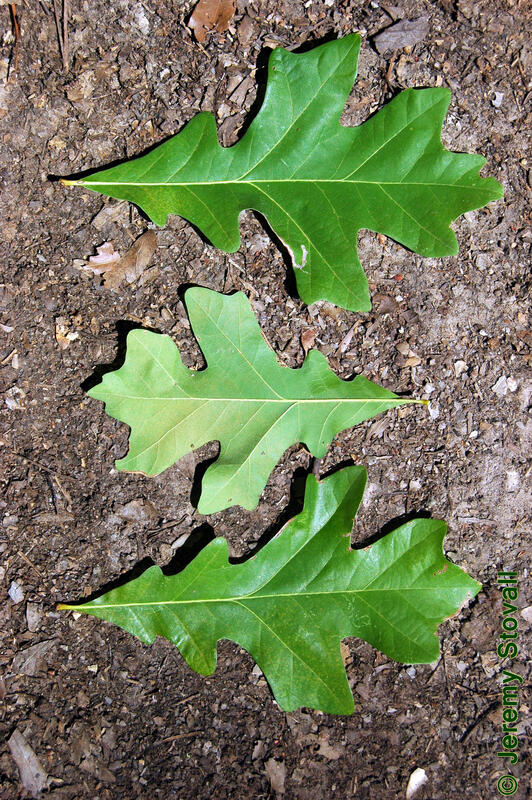
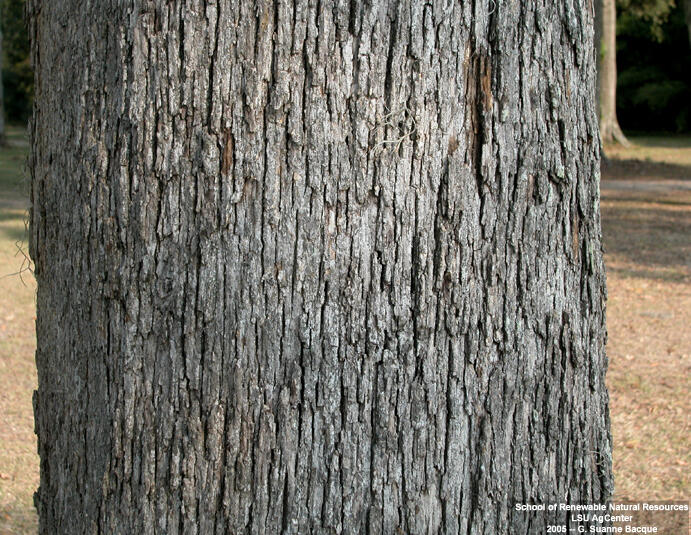
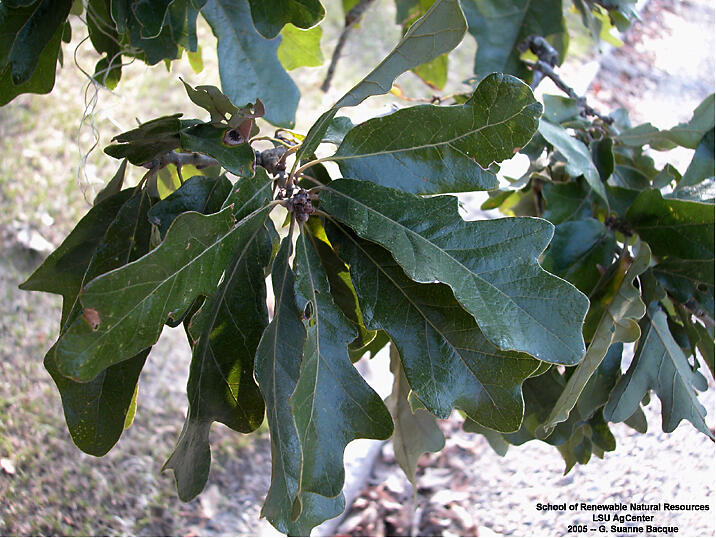
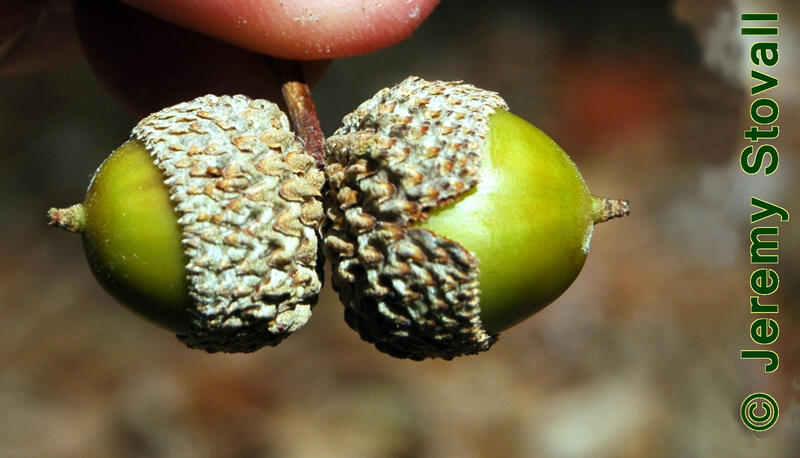
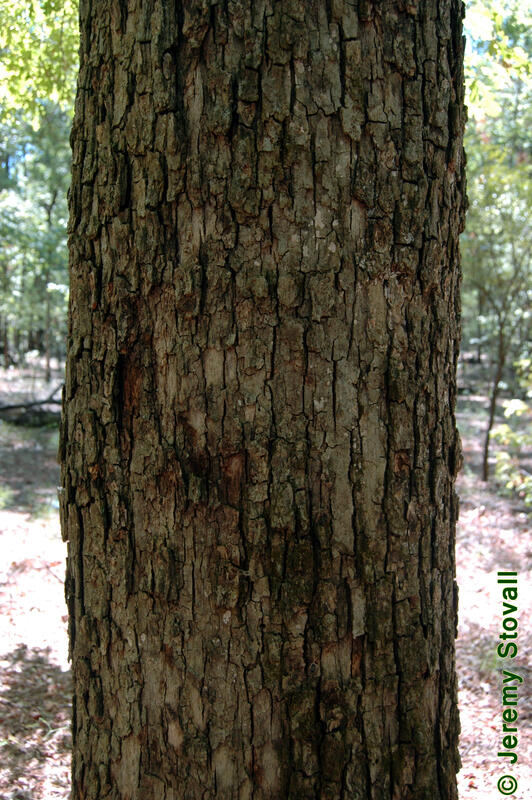
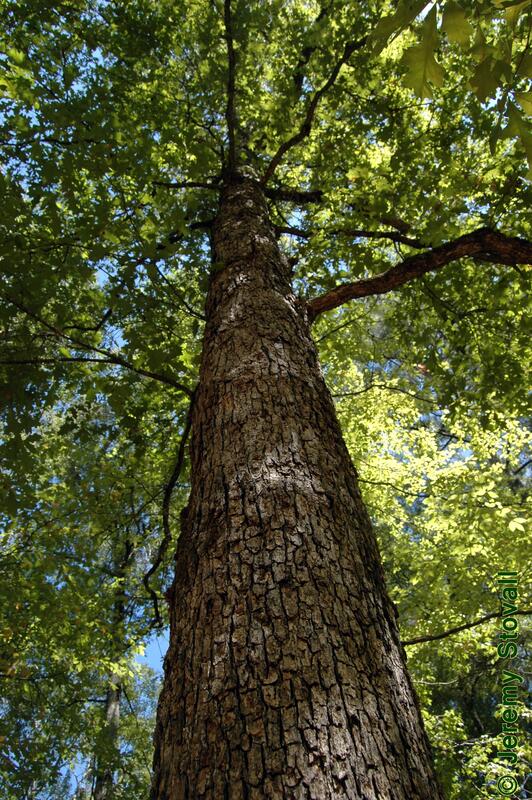
Tree up to 82 feet (25 meters) tall with a single, straight trunk; the bark is brownish-gray with long, narrow, flat ridges and shallow furrows. Twigs are grayish, densely covered with soft, branched hairs. Buds are brown, oval, about 0.1 inch (2 - 3 mm) long, clustered at the tips of twigs. Leaves are deciduous, 2 - 6 inches long and 2 - 3 inches wide (5 - 15 cm long, 5 - 8 cm wide), alternate, very variable in shape, with 2 - 4 blunt or rounded lobes on each side; the largest lobes are above the middle of the leaf, with the lobes tapering from base to tip and angled upwards relative to the midvein; the leaf base is bell- or wedge-shaped. The upper leaf surface is glossy and dark green; the lower leaf surface is grayish, with sparse hairs and glands. The leaf stalk is less than 0.4 inch (3 - 10 mm) long. The acorn cap is about 0.25 inch deep and 0.5 inch wide (0.6-0.7 cm deep and 1.0 - 1.3 cm wide), with grayish, closely appressed, finely hairy scales. The acorn nut is about 0.5 inch long and nearly as wide (1.2 - 1.6 cm long, 0.8 - 1.2 cm wide), light brown or dark reddish brown, oval or oblong. The acorn cap covers 1/3 – 1/2 of the nut.
Swamp Post Oak most closely resembles Overcup Oak (Quercus lyrata) with which it occurs in bottomland hardwood forests; both belong to the white oak subgenus. Swamp Post Oak leaf bases are bell-shaped (i.e. somewhat rounded) or wedge-shaped (i.e. short-tapering). Overcup Oak leaves have long-tapering, narrowly wedge-shaped bases. The lobes of Overcup Oak leaves have pointed, not blunt or rounded, tips. Overcup Oak twigs are hairy only in the early spring, quickly becoming smooth. Overcup Oak acorn caps cover 2/3 – 3/4 of the nut.
Swamp Post Oak was formerly considered a variety of Post Oak named Quercus stellata var. paludosa. Post Oak leaves are more or less cross-shaped with a large lobe on either side of, and at a 90-degree angle to, the midvein. There are usually smaller lobes both above and below the two largest lobes. Most of the lobes are more or less square-ish in shape, and the largest lobes are usually wider near the tips than at their bases. Post Oak is a common tree of dry uplands.
Eight other species of oak are rare in Georgia:
Quercus arkansana (Arkansas Oak) occurs on sandy upper ravine slopes in the upper Coastal Plain. For more information, see: http://beta.floranorthamerica.org/Quercus_arkansana
Quercus austrina (Bluff White Oak) occurs in the Coastal Plain in bluff forests, floodplain hammocks, and edges of Altamaha Grit outcrops. For more information, see: http://beta.floranorthamerica.org/Quercus_austrina
Quercus chapmanii (Chapman Oak) occurs on sand ridges and dunes in oak-pine scrub in the Coastal Plain. For more information, see: http://beta.floranorthamerica.org/Quercus_chapmanii
Quercus imbricaria (Shingle Oak) on sandy, moist, hardwood flats and headwater slopes in northwest Georgia. For more information, see: http://beta.floranorthamerica.org/Quercus_imbricaria
Quercus oglethorpensis (Oglethorpe Oak) occurs in Georgia’s eastern Piedmont in Broad River bottomlands and upland seepage swamps over Iredell or Enon soils with seasonally wet clay beds. For more information, see: https://georgiabiodiversity.org/portal/profile?group=plants&es_id=15988
Quercus palustris (Pin Oak) occurs in floodplain forests and margins of sag ponds in northwest Georgia. For more information, see: http://beta.floranorthamerica.org/Quercus_palustris
Quercus prinoides (Dwarf Chinquapin Oak) occurs in upland oak-hickory-pine forests, usually over basic soils in the Piedmont. For more information, see: http://beta.floranorthamerica.org/Quercus_prinoides
Quercus sinuata (Durand Oak) occurs in bluff forests and on calcareous slopes near streams in the upper Coastal Plain. For more information, see: http://beta.floranorthamerica.org/Quercus_sinuata
Seasonally flooded bottomlands and floodplain swamps on heavy, usually calcareous, loamy or clayey soils.
Swamp Post Oak is in the “white oak” sub-genus and has the suite of traits that characterize all white oaks: rounded leaf lobes, no bristles on the tips of the leaf lobes, and acorns that mature in one year. All oaks, whether white or red, are monoecious: their female and male reproductive organs are held in separate flowers on the same tree. Swamp Post Oak’s tiny female flowers develop in the leaf axils of this year’s twigs and are easily mistaken for a leaf bud; they consist of a minute ovary topped with a reddish, three-lobed stigma, with a total length of about 0.1 inch (3 mm). Since female flowers typically form in the upper half of the tree’s crown, they are seldom seen. Male flowers are held on slender, dangling catkins that develop near the tips of last year’s twigs; the flowers consist mostly of pollen-bearing stamens and are yellowish-green. Pollen is dispersed by the wind and, to minimize self-pollination, the female flowers open about a week after the male flowers begin shedding pollen. Only cross-pollinated flowers will produce acorns, which in white oaks mature in the summer and germinate later that fall (as compared to red oak acorns, which take two growing seasons to mature). Because white oak acorns remain on the tree for only one season, they accumulate fewer tannins than do red oak acorns and are less bitter. White oaks, such as Swamp Post Oak, are extremely valuable to wildlife. The leaves support hundreds of butterfly, moth, and wasp larvae and the “sweet,” low-tannin acorns are eaten by a wide range of birds and mammals. Many mammals use oak tree cavities as dens.
Swamp Post Oak is most easily identified during the summer, when bark, leaves, twigs, and possibly acorns, are available. Swamp Post Oak may be difficult to separate from Overcup Oak, its closest look-alike and with which it grows, during the winter. Their bark is similar and their fallen leaves and acorns become intermixed on the ground.
Georgia and South Carolina, west to Texas and Arkansas.
Many of the floodplain and bottomland forests that support Swamp Post Oak have been severely degraded or destroyed over the previous century by reservoir construction, channelization, logging, and conversion to agriculture and silviculture. Many have been invaded by Chinese Privet, preventing reproduction and establishment of canopy trees such as Swamp Post Oak.
| Threat 1 | Threat 2 | Threat 3 | |
|---|---|---|---|
| General Threat | Agriculture & aquaculture | Natural system modifications | Invasive & other problematic species, genes & diseases |
| Specific Threat | Wood & pulp plantations | Other ecosystem modifications | Invasive non-native/alien species/diseases |
Quercus similis is ranked S2? by the Georgia Department of Natural Resources, indicating that it is probably imperiled in the state but that more information is needed to make a definitive ranking. At least 10 populations have been observed in 6 counties throughout Georgia in the last 20 years. Four of these are on state-owned wildlife management areas.
Protect floodplain and bottomland hardwood forests from logging, inundation, and residential, agricultural, and silvicultural conversion. Eradicate Chinese Privet and other exotic pest plants from floodplains and bottomlands.
GADNR. 2019. Element occurrence records for Quercus similis. Georgia Department of Natural Resources, Wildlife Resources Division. Social Circle, Georgia.
Nixon, K.C. 1997. Species account for Quercus similis. Flora of North America North of Mexico, vol. 3. http://beta.floranorthamerica.org/Quercus_similis
NatureServe. 2019. Species account for Quercus similis. NatureServe Explorer. NatureServe, Arlington, Virginia. https://explorer.natureserve.org/Taxon/ELEMENT_GLOBAL.2.156620/Quercus_similis
Mercker, D., J. Franklin, and L. Tankersley. How do acorns develop? University of Tennessee Institute of Agriculture, Bulletin 06-0318. https://extension.tennessee.edu › publications › Documents
Weakley, A.S. 2015. Flora of the southern and mid-Atlantic States. University of North Carolina Herbarium, University of North Carolina, Chapel Hill. http://www.herbarium.unc.edu/flora.htm
Linda G. Chafin
Linda G. Chafin, 23 November 2019: original account