



Loading profile. Please wait . . .
Isoetes flaccida Shuttlw. ex A. Braun
Florida Quillwort


Federal Protection: No US federal protection
State Protection: No Georgia state protection
Global Rank: G3
State Rank: S2?
Element Locations Tracked in Biotics: Yes
SWAP 2015 Species of Greatest Conservation Need (SGCN): Yes
SWAP 2025 Species of Greatest Conservation Need (SGCN): Yes
2025 SGCN Priority Tier: High Conservation Concern
Element Occurrences (EOs) in Georgia: 2
Habitat Summary for element in Georgia: Shaded pond margins, cypress swamps, open miry places; margins of sluggish pineland streams often with cypress
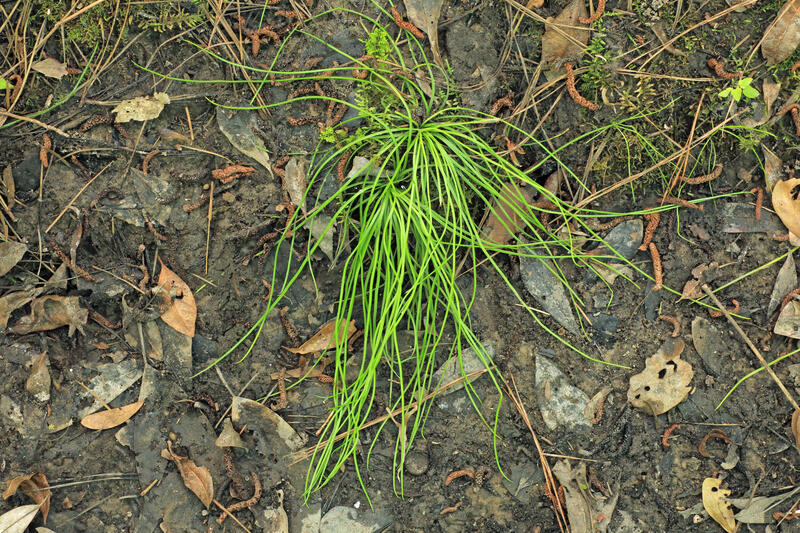
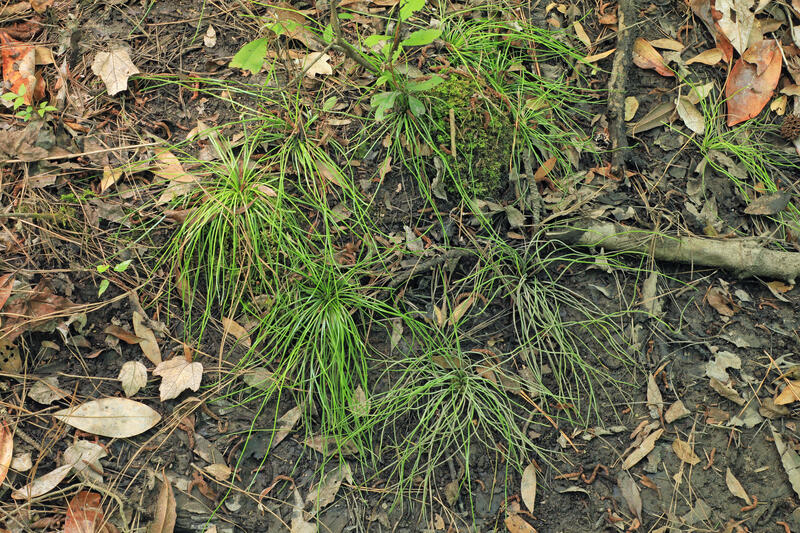
Perennial, non-flowering, grass-like, evergreen herb, forming tufts of leaves. Rootstock (corm) brown, rounded, with two (occasionally 3 or 4) lobes and forked roots emerging from the base. Leaves 10 - 35 per plant, 4 - 24 inches (10 - 60 cm) long, gradually tapering to the tip, bright green with a pale base, pliable and lax, sprawling across the soil when not submerged. Spores are produced in a sporangium, a chamber less than 0.2 inch (5 mm) long that is embedded in the leaf base; the opening to the sporangium is entirely covered with a transparent membrane (velum). The sporangium contains many white female spores (megaspores), approximately 0.3 - 0.5 mm across and covered with a dense pattern of bumps and ridges which may be seen with 30x magnification. Much smaller, brown male spores (microspores) are produced on separate leaves of the same plant but are indistinguishable without higher magnification.
Quillworts are distinguished from flowering, wetland plants by their somewhat spongy leaves with conspicuous cross-walls and by the presence of sporangia in the flared base of the leaves. There are about 15 species of Isoetes in Georgia. Isoetes flaccida is distinguished by its location (Coastal Plain only), habitat (submerged or emergent at the edges and bottoms of streams, springs, and wet ditches), leaves (longer than most other quillworts and noticeably lax and floppy), and megasporangia (not colored or streaked on the inner surface, with a velum entirely covering the opening into the chamber), and megaspores (white).
Two other common species have long, lax leaves:
Piedmont Quillwort (Isoetes piedmontana) leaves have dark bases and the sporangium opening is only partially covered by the velum. It occurs only on granite and Altamaha Grit outcrops in muddy seeps.
Engelmann's quillwort (Isoetes engelmannii) also has bright green leaves with pale bases. Its velum covers 30 - 60% of the sporangium opening. It usually occurs in flowing water.
Isoetes appalachiana (Appalachian Quillwort) occurs in seepages, small woodland streams, ephemeral wetlands, and backwaters in northwest Georgia.
Isoetes boomii (Boom's Quillwort) occurs in shallow water of slow moving streams in the Coastal Plain. For more information, see: https://georgiabiodiversity.org/portal/profile.html?group=plants&es_id=17134&fus_tab_id=1HsRRHkW2qqMS1MunY5KMrvThVR_5C8sAX2-pFapk&group=plant
Isoetes butleri (Glade Quillwort) occurs in shallow pools and seeps on limestone glades in northwest Georgia. For more information, see: http://beta.floranorthamerica.org/Iso%C3%ABtes_butleri
Isoetes georgiana (Georgia Quillwort) occurs in floodplain woods on seasonally wet or inundated margins of braided streams in the Coastal Plain. For more information, see: https://georgiabiodiversity.org/portal/profile.html?group=plants&es_id=16950&fus_tab_id=1HsRRHkW2qqMS1MunY5KMrvThVR_5C8sAX2-pFapk&group=plant
Isoetes hyemalis (Winter Quillwort) occurs on sandy blackwater creek banks and in swamps in the Coastal Plain. For more information, see: https://georgiabiodiversity.org/portal/profile.html?group=plants&es_id=17363&fus_tab_id=1HsRRHkW2qqMS1MunY5KMrvThVR_5C8sAX2-pFapk&group=plant
Isoetes junciformis (Rush Quillwort) occurs in seasonally flooded pools in floodplains in the Coastal Plain. For more information, see: https://georgiabiodiversity.org/portal/profile.html?group=plants&es_id=18998&fus_tab_id=1HsRRHkW2qqMS1MunY5KMrvThVR_5C8sAX2-pFapk&group=plant
Isoetes melanopoda (Black-footed Quillwort) occurs in swampy woods in northwest Georgia, Altamaha Grit outcrops in the Coastal Plain, and granite outcrop seeps in the Piedmont. For more information, see: http://beta.floranorthamerica.org/Iso%C3%ABtes_melanopoda
Isoetes melanospora (Black-spored Quillwort) occurs in ephemeral pools on Piedmont granite outcrops. For more information, see: https://georgiabiodiversity.org/portal/profile.html?group=plants&es_id=22510&fus_tab_id=1HsRRHkW2qqMS1MunY5KMrvThVR_5C8sAX2-pFapk&group=plant
Isoetes “snowii” occurs in the Coastal Plain on Altamaha Grit outcrops. It has not been officially named as of 2019.
Isoetes tegetiformans (Mat-forming Quillwort) occurs in ephemeral pools on Piedmont granite outcrops. For more information, see: https://georgiabiodiversity.org/portal/profile.html?group=plants&es_id=20422&fus_tab_id=1HsRRHkW2qqMS1MunY5KMrvThVR_5C8sAX2-pFapk&group=plant
Isoetes valida (Mountain Bog Quillwort) occurs in mountain bogs in northeast Georgia, dried creek beds in northwest Georgia, and a Piedmont pond. For more information, see: https://explorer.natureserve.org/Taxon/ELEMENT_GLOBAL.2.141084/Isoetes_valida AND https://www.jstor.org/stable/1547604?origin=crossref&seq=1#metadata_info_tab_contents
Isoetes flaccida is rooted in clear, sand-bottomed, natural ponds; in wet soils on the edges of blackwater streams and rivers; and, in brackish silts at the mouths of coastal rivers. Plants may be emergent or submerged for long periods.
Quillworts are seedless, non-flowering plants that look like tufts of grass. They have a short, fleshy, rootstock called a corm, stock, or rhizome; leaves are produced in a close spiral on the upper surface of the corm, roots on the lower surface. The leaves wither during dry periods on exposed plants; however, the corm remains alive and will begin to produce leaves when there is adequate water.
The outer and lowest leaves of quillworts are sterile; all other leaves are fertile and produce spores (and technically are called sporophylls). Quillworts produce two different kind of spores: relatively large megaspores (female) and very much smaller microspores (male). These are produced on different leaves on the same plant in small chambers called sporangia. The spores are freed from the chamber when the leaf decays, and they quickly develop into gametophytes. Megaspores develop egg-producing gametophytes; microspores develop sperm-producing gametophytes. Sperm swim to the eggs in available water and unite with an egg to form an embryo which develops into a new plant. Some Isoetes species reproduce vegetatively by buds developing on the corm.
Quillworts compete poorly with other aquatic plants and are typically found in relatively sterile sand or silt or in frequently submerged sites that support few other vascular plants.
Surveys are best conducted during summer and early fall when Florida Quillwort produces spores since traits of the sporangia, especially the extent of the velum coverage, are diagnostic.
Florida Quillwort occurs in Georgia, Florida, and Alabama. In Georgia, it occurs in 10 Coastal Plain counties.
Isoetes flaccida is threatened by hydrological changes that affect water levels in streams and by excessive withdrawals from the Floridan Aquifer. Sedimentation and pollution of streams are also a threat. Changes in hydrology due to altered temperature and rainfall patterns related to climate change are likely to negatively effect this species.
| Threat 1 | Threat 2 | Threat 3 | |
|---|---|---|---|
| General Threat | Natural system modifications | Climate change & severe weather | None |
| Specific Threat | None | None | None |
Isoetes flaccida is ranked S2? by the Georgia Department of Natural Resources, indicating that it may be imperiled in the state but that insufficient evidence is currently available to make a definite ranking. Only one population has been documented in this century. About a dozen more were seen between 1901 and 1982, but their current status is unknown.
Survey for and relocate historic populations. Protect aquifers from excessive withdrawal and pollution. Protect streams from damming, sedimentation, and pollution.
Biology Discussion. 2019. Isoetes: Structure and Reproduction. http://www.biologydiscussion.com/botany/pteridophyta/isoetes-structure-and-reproduction/46051
GADNR. 2019. Element occurrence records for Isoetes flaccida. Georgia Department of Natural Resources, Wildlife Resources Division. Social Circle, Georgia.
NatureServe. 2020. Species account for Isoetes flaccida. NatureServe Explorer: an online encyclopedia of life, Version 7.1. NatureServe, Arlington, Virginia. http://explorer.natureserve.org/servlet/NatureServe?searchName=Isoetes+flaccida
Taylor, W.C., N.T. Luebke, D.M. Britton, R.J. Hickey, and D.F. Brunton. 1993. Species account for Isoetes flaccida. Flora of North America North of Mexico, vol. 2. http://beta.floranorthamerica.org/Iso%C3%ABtes_flaccida
Weakley, A.S. 2015. Flora of the southern and mid-Atlantic States. University of North Carolina Herbarium, University of North Carolina, Chapel Hill. http://www.herbarium.unc.edu/flora.htm
Linda G. Chafin
Linda G. Chafin, 11 November 2019: original account