


Loading profile. Please wait . . .
Zephyranthes simpsonii Chapman
Simpson's Rain Lily


Federal Protection: No US federal protection
State Protection: No Georgia state protection
Global Rank: G2G3
State Rank: S1
Element Locations Tracked in Biotics: Yes
SWAP 2015 Species of Greatest Conservation Need (SGCN): No
SWAP 2025 Species of Greatest Conservation Need (SGCN): Yes
2025 SGCN Priority Tier: Highest Conservation Concern
Element Occurrences (EOs) in Georgia: 29
Habitat Summary for element in Georgia: Pine flatwoods; edges of sloughs on southcentral coastal plain
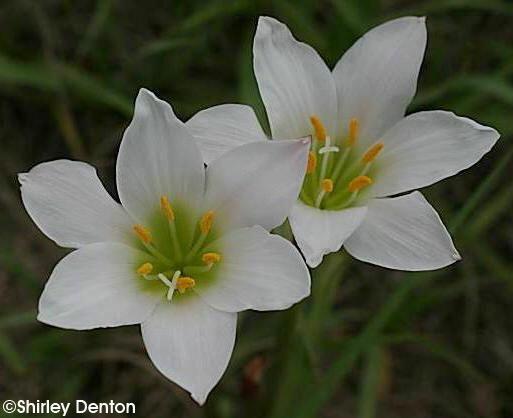
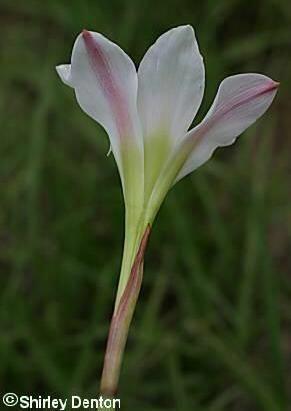
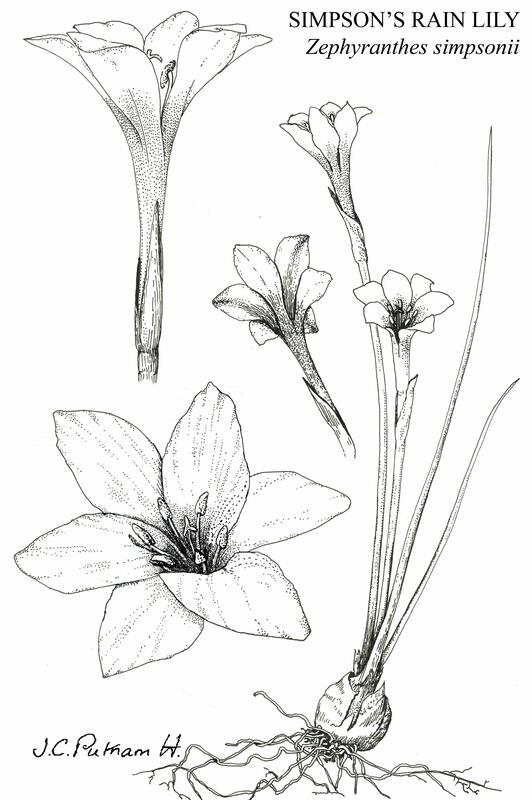
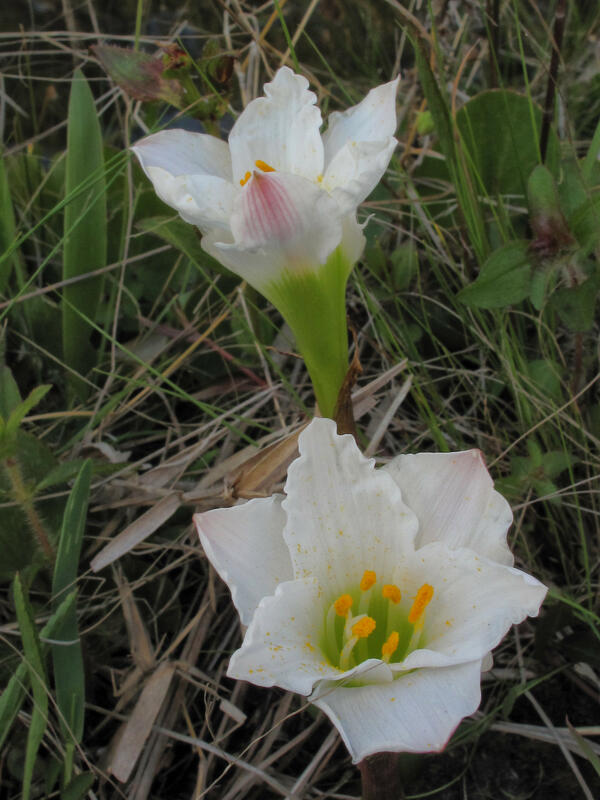
Perennial herb with an underground bulb, often growing in clumps or in large patches. The leaves are grass-like, slightly fleshy, up to 12 inches (30 cm) long and less than 0.1 inch (2 mm) wide, dull green and sometimes tinged with red, with smooth margins. The flower stalk is hollow, round or flattened in cross-section, 4 - 12 inches (10 - 30 cm) tall. Flowers are 1.6 - 4 inches (4 - 10 cm) long, narrowly funnel-shaped, with 6 erect or slightly flaring tepals (3 petals + 3 sepals) that are white, often tinted with pink, sometimes turning pinkish-purple with age; the tubular section of the flower is green and usually more than ⅓ of the total length of the flower; the stigmas are at more-or-less the same level as the anthers; the base of the flower is surrounded by a tubular, reddish-brown bract (spathe) that is divided at the top. Fruits are 3-lobed capsules with shiny, flat, black seeds.
Rain-lily (Zephyranthes atamasco) occurs throughout Georgia in bottomlands, seepy granite outcrop margins, and low roadsides. Its leaves are larger, up to 15 inches (38 cm) long and 0.4 inch (1 cm) wide and shiny green; the flowers are white, seldom pink-tinged, and the stamens are more than 2 mm shorter than the stigma; the tubular section of the flower is less than ⅓ of the total length of the flower, and the tepal tips are curved out and down.
Treat's Rain-lily (Zephyranthes treatiae) occurs in wet savannas in south Georgia. Its leaves are wider, up to 4 mm wide. The pink or white tepals are curved out and down, the stamens are more than 2 mm shorter than the stigmas, and the tubular section of the flower is ¼ or more of the total length of the flower.
None in Georgia.
Pine flatwoods, wet savannas, low pastures and roadsides through these habitats.
Little has been published about the life history of this species, but its flowers are known to be pollinated by bees and hawkmoths. Pollination studies of other Zephyranthes species have shown that the flowers produce viable seeds after both self- and cross-pollination; the position of the pollen-bearing anthers at about the same level as the stigmas in Z. simpsonii suggests that is the case with this species as well.
Surveys are best conducted during flowering (February–April).
Georgia, Florida, South Carolina, and North Carolina.
Fire suppression, conversion of habitat to pine plantations and agricultural fields; ditching, draining, and filling wetlands.
| Threat 1 | Threat 2 | Threat 3 | |
|---|---|---|---|
| General Threat | Transportation & Service Corridors | Residential & commercial development | Natural system modifications |
| Specific Threat | None | None | None |
Zephyranthes simpsonii is ranked S1 by the Georgia Department of Natural Resources, indicating that the species is critically imperiled in Georgia. Several populations are known on state conservation lands in southeast Georgia.
Apply prescribed fire to flatwoods and savannas every 2 - 3 years during the growing season. Avoid placing roads and firebreaks through these habitats. Avoid ditching, draining, and filling wetlands. Protect flatwoods and savannas from development and conversion to pine plantations.
Adams, L.D., S. Buchmann, A.D. Howell, and J. Tsang. 2010. A study of insect pollinators associated with DoD TER-S flowering plants, including identification of habitat types where they co-occur, by military installation in the southeastern United States. Department of Defense Legacy Program, Arlington, Virginia. https://scholar.google.com/scholar?cluster=5836591538748705721&hl=en&as_sdt=0,11
Broyles, S.B. and R. Wyatt. 1991. The breeding system of Zephyranthes atamasco (Amaryllidaceae). Bulletin of the Torrey Botanical Club 118(2): 137-140. https://www.jstor.org/stable/2996854
Flagg, R.O. and G.L. Smith. 2008. Delineation and distribution of Zephyranthes species (Amaryllidaceae) endemic to the southeastern United States. Castanea 73(3): 216-227. https://bioone.org/journals/castanea/volume-73/issue-3/07-23.1/Delineation-and-Distribution-of-span-classgenus-speciesZephyranthes-span-Species-amaryllidaceae/10.2179/07-23.1.short
Flagg, R.O., G.L. Smith, and W.S. Flory. Zephyranthes simpsonii species account. Flora of North America. http://beta.floranorthamerica.org/Zephyranthes_simpsonii
GADNR. 2020. Element occurrence records for Zephyranthes simpsonii. Georgia Department of Natural Resources, Wildlife Resources Division, Social Circle, Georgia.
Godfrey, R.K. and J.W. Wooten. 1979. Aquatic and wetland plants of the southeastern United States, Vol. 1, monocotyledons. University of Georgia Press, Athens.
Grant, V. 1983. The systematic and geographical distribution of hawkmoth flowers in the temperate North American flora. Botanical Gazette 144(3): 439-449. https://www.journals.uchicago.edu/doi/pdfplus/10.1086/337395
Kral, R. 1983. A report on some rare, threatened, or endangered forest- related vascular plants of the South. Technical Publication R8-TP2. United States Forest Service, Atlanta.
Langdon, K.R. 1983. Simpson’s zephyr lily, Zephyranthes simpsonii, an endangered species. Botany Circular 20. Florida Department of Agriculture and Consumer Services, Gainesville. https://tinyurl.com/y4obkpo4
NatureServe. 2020. Zephyranthes simpsonii species account. NatureServe Explorer. Arlington, Virginia. https://explorer.natureserve.org/Taxon/ELEMENT_GLOBAL.2.138288/Zephyranthes_simpsonii
Radford, A.E., H.E. Ahles, and C.R. Bell. 1968. Manual of the vascular flora of the Carolinas. University of North Carolina Press, Chapel Hill.
Weakley, A.S. 2015. Flora of the southern and mid-Atlantic States. University of North Carolina Herbarium, University of North Carolina, Chapel Hill. http://www.herbarium.unc.edu/flora.htm
Linda G. Chafin
L.Chafin, Oct. 2007: original account
D.Weiler, Jan. 2010: updated status and ranks, added pictures
Z. Abouhamdan, April 2016: updated link.
L. Chafin, June 2020: updated original account.