


Loading profile. Please wait . . .
Rhexia aristosa Britton
Awned Meadowbeauty


Federal Protection: No US federal protection
State Protection: No Georgia state protection
Global Rank: G3G4
State Rank: S2
Element Locations Tracked in Biotics: Yes
SWAP 2015 Species of Greatest Conservation Need (SGCN): Yes
SWAP 2025 Species of Greatest Conservation Need (SGCN): Yes
2025 SGCN Priority Tier: High Conservation Concern
Element Occurrences (EOs) in Georgia: 38
Habitat Summary for element in Georgia: Pond margins and wet savannas
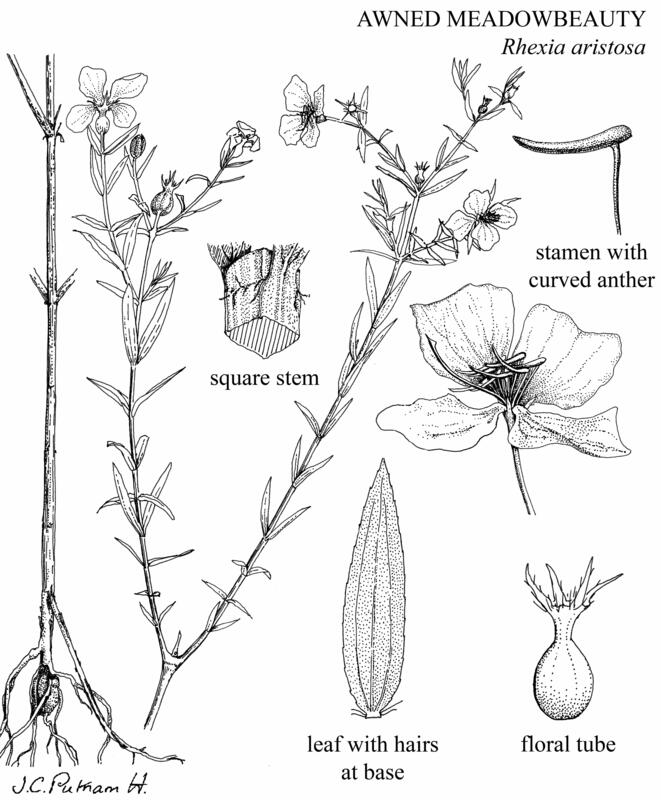
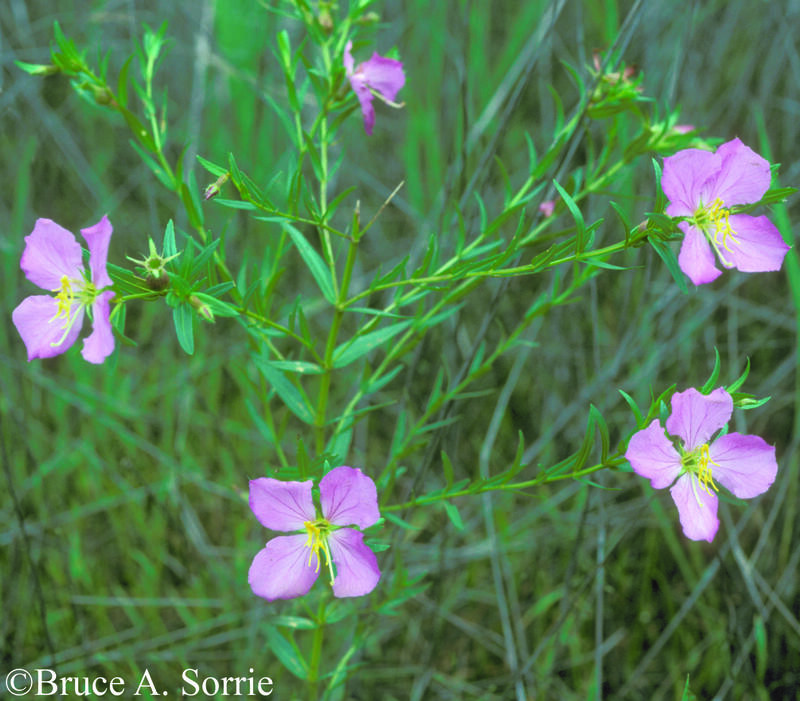
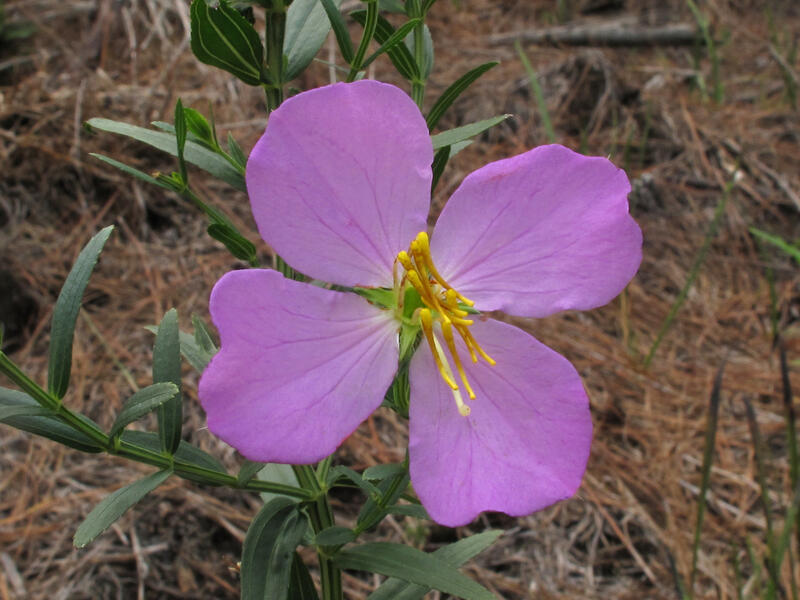
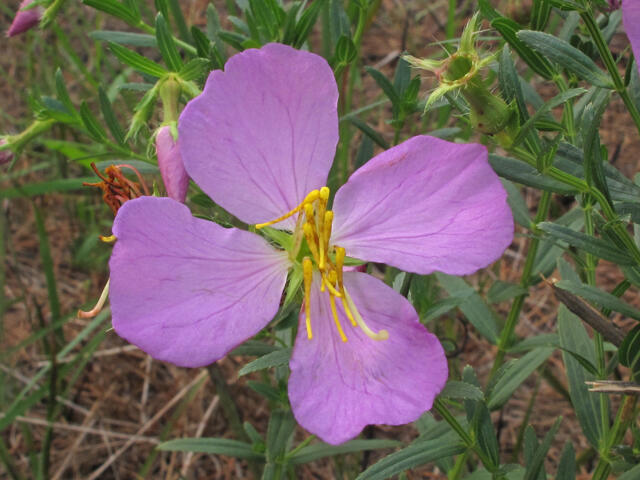
Perennial herb with underground tubers. The stem is 16 - 28 inches (40 - 70 cm) tall, rigidly erect, much-branched, with a spongy, thickened base; the stem is 4-sided, each side about the same width, and the angles are often narrowly winged. Leaves are about 1 inch (2 - 3 cm) long and 0.5 inch (1.3 cm) wide, bright green, lance-shaped, opposite, angled strongly upward, with hairs at the base, 3 conspicuous veins, and finely toothed, hair-tipped margins. The flowers have 4 deep pink petals and 8 stamens with yellow, curving anthers. The base of the flower is enclosed by a small, vase-shaped floral tube that has stiff, yellowish hairs concentrated around its neck and 4 triangular calyx segments at the top, each segment tipped with a bristle. The fruit is enclosed in the floral tube, which expands to about 0.4 inch (1 cm) long when mature; the seeds are tiny, curved and marked like a snail shell.
West Indies Meadowbeauty (Rhexia cubensis), Maryland Meadowbeauty (R. mariana), and Hairy Meadowbeauty (R. nashii) stems have unequal sides: 2 sides are wider, dark green, and rounded; 2 other sides are narrow, light green, and flat.
Nuttall’s Meadowbeauty (Rhexia nuttallii, Georgia Special Concern) occurs in wet pine flatwoods and bogs in southeast Georgia. For more information, see: https://explorer.natureserve.org/Taxon/ELEMENT_GLOBAL.2.156835/Rhexia_nuttallii
Small-flowered White Meadowbeauty (Rhexia parviflora, Georgia Special Concern) occurs in the margins of limesink ponds in southwest Georgia. For more information, see: https://www.fnai.org/FieldGuide/pdf/Rhexia_parviflora.pdf
Panhandle Meadow-beauty (Rhexia salicifolia, Georgia Special Concern) occurs in the drawdown zones of sandhill depression ponds in the Coastal Plain. For more information, see: https://www.georgiabiodiversity.org/portal/profile?group=plants&es_id=33515
Limesink and depression ponds, Carolina bays, wet savannas.
Awned Meadowbeauty is a perennial herb that reproduces both sexually by seed and vegetatively by the spread of rhizomes and sprouting from tubers. Its flowers are pollinated by bumblebees. The bright yellow anthers (the pollen-bearing structures in the flower) are curved and appear to be hinged at the junction with the stamen’s filament, or stalk. Bees grasp the anther and “buzz” it, causing pollen to shake from a tiny pore at the tip of the anther. Seeds are released from a pore at the top of the fruit (mature floral tube) – the fruit does not otherwise open – and are dispersed by gravity, water, and waterfowl. The seeds of Awned Meadowbeauty remain in the soil seed bank for years, and germinate when fire or receding water levels expose bare soil.
Surveys are best conducted during flowering (June–July).
Georgia, Alabama, South Carolina, North Carolina, Delaware, New Jersey. It is rare throughout its range.
Lowering of the groundwater table by excessive withdrawal for irrigation and urban uses; draining and filling of ponds and savannas; conversion of habitat to pine plantations; fire suppression.
| Threat 1 | Threat 2 | Threat 3 | |
|---|---|---|---|
| General Threat | Natural system modifications | Invasive & other problematic species, genes & diseases | Pollution |
| Specific Threat | None | None | None |
Rhexia aristosa is ranked S2 by the Georgia Department of Natural Resources, indicating that it is imperiled in Georgia. Documented from 30 sites, only 11 populations of Rhexia aristosa have been seen recently in Georgia, most on a single conservation area. Population sizes fluctuate widely, depending on water levels in ponds.
Prevent conversion of habitat to pastures, pine plantations, or agriculture. Prevent altering the hydrology of isolated wetlands by avoiding ditching, draining, and filling. Allow fire in surrounding uplands to burn into and across ponds and wetlands; avoid placing firebreaks in pond margins. Avoid soil compaction and disturbances to ground cover in isolated wetlands. Limit withdrawal from Floridan aquifer.
Britton, N.L. 1890. A new species of Rhexia. Bulletin of the Torrey Botanical Club 17(1): 14-15. https://www.jstor.org/stable/pdf/2476826.pdf?refreqid=excelsior% 3A33f17b2aef1e68061b4e99fee1952ac6
Chafin, L.G. 2007. Field guide to the rare plants of Georgia. State Botanical Garden of Georgia and University of Georgia Press, Athens.
GADNR. 2020. Element occurrence records for Rhexia aristosa. Georgia Department of Natural Resources, Wildlife Resources Division, Social Circle, Georgia.
Godfrey, R.K. and J.W. Wooten. 1981. Aquatic and wetland plants of southeastern United States, Vol. 2, dicotyledons. University of Georgia Press, Athens.
Kral, R. and P.E. Bostick. 1969. The genus Rhexia (Melastomataceae). Sida 3(6): 387-440. https://www.jstor.org/stable/41966381?seq=1#metadata_info_tab_contents
NatureServe. 2019. Rhexia aristosa comprehensive report. NatureServe Explorer. Arlington, Virginia. http://explorer.natureserve.org/servlet/NatureServe?searchName=Rhexia+aristosa
Radford, A.E., H.E. Ahles, and C.R. Bell. 1968. Manual of the vascular flora of the Carolinas. University of North Carolina Press, Chapel Hill.
Thunhorst, G.A. 1995. The seed bank as a buffer to change in population size, distribution, and genetic composition in the rare plant Rhexia aristosa at Antioch Church Bay with implications for conservation. Master's Thesis, University of North Carolina, Chapel Hill.
Weakley, A.S. 2015. Flora of the southern and mid-Atlantic States. University of North Carolina Herbarium, University of North Carolina, Chapel Hill. http://www.herbarium.unc.edu/flora.htm
Linda G. Chafin
L. Chafin, Jul. 2008: original account
K. Owers, Feb. 2010: added pictures
L. Chafin, Mar. 2020: updated original account