



Loading profile. Please wait . . .
Aureolaria patula (Chapman) Pennell
Cumberland Oak-leech


Federal Protection: No US federal protection
State Protection: Threatened
Global Rank: G3
State Rank: S1
Element Locations Tracked in Biotics: Yes
SWAP 2015 Species of Greatest Conservation Need (SGCN): Yes
SWAP 2025 Species of Greatest Conservation Need (SGCN): Yes
2025 SGCN Priority Tier: High Conservation Concern
Element Occurrences (EOs) in Georgia: 10
Habitat Summary for element in Georgia: Circumneutral alluvial bottoms
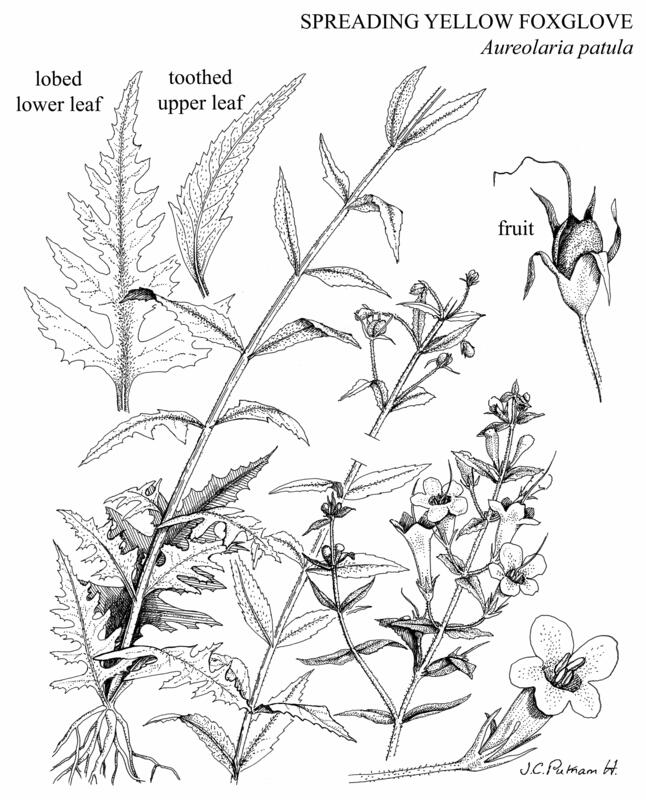
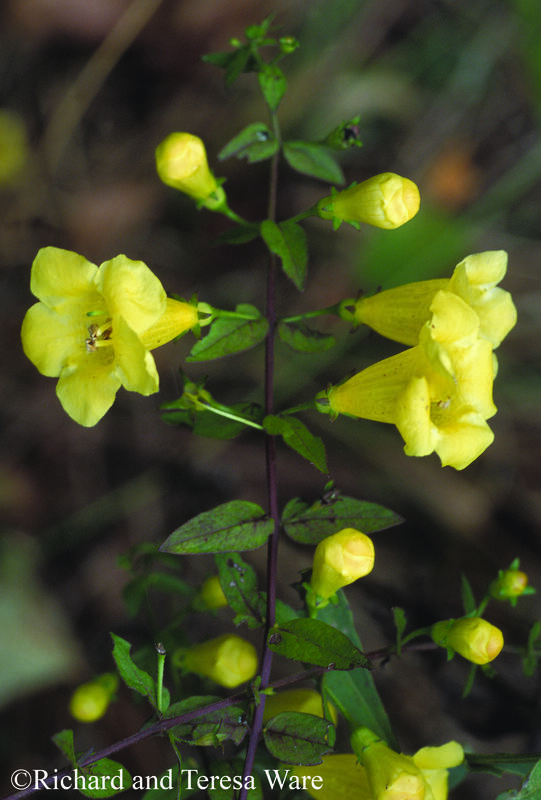
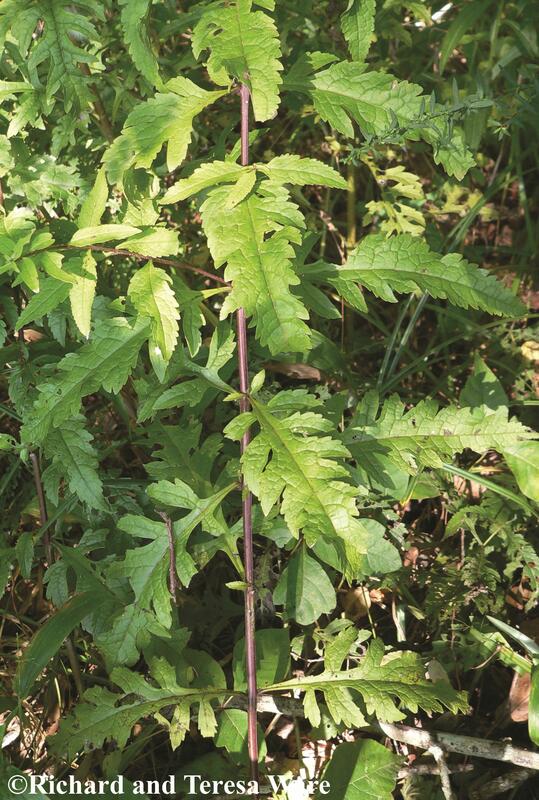
Perennial herb 3 - 4 feet (1 - 1.2 meters) tall, parasitic on the roots of oaks. Stems are green tinged with reddish-purple and lean on other plants, sprawl on the ground, or stand erect. Leaves are opposite, mostly hairless except on veins; mid- and lower stem leaves are 5 - 8 inches (13 - 20 cm) long, deeply lobed and toothed, and taper to a narrow wing on the leaf stalk; upper leaves are smaller, lance-shaped, and toothed. Flowers are up to 1.4 inches (3 - 3.5 cm) long, yellow, with a funnel-shaped tube and 5 spreading petals; the flower stalk is 0.5 - 1 inch (1.2 - 2.5 cm) long and less than 0.5 mm thick. Flower, sepals, and flower stalk are covered with tiny, soft hairs. Fruit is oval, hairless, about 0.2 inch (5 - 6 mm) long, on a stalk 0.5 - 1 inch long.
False-foxglove (Aureolaria laevigata) leaves have only a few teeth and are not deeply lobed.
Downy false-foxglove (Aureolaria virginica) has hairy fruit; it flowers May–July.
Smooth false-foxglove (Aureolaria flava) is mostly hairless; its flower stalks curve strongly upward.
All of these species have shorter (about 0.3 inch or 8 mm long) and thicker (about 1.5 mm) flower stalks.
Aureolaria pedicularia (Annual Oak Leach) occurs in oak woodlands and forests in northeast Georgia. For more information, see: https://www.illinoiswildflowers.info/savanna/plants/fernleaf_foxglove.htm AND http://explorer.natureserve.org/servlet/NatureServe?searchName=Aureolaria%20pedicularia
Coosa Valley flatwoods with moist, calcium-rich soil and low, streamside forests over circumneutral soils.
Spreading Yellow Foxglove is a hemiparasite – its leaves and stem have chlorophyll and photosynthesize, but it also parasitizes other plants to extract water and nutrients by means of haustoria (tiny, root-like organs that embed into the roots of host plants). Known host plants of Spreading Yellow Foxglove include Sweet Gum (Liquidambar styraciflua), Red Bud (Cercis canadensis), Ironwood (Carpinus caroliniana), and Flowering Dogwood (Cornus florida). Spreading Yellow Foxglove is self-incompatible and relies on bumblebees and other insects to effect cross-pollination.
Surveys are best conducted during flowering (August–October) and fruiting (September–October)
Georgia, Alabama, Tennessee, and Kentucky.
Clearcutting in lowland forests, stream impoundment, cattle grazing, overbrowsing by deer, and invasion by exotic pest plants such as Chinese Privet and Japanese Honeysuckle.
| Threat 1 | Threat 2 | Threat 3 | |
|---|---|---|---|
| General Threat | Energy production & mining | Transportation & service corridors | Biological resource use |
| Specific Threat | None | None | None |
Aureolaria patula is ranked S1? by the Georgia Department of Natural Resources, indicating that the species is probably critically imperiled in the state, but that additional information is needed to make a definitive ranking. It is also listed as Threatened by the state of Georgia. Ten populations have been documented in 4 counties in northwest Georgia. All occur on private land and most are protected by a conservation easement.
Protect streamside forests from clearcutting, impoundment, development, cattle grazing, and trampling. Eradicate exotic pest plants, especially Chinese Privet and Japanese Honeysuckle.
Chafin, L.G. 2007. Field guide to the rare plants of Georgia. State Botanical Garden of Georgia and University of Georgia Press, Athens.
Cunningham, M. 1999. Demographic trends and host interactions of the rare hemiparasite, Aureolaria patula (Scrophulariaceae). Dissertation, University of Tennessee, Knoxville.
Cunningham, M. and M. Cruzan. 1998. Population biology and conservation of a rare plant of the southern Appalachians, Aureolaria patula (Scrophulariaceae). 9th Annual SAMAB Conference, Gatlinburg, Tenn.
GADNR. 2019. Element occurrence records for Aureolaria patula. Georgia Department of Natural Resources, Wildlife Resources Division, Social Circle, Georgia.
Govus, T.E. 1999. Survey for Clematis socialis and significant calcareous flatwoods. Georgia Department of Natural Resources, Wildlife Resources Division, Social Circle, Georgia.
Horn, D., T. Cathcart, T.E. Hemmerly, and D. Duhl. 2005. Wildflowers of Tennessee, the Ohio Valley, and the southern Appalachians. Lone Pine Publishing, Auburn, Washington.
Kral, R. 1983. A report on some rare, threatened, or endangered forest-related vascular plants of the South. Technical Publication R8-TP2. United States Forest Service, Atlanta.
NatureServe. 2019. Aureolaria patula comprehensive report. NatureServe Explorer. Arlington, Virginia. http://explorer.natureserve.org/servlet/NatureServe?searchName=Aureolaria%20patula
Pennell, F.W. 1935. Scrophulariaceae of eastern temperate North America. Monograph No. 1. Academy of Natural Sciences, Philadelphia.
Ware, R.T., Sr. 1999. Summary report: survey for Clematis socialis and other rare plants of the significant calcareous or Coosa flatwoods in the Ridge and Valley province of northwest Georgia. Georgia Department of Natural Resources, Wildlife Resources Division, Social Circle, Georgia.
Weakley, A.S. 2015. Flora of the southern and mid-Atlantic States. University of North Carolina Herbarium, University of North Carolina, Chapel Hill. http://www.herbarium.unc.edu/flora.htm
Linda G. Chafin
L. Chafin, Aug. 2007: original account.
K. Owers, Jan. 2010: updated status and ranks, added pictures.
L. Chafin, Jan. 2020: updated original account.