


Loading profile. Please wait . . .
Draba aprica Beadle
Sun-loving Draba


Federal Protection: No US federal protection
State Protection: Endangered
Global Rank: G3
State Rank: S1S2
Element Locations Tracked in Biotics: Yes
SWAP 2015 Species of Greatest Conservation Need (SGCN): Yes
SWAP 2025 Species of Greatest Conservation Need (SGCN): Yes
2025 SGCN Priority Tier: High Conservation Concern
Element Occurrences (EOs) in Georgia: 13
Habitat Summary for element in Georgia: Granite and amphibolite outcrops, usually in redcedar litter
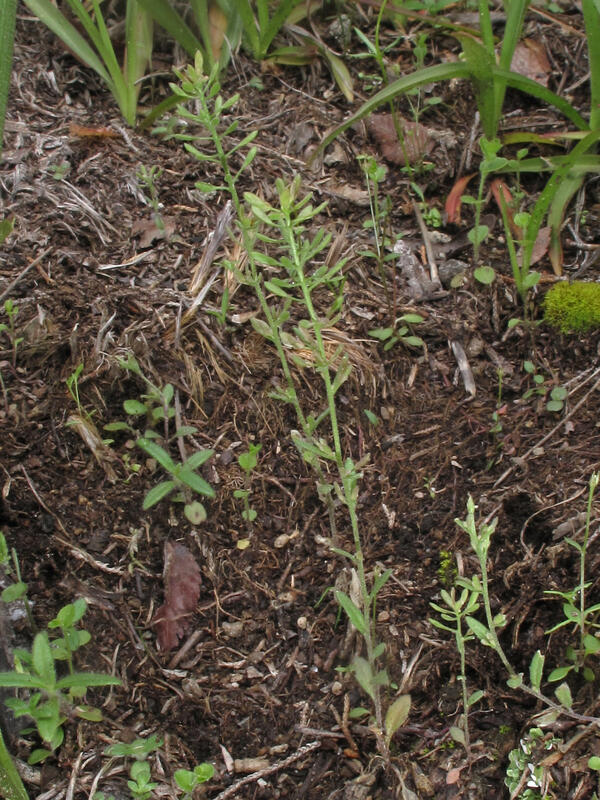
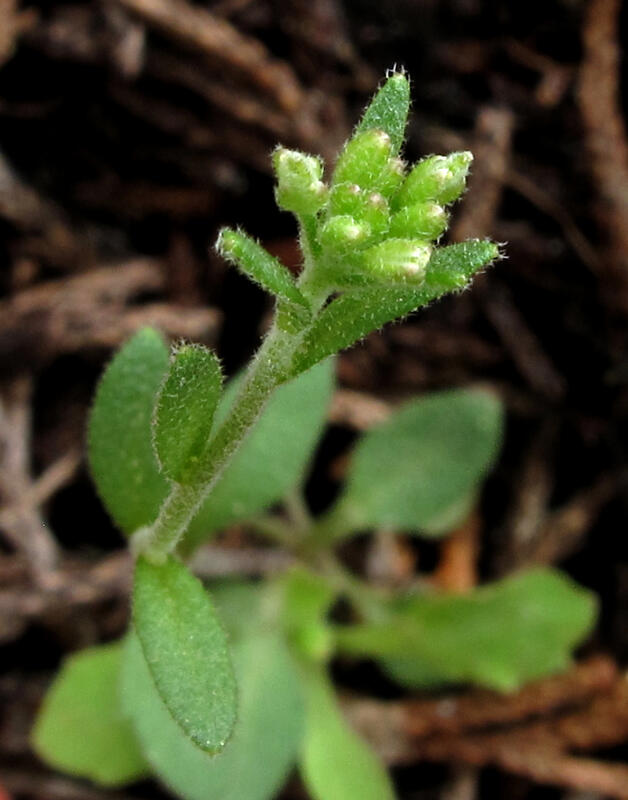
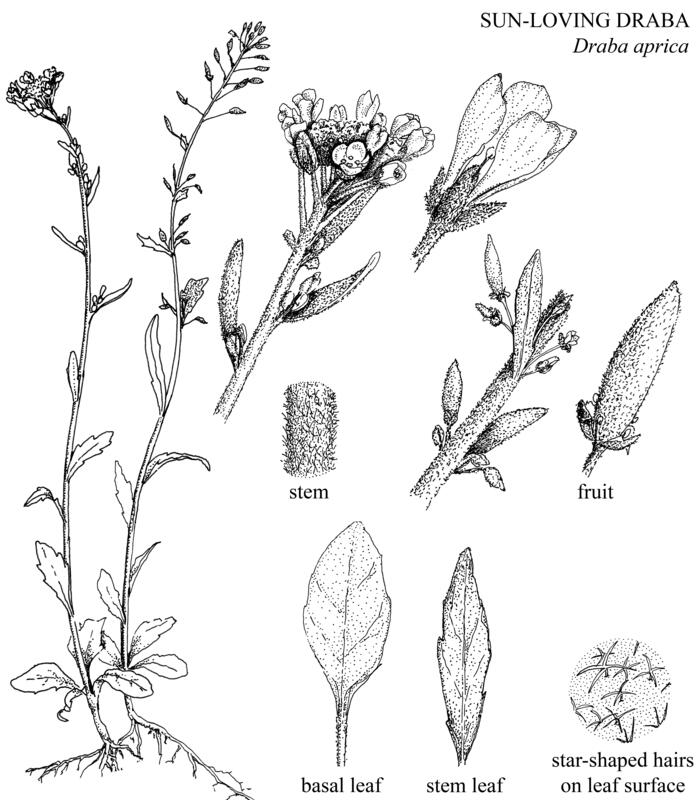
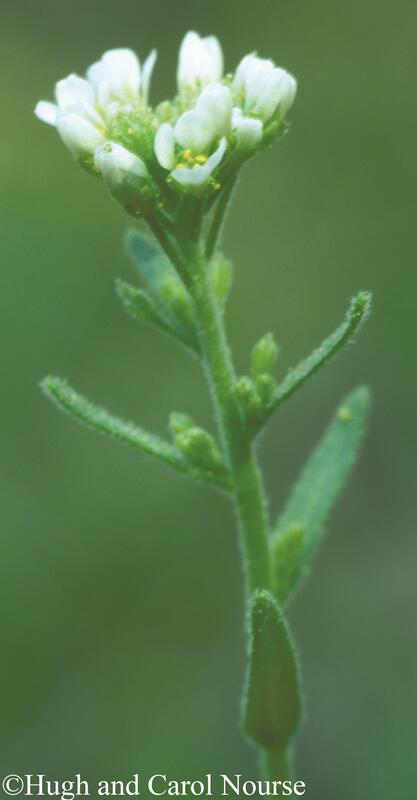
Annual herb with an erect stem 3 - 8 inches (8 - 20 cm) tall, sometimes with a few short branches above mid-stem. Basal rosette leaves are 0.6 - 1.2 inches (1.5 - 3 cm) long, oval to nearly round, some with a few low teeth; visible through the winter and early stem. Stem leaves are up to 1 inch (2.5 cm) long near the base of the stem, shorter and more widely spaced upward along the stem, alternate, with no or very short leaf stalks. Flower clusters are held at the top of the stem on short stalks and in the axils between leaves and stem. The flowers have 4 white petals, 0.1 inch (3 mm) long, rounded or notched at the tip (late-flowering plants may lack petals). Fruits are pods less than 0.25 inch (4 - 6 mm) long, held on short, densely clustered stalks. Stems, leaves, and fruits are covered with star-shaped hairs (visible with 10x magnification).
Short-fruited Whitlow-grass (Draba brachycarpa, Abdra brachycarpa) usually has more and longer branches, some rising from near the base of the plant, and its fruits are hairless. It occurs on granitic and amphibolite outcrops and in disturbed areas such as lawns, fields, pastures, and roadsides.
Spring Whitlow-grass (Draba verna) has only basal rosette leaves (no stem leaves), and has deeply notched petals and smooth, hairless fruits. It occurs on granitic outcrops and in disturbed areas with dry soils.
Draba cuneifolia (Wedge-leaf Whitlow-grass) occurs in blackland prairies and in surrounding woodlands. For more information, see: https://georgiabiodiversity.org/portal/profile?group=plants&es_id=32149
Shallow soils on and around granite outcrops, usually near the edges of “islands” of Eastern Red Cedar (Juniperus virginiana) trees.
Draba aprica is a winter annual, germinating in late fall through early spring, and forming a small rosette of overwintering leaves. A single flowering stem is produced by each plant in early spring. Early flowers of Draba aprica are probably self-pollinated since their small size and low numbers are unlikely to attract many insect pollinators. Late-flowering plants, which produce no petals, are almost certainly self-pollinated. Draba aprica does not tolerate competition and is quickly overwhelmed by other herbs and grasses; as a result, it occurs in partially shaded areas with thin, dry soil where other plants do not thrive.
Surveys are best conducted during flowering (March–early April) and fruiting (April–May). The hairy fruits are important for identification.
Piedmont of Georgia and South Carolina, and the Ozark Plateau of Arkansas and Missouri.
Degradation of granite outcrop habitat by quarrying, trash dumping, invasion by exotic pest plants, and off-road vehicles. Trampling of plants by people and stock.
| Threat 1 | Threat 2 | Threat 3 | |
|---|---|---|---|
| General Threat | Natural system modifications | Transportation & service corridors | Biological resource use |
| Specific Threat | None | None | None |
Draba aprica is ranked S1S2 by the Georgia Department of Natural Resources, indicating that it is either critically imperiled or imperiled. It is listed by the State of Georgia as Endangered. Only 4 populations have been seen since 2000, and only 2 of these occur on conservation lands.
Protect granite outcrops from quarrying, trash dumping, and off-road vehicle use. Create buffers and limit development around outcrops. Eradicate exotic pest plants. Map locations of plants and direct foot traffic away from populations. Remove competing vegetation from around Draba sites.
Al-Shehbaz, A., M.D. Windham, and R. Elven. 2010. Draba aprica species account. Flora of North America, Vol. 7. http://www.efloras.org/florataxon.aspx?flora_id=1&taxon_id=242416457
Chafin, L.G. 2007. Field guide to the rare plants of Georgia. State Botanical Garden of Georgia and University of Georgia Press, Athens.
GADNR. 2020. Element occurrence records for Draba aprica. Georgia Department of Natural Resources, Wildlife Resources Division, Social Circle, Georgia.
Jordan-Thaden, I. Hase, I. Al-Shehbaz, M.A. Koch. 2010. Molecular phylogeny and systematics of the genus Draba (Brassicaceae) and identification of its most closely related genera. Molecular Phylogenetics and Evolution 55: 524-540. https://doi.org/10.1016/j.ympev.2010.02.012
Koch, M., and I.A. Al-Shehbaz. 2002. Molecular data indicate complex intra- and inter-continental differentiation of American Draba (Brassicaceae). Annals of Missouri Botanical Garden 89: 88-109. https://www.jstor.org/stable/3298659
Kral, R. 1983. A report on some rare, threatened, or endangered forest-related vascular plants of the South. Technical Publication R8-TP2. United States Forest Service, Atlanta.
NatureServe. 2019. Draba aprica comprehensive report. NatureServe Explorer. Arlington, Virginia. http://explorer.natureserve.org/servlet/NatureServe?searchName=Draba%20aprica
Patrick, T.S., J.R. Allison, and G.A. Krakow. 1995. Protected plants of Georgia. Georgia Department of Natural Resources, Natural Heritage Program, Social Circle.
Weakley, A.S. 2015. Flora of the southern and mid-Atlantic States. University of North Carolina Herbarium, University of North Carolina, Chapel Hill. http://www.herbarium.unc.edu/flora.htm
Linda G. Chafin
L. Chafin, Feb. 2007: original account.
K. Owers, Jan. 2010: updated status and ranks, added pictures.
L. Chafin, Feb 2020: updated original account.