



Loading profile. Please wait . . .
Tephrosia mohrii (Rydb.) Godfrey
Dwarf Goat's-rue


Federal Protection: No US federal protection
State Protection: No Georgia state protection
Global Rank: G3
State Rank: S1?
Element Locations Tracked in Biotics: Yes
SWAP 2015 Species of Greatest Conservation Need (SGCN): Yes
SWAP 2025 Species of Greatest Conservation Need (SGCN): Yes
2025 SGCN Priority Tier: High Conservation Concern
Element Occurrences (EOs) in Georgia: 2
Habitat Summary for element in Georgia: Scrub; longleaf pine-wiregrass savannas
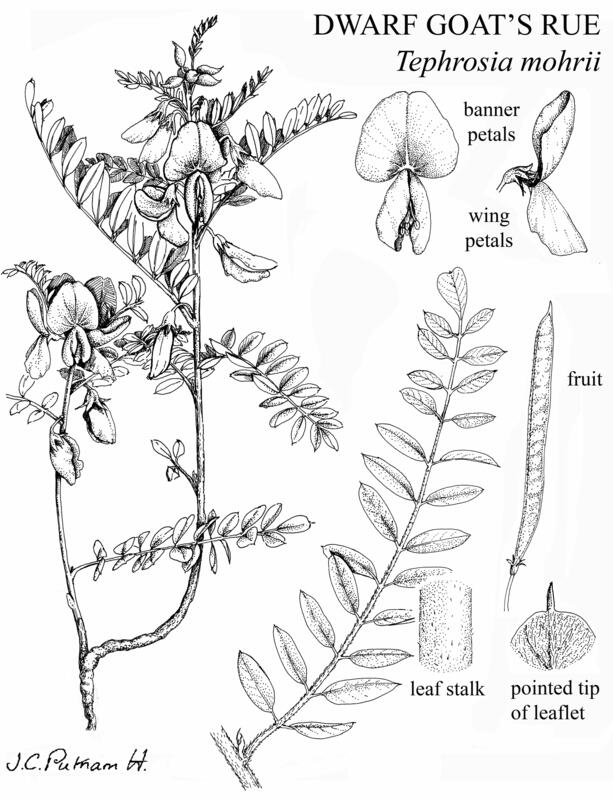
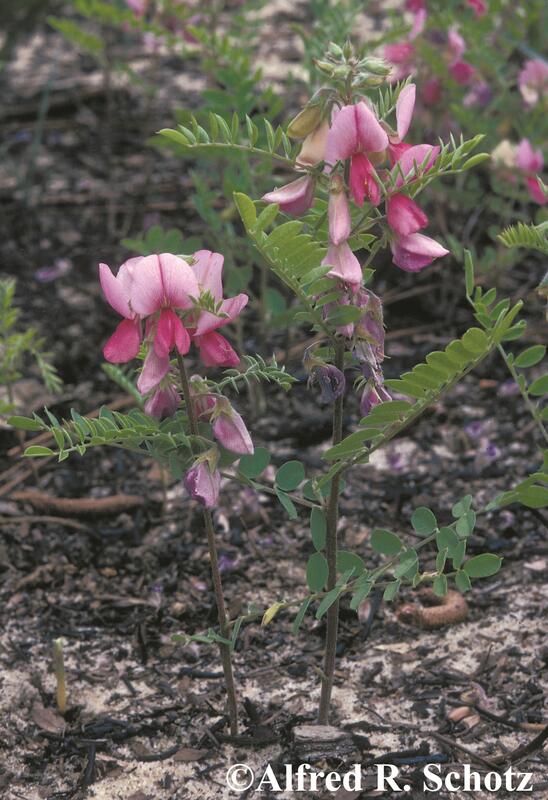
Perennial herb with an erect, hairy stem usually less than 6 inches (15 cm) tall, rarely up to 12 inches (30 cm) tall. The leaves are alternate and compound, with 15 - 20 pairs of leaflets; each leaflet is 0.4 - 0.8 inch (1 - 2 cm) long, oval with a tiny point at the tip. The flower clusters are shorter than the leaves, and are usually held in the angle between leaf and stem (only rarely at the top of the stem). The flowers are about 0.8 inch (2 cm) long, with a showy, erect banner petal that is pink or yellow streaked with pink, and two dark pink wing petals enclosing a keel petal. Fruits are flat pods, 1.6 - 2 inches (4 - 5 cm) long.
Some botanists consider this species to be a variety of the Common Goat’s Rue (Tephrosia virginiana var. mohrii) or even to be the same species. They are similar in appearance: Common Goat’s Rue is always more than 8 inches (20 - 70 cm) tall and has hairier leaflets that are usually longer than 0.4 inch (1 - 3.3 cm) long. It has larger flowers with a consistently yellow banner petal. Its flower clusters, which are longer than the leaves, are held at the top of the stem as well as in the angle between leaf and stem.
Golden Hoary-pea (Tephrosia chrysophylla, Special Concern) occurs in sandhills, scrub, or dry pine flatwoods in Charlton, Long, and McIntosh counties. It is a creeping, mat-forming herb with leaflets covered in soft, golden hairs. Its flower changes from white to pink to red as it matures. For more information, see: http://coastalplainplants.org/wiki/index.php/Tephrosia_chrysophylla
Sandhills, scrub, dry pine flatwoods in southwest Georgia.
Dwarf Goat’s Rue is a perennial herb that reproduces sexually by seed; little else is known about its reproduction. In other pea family species with similar flowers, the flowers are pollinated by large bees, such as honeybees and bumblebees, which are attracted by the showy banner petal and directed by pollen guides (darker pink lines) on the banner toward the center of the flower. The weight of these large insects presses down the keel petal, creating an opening for the bee and exposing the brush-tipped style. As the bee probes for nectar at the base of the banner petal, its underside contacts the brushy tip of the style where pollen, released from the anthers while the flower was still in bud, has accumulated. The pollen sticks to the bee and is carried to another flower. Dwarf Goat’s Rue fruit is a flattened pod that splits along both sides to release numerous small seeds. The seeds are probably dispersed by small animals.
Like most members of the bean family, the roots of Tephrosia species are colonized by nodule-forming Rhizobia bacteria that convert atmospheric nitrogen into a useable form of nitrogen.
Surveys are best conducted during flowering (April–June) when the plants are more easily distinguished from Common Goat's Rue.
Coastal Plain of Georgia, Florida, and Alabama.
Conversion of habitat to pine plantations, fields, pastures, and residential and commerical developments. Fire suppression and encroachment by woody species. Straw-raking in sandhills.
| Threat 1 | Threat 2 | Threat 3 | |
|---|---|---|---|
| General Threat | Invasive & other problematic species, genes & diseases | Pollution | None |
| Specific Threat | None | None | None |
Tephrosia mohrii is ranked S1? by the Georgia Department of Natural Resources, indicating that the species is imperiled in Georgia, but that more information is needed to make a definitive ranking. Only 2 populations have been documented in Georgia, in 1969 and 1970, neither on conservation lands.
Apply prescribed fire every 2 - 3 years. Avoid mechanical disturbances such as clearing and forestry site preparation. Prevent straw-raking in sandhills and scrub.
Chafin, L.G. 2007. Field guide to the rare plants of Georgia. State Botanical Garden of Georgia and University of Georgia Press, Athens.
GADNR. 2020. Element occurrence records for Tephrosia mohrii. Georgia Department of Natural Resources, Wildlife Resources Division, Social Circle, Georgia.
Godfrey, R.K. and R. Kral. 1958. Observations on the Florida flora. Brittonia 10: 169-170. https://link.springer.com/article/10.2307/2804946
Isely, D. 1990. Vascular flora of the southeastern United States, Vol. 3, Part 2, Leguminosae (Fabaceae). University of North Carolina Press, Chapel Hill.
Kral, R. 1983. A report on some rare, threatened, or endangered forest-related vascular plants of the South. Technical Publication R8-TP2. United States Forest Service, Atlanta.
NatureServe. 2008. Tephrosia mohrii species account. NatureServe Explorer. Arlington, Virginia. https://explorer.natureserve.org/Taxon/ELEMENT_GLOBAL.2.132111/Tephrosia_mohrii
Proctor, M. and P. Yeo. 1972. The pollination of flowers. Taplinger Publishing Company, New York.
Weakley, A.S. 2015. Flora of the southern and mid-Atlantic States. University of North Carolina Herbarium, University of North Carolina, Chapel Hill. http://www.herbarium.unc.edu/flora.htm
Linda G. Chafin
L. Chafin, Sept. 2008: original account
K. Owers, Feb. 2010: added pictures
L. Chafin, May 2020: updated original account.