


Loading profile. Please wait . . .
Pedicularis lanceolata Michx.
Swamp Lousewort


Federal Protection: No US federal protection
State Protection: Endangered
Global Rank: G4
State Rank: S1
Element Locations Tracked in Biotics: Yes
SWAP 2015 Species of Greatest Conservation Need (SGCN): Yes
SWAP 2025 Species of Greatest Conservation Need (SGCN): No
2025 SGCN Priority Tier:
Element Occurrences (EOs) in Georgia: 3
Habitat Summary for element in Georgia: Bogs and wet woods
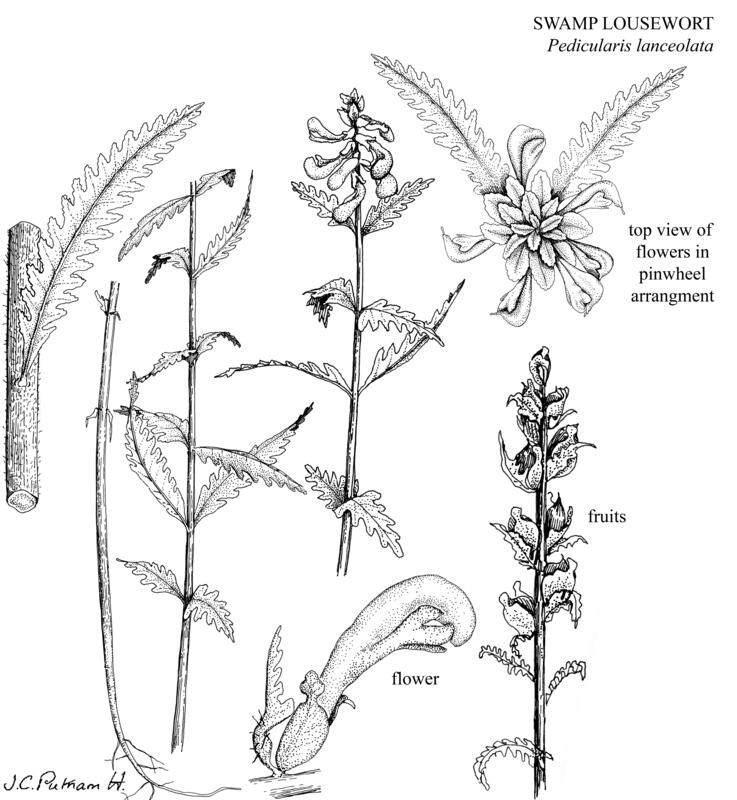
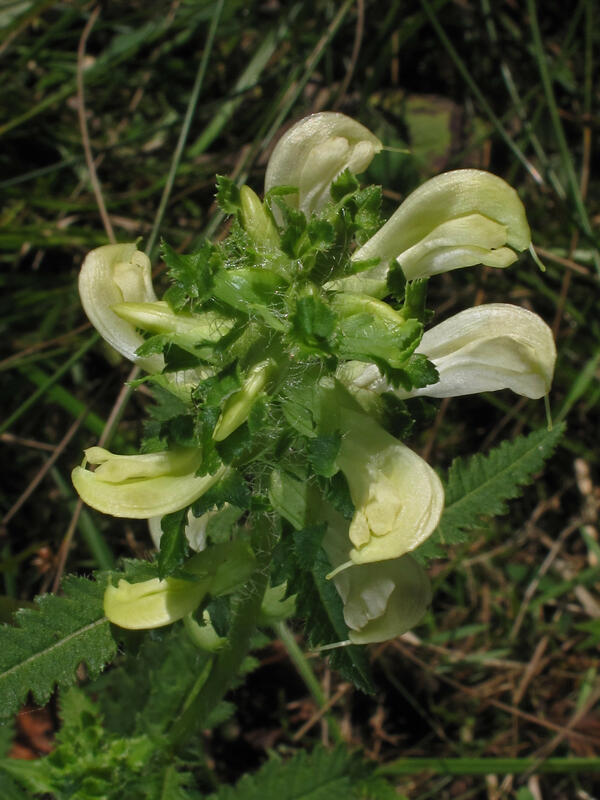
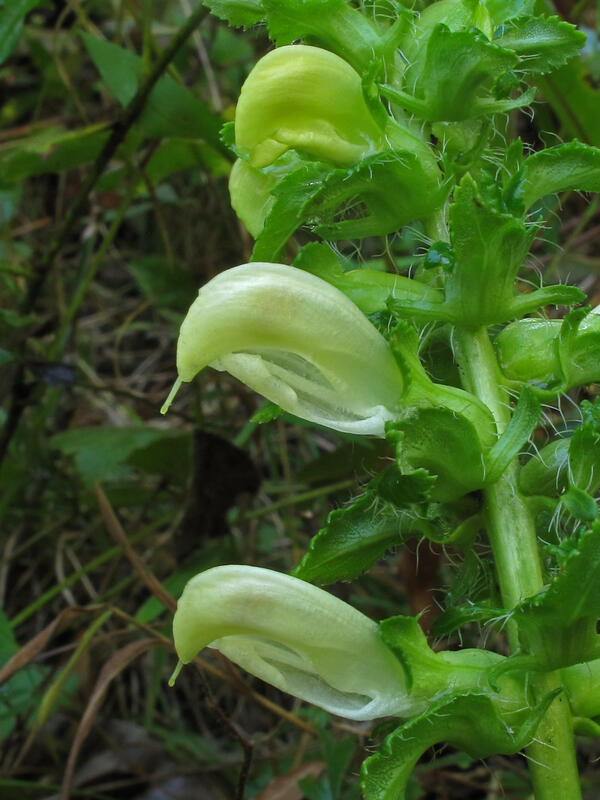
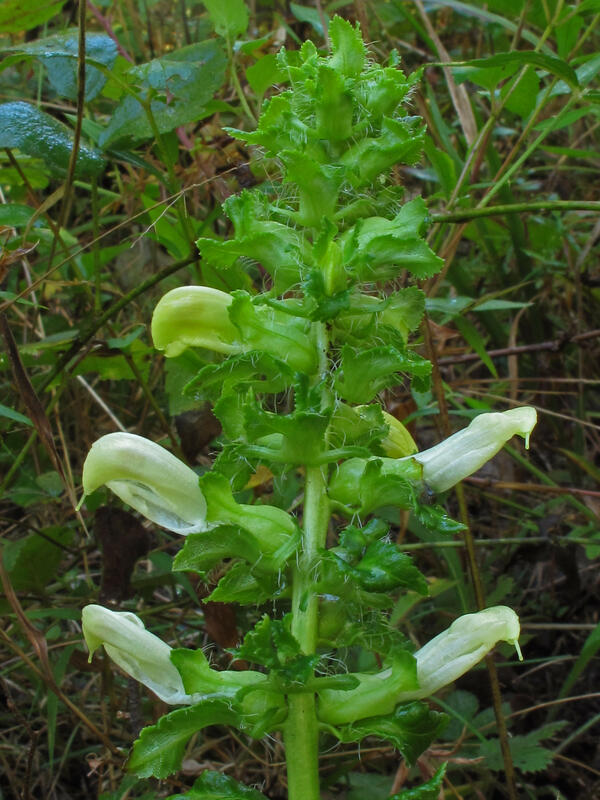
Perennial herb 16 - 32 inches (40 - 80 cm) tall. Its stems are red or green with purple stripes, slightly angled, the angles rounded; the flat surfaces between the pairs of leaves have a vertical line of hairs, but are otherwise smooth. The leaves are 2 - 4 inches (5 - 10 cm) long, tapering to a blunt tip; the margins are scalloped or lobed, each lobe with rounded teeth; the leaves are opposite, the pairs set at right angles to each other, with very short or no leaf stalks; leaf surfaces are smooth or with a few short hairs. The flower cluster is 15.7 inches (40 - 100 cm) tall, narrow, with many leafy bracts; the flowers appear to be arranged in a pinwheel pattern when viewed from above. Flowers are less than 1 inch (2.3 cm) long, white or pale yellow, tubular with 2 lips, the upper lip hood-like, the lower lip with 3 erect lobes that nearly close the end of the tube.
Canada Lousewort (Pedicularis canadensis) is 6 - 12 inches tall, and has alternate, deeply lobed leaves, the lower ones with leaf stalks. The upper stem is very hairy. Flowers appear April–May and are yellow, often with a purple or red upper lip or even entirely red corolla. Plants typically form colonies of many plants.
None in Georgia.
Bogs, seeps, springheads, wet woods over mafic bedrock.
Swamp Lousewort is a perennial herb that reproduces sexually by seed. Its flowers – with their yellow color, lack of fragrance and nectar, abundance of pollen, and closed lips (requiring a relatively large and strong insect pollinator) – are adapted to attract large bees. The pinwheel arrangement of the flowers on the stem is thought to facilitate the foraging movements of bees. Swamp Lousewort is self-incompatible and will not set fruit and produce seeds without cross-pollination. Like other members of the broomrape family, Swamp Lousewort is a hemiparasite. Although it photosynthesizes and produces carbohydrates, it is partially dependent on other plants for water and nutrients, especially iron and phosphorus. As a seedling, it attaches to its host by haustoria, small root-like organs that penetrate the roots of other plants and extract water, minerals, hormones, and sugars. Without the attachment, seedlings fail to thrive.
Surveys are best conducted during flowering (August–October) and fruiting (September–October).
Georgia, north to Maine, west to Nebraska and Manitoba.
Clearing of streamsides and logging in wetland forests, conversion of habitat to pasture; use of herbicides in utility rights-of-way, invasion by exotic pest plants.
Pedicularis lanceolata is ranked S1 by the Georgia Department of Natural Resources, indicating that the species is critically imperiled in Georgia. It is listed as Endangered by the State of Georgia. Three populations are known, 2 on state-owned lands, one in the Chattahoochee National Forest.
Use prescribed fire and hand-clearing to create wet meadows and sunny openings. Avoid mechanical clearing and logging in wetlands. Avoid broadcast use of herbicides. Eradicate exotic pest plants.
Chafin, L.G. 2007. Field guide to the rare plants of Georgia. State Botanical Garden of Georgia and University of Georgia Press, Athens.
GADNR. 2020. Element occurrence records for Pedicularis lanceolata. Georgia Department of Natural Resources, Wildlife Resources Division, Social Circle, Georgia.
Godfrey, R.K. and J.W. Wooten. 1981. Aquatic and wetland plants of southeastern United States, Vol. 2, dicotyledons. University of Georgia Press, Athens.
Lackney, B.K. 1981. Parasitism of Pedicularis lanceolata Michx., a root hemiparasite. Bulletin Torrey Botanical Club 108 (4): 422-429. https://www.jstor.org/stable/2484442?seq=1#metadata_info_tab_contents
Macior, L.W. 1969. Pollination adaptation in Pedicularis lanceolata. American Journal of Botany 56(8): 853-859. https://bsapubs.onlinelibrary.wiley.com/doi/abs/10.1002/j.1537-2197.1969.tb09735.x
NatureServe. 2019. Pedicularis lanceolata comprehensive report. NatureServe Explorer. Arlington, Virginia. http://explorer.natureserve.org/servlet/NatureServe?searchName=Pedicularis+lanceolata
Radford, A.E., H.E. Ahles, and C.R. Bell. 1968. Manual of the vascular flora of the Carolinas. University of North Carolina Press, Chapel Hill.
Record, S. 2010. Conservation while under invasion: insights from a rare hemiparasitic plant, Swamp Lousewort (Pedicularis lanceolata Michx.) Ph.D. Dissertation, University of Massachusetts, Amherst. https://scholarworks.umass.edu/open_access_dissertations/317/
Tenaglia, D. 2008. Pedicularis lanceolata species account. Missouri plants: photographs and descriptions of flowering and non-flowering plants of Missouri. http://missouriplants.com/Pedicularis_lanceolata_page.html
Weakley, A.S. 2015. Flora of the southern and mid-Atlantic States. University of North Carolina Herbarium, University of North Carolina, Chapel Hill. http://www.herbarium.unc.edu/flora.htm
Linda G. Chafin
L. Chafin, Jul. 2008: original account
K. Owers, Feb. 2010: added pictures
L. Chafin, Mar. 2020: updated original account.