



Loading profile. Please wait . . .
Echinacea simulata R.L. McGregor
Prairie Purple Coneflower


Federal Protection: No US federal protection
State Protection: No Georgia state protection
Global Rank: G4
State Rank: S2
Element Locations Tracked in Biotics: Yes
SWAP 2015 Species of Greatest Conservation Need (SGCN): Yes
SWAP 2025 Species of Greatest Conservation Need (SGCN): Yes
2025 SGCN Priority Tier: High Conservation Concern
Element Occurrences (EOs) in Georgia: 16
Habitat Summary for element in Georgia: Remnant prairies in the Coosa flatwoods near Rome
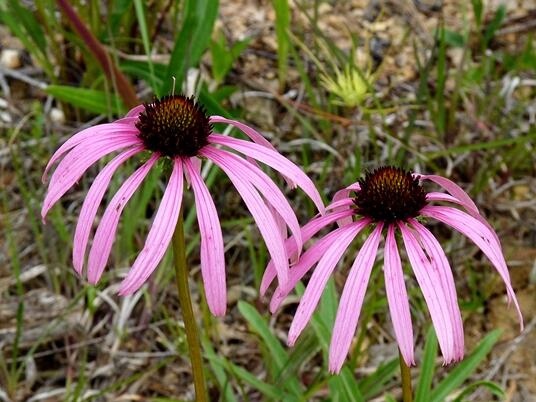
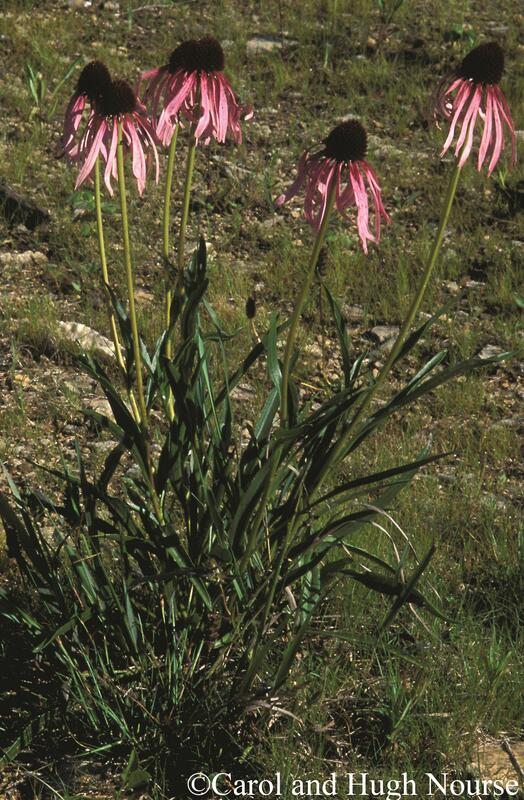
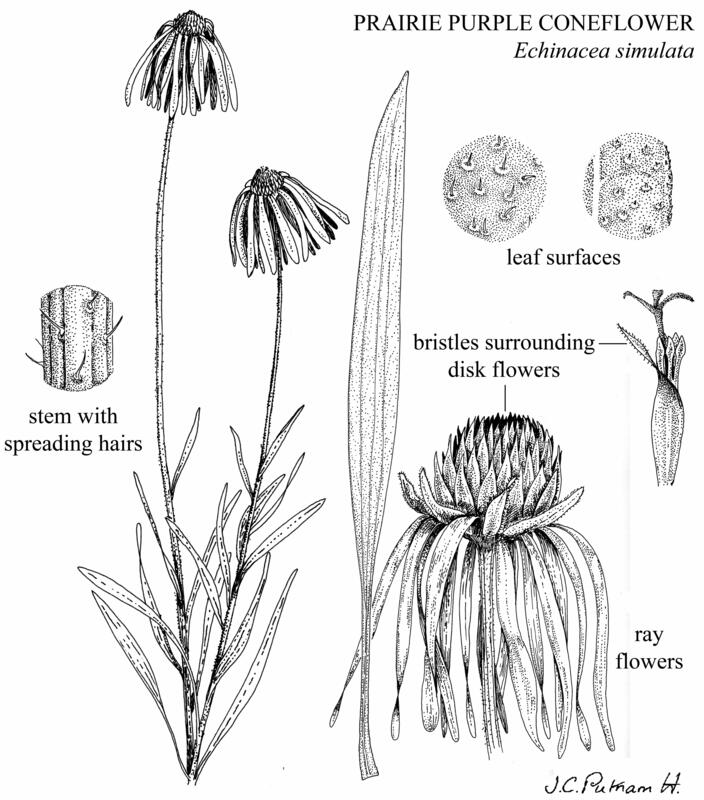
Perennial herb with stems up to 3 feet (100 cm) tall and usually unbranched. Leaves are 2 - 16 inches (5 - 40 cm) long and 0.2 - 1.6 inches (0.5 - 4 cm) wide, mostly basal with a few smaller, alternate leaves on the lower stem, often coarsely hairy, not toothed. The leaf stalk is up to 8 inches long. Flower heads are solitary at the top of the stem. The ray flowers are 1.6 - 3.5 inches (4 - 9 cm) long, 8 - 21 in number, narrowly strap-shaped, drooping, white, pink, or rose, and surround a central, dome- or cone-shaped, disk. Disk flowers are purple with yellow pollen, and are interspersed with sharply pointed, maroon bristles (chaff or pales) up to 0.6 inch (1.4 cm) long. Fruit is 3-4.5 mm long, dry and seed-like, 4-sided.
See Related Rare Species, below.
Pale Purple Coneflower (Echinacea pallida) basal leaves are up to 13 inches (33 cm) long and only 1.6 inches (4 cm) wide and usually very hairy; its pollen grains are usually white, rarely yellow. It occurs in three widely separated counties in northwest and central Georgia in open pine-hardwood woodlands and on roadbanks. It was once thought to be a garden escape in Georgia but is now believed to be native. For more information, see: http://www.missouriplants.com/Pinkalt/Echinacea_pallida_page.html https://www.illinoiswildflowers.info/prairie/plantx/pale_coneflowerx.htm
Purple Coneflower (Echinacea purpurea) is widely planted in gardens but, because it requires basic soils, is rare in the wild in Georgia; it occurs in open woodlands in several northwest counties. Its leaves are oval, rough or hairy on both surfaces, with toothed edges and long leaf stalks; its stems are hairy; the purple ray flowers are 1-3 inches (3-8 cm) long, only slightly drooping; the chaff bristles are orange with straight tips. For more information, see: http://www.missouriplants.com/Pinkalt/Echinacea_purpurea_page.html
Smooth Coneflower (Echinacea laevigata) occurs in grassy openings and rocky glades with shallow soil over mafic bedrock in northeast Georgia. For more information, see: https://georgiabiodiversity.org/portal/profile?group=plants&es_id=22505
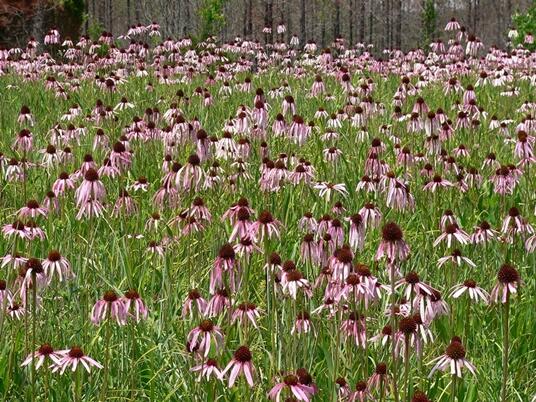
Remnant prairies in the Coosa flatwoods near Rome, with scattered, stunted Eastern Red Cedar in clayey soils over calcium-rich bedrock (such as limestone or calcareous shale); roadsides and utility rights-of-way through this habitat.
Prairie Purple Coneflower reproduces sexually by seed. Its flowers are pollinated by a variety of butterflies, moths, beetles, bees, and other insects. Seeds are dispersed by gravity and by birds (especially finches) and small mammals. Its leaves are used as larval hosts by a number of moth and butterfly species. Prairie Purple Coneflower will hybridize with other coneflowers, such as Pale Purple Coneflower (Echinacea pallida) and Sanguine Purple Coneflower (E. sanguinea), a native of Arkansas, Louisiana, Oklahoma, and Texas, and widely planted in gardens.
Surveys are best conducted during flowering (May–June) and fruiting (July–August).
Georgia, Tennessee, Kentucky, Indiana, Illinois, and Missouri.
Conversion of habitat to pine plantations. Logging, clearing, fire suppression. Use of herbicides in rights-of-way. Poaching.
| Threat 1 | Threat 2 | Threat 3 | |
|---|---|---|---|
| General Threat | Agriculture & aquaculture | Natural system modifications | None |
| Specific Threat | Wood & pulp plantations | Fire & fire suppression | None |
Echinacea simulata is ranked S2 by the Georgia Department of Natural Resources, indicating that it is imperiled in the state. There are 16 populations documented in Georgia, about half protected by a conservation easement.
Apply prescribed fire frequently. Avoid logging, mechanical clearing, and site preparation. Avoid herbicide use along roadsides and in utility rights-of-way. Protect plants from poaching.
Binns, S.E., B.R. Baum, and J.T. Arnason. 2002. Taxonomic revision of Echinacea (Asteraceae: Heliantheae). Systematic Botany 27(3): 610-632. https://bioone.org/journals/Systematic-Botany/volume-27/issue-3/0363-6445-27.3.610/A-Taxonomic-Revision-of-Echinacea-Asteraceae-Heliantheae/10.1043/0363-6445-27.3.610.full
Chafin, L.G. 2007. Field guide to the rare plants of Georgia. State Botanical Garden of Georgia and University of Georgia Press, Athens.
GADNR. 2020. Element occurrence records for Echinacea simulata. Georgia Department of Natural Resources, Wildlife Resources Division, Social Circle, Georgia.
Horn, D., T. Cathcart, T.E. Hemmerly, and D. Duhl. 2005. Wildflowers of Tennessee, the Ohio Valley, and the southern Appalachians. Lone Pine Publishing, Auburn, Washington.
McGregor, R.L. 1968. Taxonomy of the genus Echinacea (Compositae). University of Kansas Science Bulletin 48(4): 113-142. https://ci.nii.ac.jp/naid/10007685123/
McKeown, K.A. 1999. Review of the taxonomy of the genus Echinacea. In, J. Janick, Perspectives on new crops and new uses. ASHS Press, Alexandria, Virginia. https://www.hort.purdue.edu/newcrop/proceedings1999/pdf/mckeown.pdf
NatureServe. 2019. Echinacea simulata comprehensive report. NatureServe Explorer. Arlington, Virginia. http://explorer.natureserve.org/servlet/NatureServe?searchName=Echinacea%20simulata
Urbatsch, L.E., K.M. Neubig, and P.B. Cox. 2006. Flora of North America, Vol. 21. Oxford University Press, New York. http://beta.floranorthamerica.org/Echinacea_simulata
Weakley, A.S. 2015. Flora of the southern and mid-Atlantic States. University of North Carolina Herbarium, University of North Carolina, Chapel Hill. http://www.herbarium.unc.edu/flora.htm
Linda G. Chafin
L. Chafin, Feb. 2007: original account
K. Owers, Jan. 2010: added pictures
L. Chafin, Feb 2020: updated original account.