



Loading profile. Please wait . . .
Juniperus communis var. depressa Pursh
Ground Juniper


Federal Protection: No US federal protection
State Protection: No Georgia state protection
Global Rank: G5T5
State Rank: S1
Element Locations Tracked in Biotics: Yes
SWAP 2015 Species of Greatest Conservation Need (SGCN): Yes
SWAP 2025 Species of Greatest Conservation Need (SGCN): No
2025 SGCN Priority Tier:
Element Occurrences (EOs) in Georgia: 3
Habitat Summary for element in Georgia: Gneiss ledges
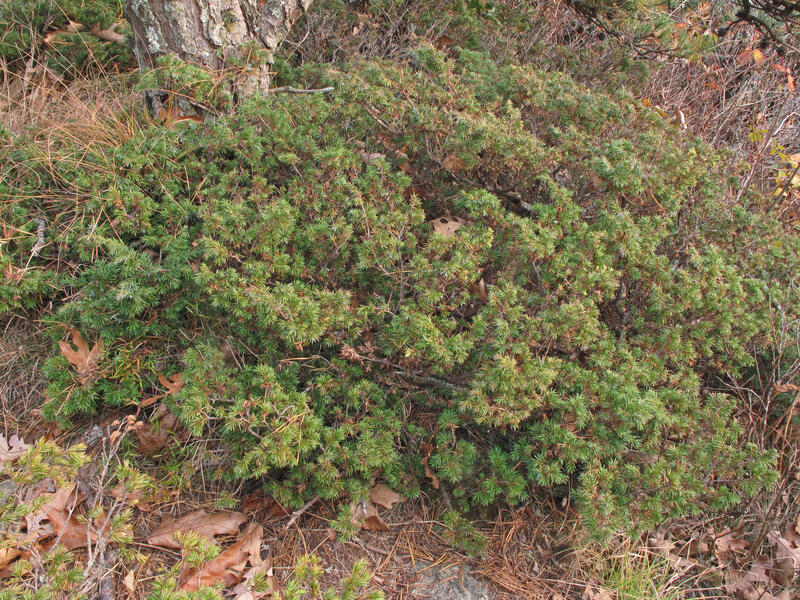
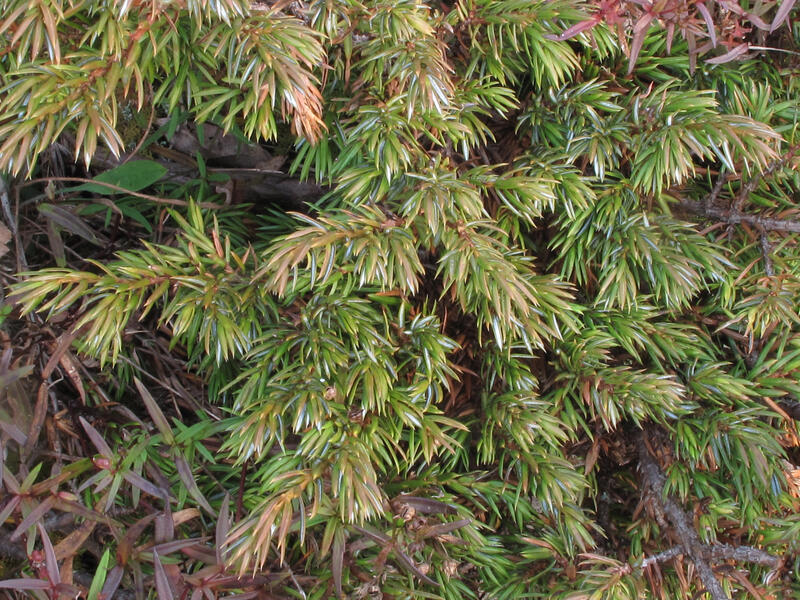
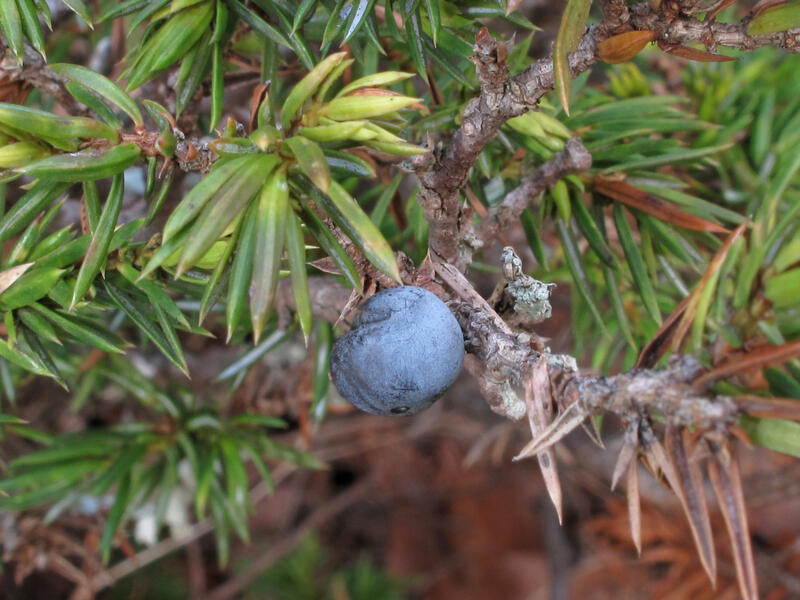
Ground Juniper is a low-growing, evergreen shrub with thin, shredding bark, rarely reaching above 3 feet (1 meter) in height. Young, yellowish-green shoots tend to droop at the tips while older branches spread stiffly, forming dense mats up to several feet/meters wide. The needles are 0.3 - 0.6 inch (8 - 16 mm) long and narrowly linear, 1.0 - 1.5 mm wide, opposite or in whorls of 3, pointed upward toward the end of the twig, slightly incurved and very sharp at the tips. The upper surface of each needle has a white stripe along the midvein that is bordered by a green band on either side; needles appear silvery-green in the summer and turn greenish-brown in winter. Female and male cones are produced on different plants. Female (seed) cones are about 0.3 inch (6 - 9 mm) wide, round, green and hard when immature, dark blue-gray and fleshy, resembling berries, when mature; they are held in the axils of the needles (not at the tips of the twigs); since seed cones take two years to mature, both immature and mature seed cones may be present. Male (pollen) cones are yellowish-brown, oval, and 0.25 inch (6 mm) long. Needles and seed cones have a piney, gin-like smell.
Common Juniper (Juniperus communis var. communis) does not occur naturally in Georgia; however, some cultivars of Common Juniper are widely used as landscape plants and may persist at home sites or have escaped from cultivation. Shore Juniper (Juniper conferta) is a frequently planted, creeping shrub that may persist at home sites or escape to native habitats. Its needles are 0.5 - 1 inch long (15-25 mm) long, and the seed cone is 0.3 - 0.5 inches (8-12 mm) in diameter; it is native to Japan. Ground Juniper is distinguished from these plants by having needles that point upward along the twig, rather than spreading, and by seed cones held in the axils of needles rather than at the tips of twigs.
The genus Juniperus is in the Cypress plant family, Cupressaceae, which also includes Atlantic White Cedar (Chamaecyparis thyoides), a large tree found at a few locations in Fall Line bogs in Georgia and in swamps, floodplains, and pocosins elsewhere in its range. For more information, see: https://www.georgiabiodiversity.org/portal/profile?group=plants&es_id=20334
Dry, rocky or sandy hillsides, bluffs, and ledges with a thin canopy of Shortleaf or Virginia Pine, Chestnut Oak, and Sourwood and a shrub layer including Mountain Laurel.
Ground Juniper is a slow-growing, long-lived shrub with a shallow root system and widely spreading, mat-forming branches. Plants reproduce sexually by production of seeds and asexually by rooting of the prostrate stems if they are buried by soil. Ground Juniper is dioecious: female seed cones and male pollen cones are produced on separate plants, thus ensuring that cross-fertilization takes place. Pollen is dispersed by the wind in early to mid-spring and female seed cones begin to develop in early summer. The fleshy female seed cones do not develop into the blue-gray “berries” until summer of the following year. Large crops of seed cones are produced in some years and few or no cones in other years. Seed cones take two years (sometimes three) to mature so both immature and mature seed cones may be present on female plants that have been fertilized. The seeds are spread by birds and small mammals that relish the fleshy seed cones. Ground Juniper is not browsed by deer. The seed cones have been widely used as a medicinal and are still used to flavor gin and meat dishes. It is also used in landscaping. Ground Juniper is reported by several sources to be an alternate host for Cedar-Apple Rust; other sources report that it is resistant to this fungus.
Surveys may be conducted year-round.
Juniperus communis is the most globally widespread woody plant in the world; there are at least five recognized varieties in North America, Europe, and Asia. Variety depressa (considered a subspecies by some authors) occurs in much of North America, though it is rare and disjunct south of Pennsylvania, where it occurs in widely separated locations in Alabama, Georgia, South Carolina, North Carolina, and Virginia.
Ground Juniper is threatened by wildfires, logging, conversion of habitat to pine plantations or agriculture, and other ground-disturbing activities. It may also be subject to eradication efforts as a possible host for Cedar-Apple Rust.
Juniperus communis var. depressa is ranked S1 by the Georgia Department of Natural Resources, indicating that it is critically imperiled in Georgia. Only one of Georgia’s three populations is protected on conservation land, a Georgia DNR Wildlife Management Area.
Georgia’s plants are among the southernmost populations of this variety of Juniperus communis. Plants occurring at the periphery of a species’ range are thought to be of special conservation importance. Peripheral populations are usually smaller and less genetically diverse within the population, but genetically divergent from centrally located populations. These genetic differences may confer special survival traits that plants in other portions of the species’ range lack, such as the ability to survive changes in the climate or the arrival of a new pathogen. Peripheral populations may be in the process of evolving into a new species. They are especially deserving of conservation action.
In Georgia and other southeastern states, Ground Juniper grows with fire-tolerant or fire-dependent species such as Virginia Pine (Pinus virginiana) and Chestnut Oak (Quercus montana). However, sources from western states report that Ground Juniper is killed by fire and, because of its shallow roots and lack of a crown or rhizome system from which to re-sprout, post-fire recovery is slow. Patchy fire that spares some plants or parts of individual plants allow the colony to slowly re-establish over time. Seed bank survival is reportedly low after fires.
Georgia’s three populations appear to have low seed cone production and are spreading largely by vegetative reproduction. It is likely that these populations are single-sex fragments of once more extensive populations that included both female and male plants. Research is needed to determine the sexual makeup of these populations and whether introduction of opposite-sex plants is indicated.
Only one of Georgia’s three populations is protected on conservation land, a GA DNR Wildlife Management Area. Landowners of the two other sites should be approached for permission to conduct long-term monitoring, management, and research.
Adams, R.P. 2018. Juniperus of Canada and the United States: taxonomy, key, and distribution. Lundellia 21(1): 1-34. Accessed 28 May 2019. https://doi.org/10.25224/1097-993X-21.1
Adams, R.P. 1993. Species account for Juniperus communis var. depressa. Flora of North America North of Mexico, vol. 2. Accessed 28 May 2019. http://www.efloras.org/florataxon.aspx?flora_id=1&taxon_id=233500725
Beckerman, J. Cedar-apple and related rusts on landscape plants. Purdue University Extension. Accessed 28 May 2019. https://www.extension.purdue.edu/extmedia/BP/BP-137-W.pdf
Brazee, N.J. 2019. Cedar-apple rust. University of Massachusetts Extension, Amherst. Accessed 28 May 2019. https://ag.umass.edu/landscape/fact-sheets/cedar-apple-rust
Hilty, J. 2019. Species profile for Canadian Juniper, Juniperus communis depressa. Illinois Wildflowers. Accessed 28 May 2019. https://www.illinoiswildflowers.info/trees/plants/cn_juniper.html
Marion, C. and G. Houle. 1996. No differential consequences of reproduction according to sex in Juniperus communis var. depressa (Cupressaceae). American Journal of Botany 83(4):480-488. https://bsapubs.onlinelibrary.wiley.com/doi/abs/10.1002/j.1537-2197.1996.tb12729.x
McKeon, C. Juniperus communis: Revisiting use of common juniper for modern culinary uses & producing drought-resistant cultivars for evolving markets. Accessed 28 May 2019. https://conservancy.umn.edu/ bitstream/handle/11299/175834/Colin%20McKeon%20-%20Juniper.pdf?sequence=1
NatureServe. 2019. Juniperus communis var. depressa species profile. NatureServe Explorer: an online encyclopedia of life, version 7.1. NatureServe, Arlington, Virginia. Accessed 28 May 2019. http://explorer.natureserve.org/servlet/NatureServe?searchName=Juniperus+communis+var.+depressa
Chatfield, J., S. Nameth, and C.W. Ellett. 2011. Cedar rust diseases of ornamental plants, HYG-3055-96. Ohio State University Extension, Columbus, OH. Accessed 28 May 2019. https://articles.extension.org/pages /60612/table-of-juniper-hawthorn-and-crab-apple-resistant-to-rust-diseases#top
Tirmenstein, D. 1999. Juniperus communis. In: Fire Effects Information System. U.S. Department of Agriculture, Forest Service, Rocky Mountain Research Station, Fire Sciences Laboratory. Accessed 28 May 2019. https://www.fs.fed.us/database/feis/plants/shrub/juncom/all.html
Weakley, A.S. 2015. Flora of the southern and mid-Atlantic States. University of North Carolina Herbarium, University of North Carolina, Chapel Hill.
Linda G. Chafin
Linda G. Chafin: 28 May 2019, original account