



Loading profile. Please wait . . .
Erynnis martialis (Scudder, [1870])
Mottled Duskywing


Federal Protection: No US federal protection
State Protection: No Georgia state protection
Global Rank: G3
State Rank: S2
Element Locations Tracked in Biotics: Yes
SWAP 2015 Species of Greatest Conservation Need (SGCN): Yes
SWAP 2025 Species of Greatest Conservation Need (SGCN): Yes
2025 SGCN Priority Tier: Moderate Conservation Concern
Element Occurrences (EOs) in Georgia: 26
Habitat Summary for element in Georgia: New Jersey tea, longleaf-wiregrass, mountain hardwoods
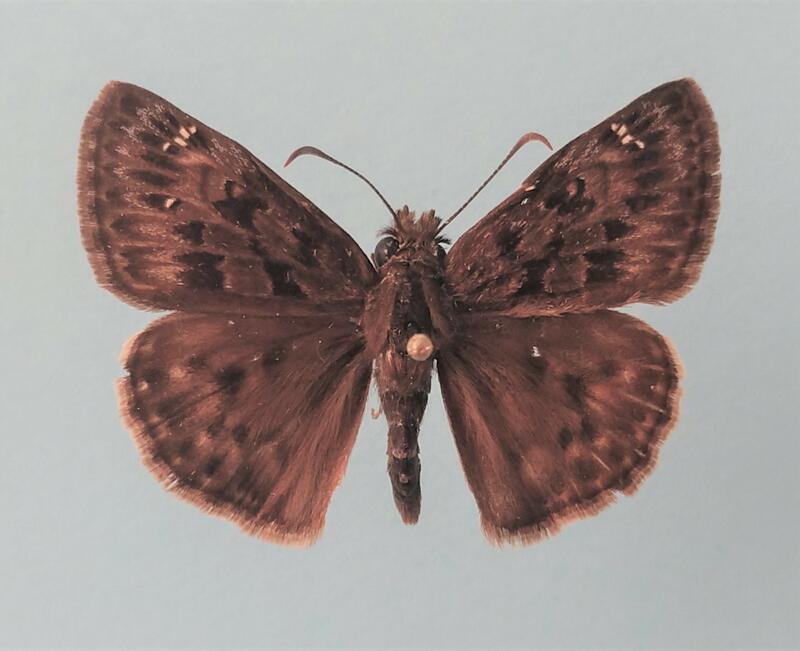
Erynnis martialis is appropriately named the Mottled Duskywing. The forewing has significant scattered dark patches on a medium brown background which makes it one of the more easily identifiable of the Duskywings. The hindwings also have prominent irregular bands of dark spots (see photo above). The wingspan (2.5 to 3.3 cm) is also a bit smaller than the other species (baptisiae, juvenalis, horatius) with which it might be confused. With duskywings, the adults always sit with the wings open, so the observer will see the upperside of the wings. and therefore be able to see clearly the diagnostic markings.
In Georgia, none of the other large sympatric Erynnis (baptisiae, juvenalis, horatius; see photo below) have as mottled a pattern on all wings as the somewhat smaller Erynnis martialis. The one species that could MOST easily be confused with E. martialis is very small female E. horatius (photo below; lower left specimen). High quality pictures or actual collected specimens might be necessary to distinguish these two in Georgia, though, as the images above and below show, the two can be distinguished. Indeed, the problem of indentification in Erynnis is more of an issue of telling the other similar species from one another, not so much distinguishing martialis. If vouchers of E. martialis are required for identification, collection should be restricted to one or two males where populations are small.
Forest edges and open spaces, including sandhills and grasslands (including longleaf/wiregrass habitats), where the foodplant, New Jersey tea (Ceanothus americanus), grows. It appears that isolated or small patches of the plant will not support the skipper. Schweitzer, et al. (2011) suggest that occurrence of multiple patches of the foodplant with scattered individuals in between the patches are vital to support any population of the Mottled Duskywing.
By the way, it should be mentioned that there are two other Lepidoptera species whose larvae are intimately tied to Ceanothus americanus -- two geometrid moths, Erastria coloraria and Apodrepanulatrix liberaria, both of which are or should be monitored in Georgia as well.
In Georgia, larvae of Erynnis martialis feed exclusively on New Jersey tea (Ceanothus americanus L.) (Rhamnaceae). The adults sip nectar from a variety of flowers, including the larval host plants, and males will visit moist soil for the water and minerals.
The Mottled Duskywing is double-brooded in Georgia. The first adult brood starts flying as early as mid to late April and is likely done by the end of May. The second brood flies mostly in July (however, note the fresh specimen in the photo is from July 30). There are relatively few records from Georgia so it is difficult to know precisely when the broods begin and end. The full grown larva is pale green with the typical contrasting dark (black) head of skipper butterflies. The larval head has some small patches of orange on the vertex. These larvae, also like many other skippers, fold leaf edges of the hostplant and secure them with silk, using these retreats as a place of refuge when not actively feeding. Pupation occurs in the leaf litter (Schweitzer, et al., 2011).
Daytime searches for adults of the Duskywing should be done during the times the two broods are likely to be in flight (mid-April through May, late June into early August) in places where the foodplant, New Jersey Tea (Ceanothus americanus), occurs. This needs to be done because presence of large stands of the foodplants does not insure occurrence of the Duskywing. As already mentioned, the Duskywing needs sufficient stands of the foodplants, not just occasional individual plants scattered in the undergrowth.
This species has a rather broad historical range in the eastern U.S., but in rather localized colonies. Although it used to be found in the southern New England states, it is apparently gone from there. There are relatively recent records from New York across to Minnesota and Iowa, southward into the Floridian peninsula and central Texas. There are also disjunct populations in the Black Hills of South Dakota and the Rocky mountain foothills in Colorado (Schweitzer, et al. 2011).
In the southeast, it is sparsely distributed in NC and Georgia into the Floridian panhandle. In Georgia, this was a "common species" (Harris, 1972) that has historically been recorded mostly in the northern half of the state (Harris,), although more recently it has been found in very southern Georgia and in middle Georgia. There is a question as to how many populations are actually extant in Georgia.
The Mottled Duskywing is completely tied to the fate of its foodplant. The foodplant Ceanothus americanus requires open habitat, but is a plant that is perhaps most abundant along forest edges. As indicated, it can also be found in widely open habitats, such as sandhills and grasslands, but again, even in most of these places, the plant seems to require a bit of heterogeneity (nearby shrubs, woodlands). The plant certainly has suffered due to urbanization in many locations (I know of a couple locations in the Atlanta area which once had an abundance of the plant and are now under houses and buildings), and is surely under continued threat from urbanization. Lack of fires allowing forests to grow up and over the edge habitat (reforestation) may be an issue as well (Schweitzer, et al., 2011). On the opposite end of the spectrum, areas where burns have been frequent have also seen the butterfly disappear, as all life stages are sensitive to fires. As such, prescribed burns in habitats containing abundant Ceanothus should be done with a patch work approach to allow for refugia for the Duskywing, and reestablishment back into the burned areas from those refugia.
Interestingly, the biggest threat to the Duskywing in some places may actually be deer browsing on the foodplant. Ceanothus is a favorite browse plant of deer, and in the northeast U.S. in some locations where deer became overabundant, the Ceanothus became quite rare and the Duskywing disappeared. Since that time, in areas where deer have been culled, the Ceanothus has rebounded but the Mottled Duskywing has not returned (Schweitzer, et al., 2011). There is less evidence for this direct affect of deer on the Mottled Duskywing in Georgia, but this is certainly a possibility.
It is also true that, if the Gypsy Moth becomes widespread in Georgia, that the application of Btk for control of larval Gypsy Moths (applied in the Spring when the Gypsy Moth is in the larval stages), this might be problematic for the Duskywing. However, the Duskywing would likely not be in the larval stages at the time of application, so this threat is probably not signficant.
| Threat 1 | Threat 2 | Threat 3 | |
|---|---|---|---|
| General Threat | Natural system modifications | Pollution | Climate change & severe weather |
| Specific Threat | Fire & fire suppression | Air-borne pollutants | Habitat shifting & alteration |
This species is currently listed as S2 in the state, but in all fairness it could be S1. There have been a few recent (since 2014) records from scattered locations (DeKalb, Taylor, and Emanuel Cos.) (see BAMONA).
Since the Mottled Duskywing seems to need a significant patchwork of the New Jersey Tea (Ceanothus americanus) with individual plants scattered between patches (see habitat above), prescribed burning in such habitat has to be done with the utmost care, and not too frequently. Prescribed burns should take place in a small patch work fashion, being sure to leave unburned refugia from which the Duskywing can recolonize recently burned areas.
Surveys for large stands of the foodplant should be done, and, if such areas are found, these should be protected if at all possible. Remember, as already stated, occurrence of the foodplant does not insure presence of the Duskywing, so surveys should be made for the adult Duskywings as well. Even is the Duskywing is not found, do not forget that the plant supports two other Lepidoptera of interest -- the geometrid moths Erastria coloraria and Apodrepanulatrix liberaria -- and so management of the foodplant can help these two species even if the Duskywing is not present.
If deer herds are found to be particularly dense in an area with recent Duskywing records, efforts should be made to cull the herd, as deer eagerly use Ceanothus as a browse plant.
BAMONA (Butterflies and moths of North America website). Online at https://www.butterfliesandmoths.org/species/Erynnis-martialis
Harris, L., Jr. 1972. Butterflies of Georgia, pages 92-93. University of Oklahoma Press, Norman.
Schweitzer, D. F., M. C. Minno, and D. L. Wagner. 2011. Rare, declining and poorly known butterfly and moths (Lepidoptera) of forests and woodlands in the eastern United States, pages 89-93. Forest Health Technology Enterprise Team.
James K. Adams, Professor of Biology, Dalton State College, Dalton, GA
July 13, 2020
