



Loading profile. Please wait . . .
Lysimachia fraseri Duby
Fraser's Loosestrife


Federal Protection: No US federal protection
State Protection: Rare
Global Rank: G3
State Rank: S2
Element Locations Tracked in Biotics: Yes
SWAP 2015 Species of Greatest Conservation Need (SGCN): Yes
SWAP 2025 Species of Greatest Conservation Need (SGCN): Yes
2025 SGCN Priority Tier: High Conservation Concern
Element Occurrences (EOs) in Georgia: 25
Habitat Summary for element in Georgia: Moist, open, bouldery gravel bars and streambanks; edges of sandstone and granite outcrops
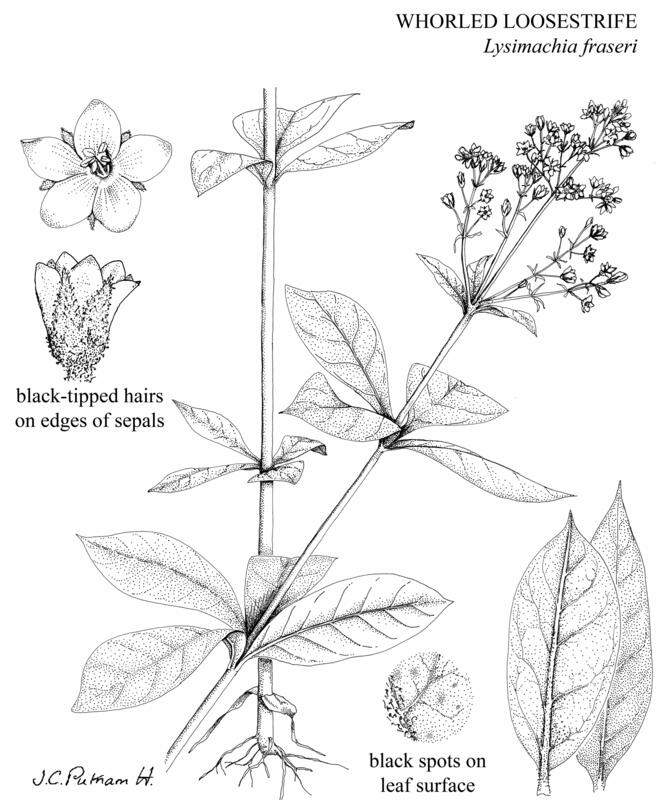
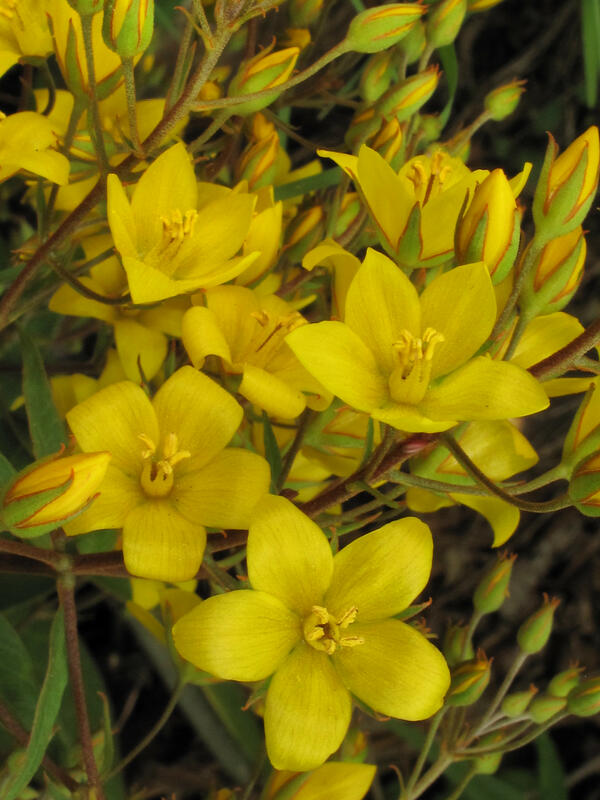
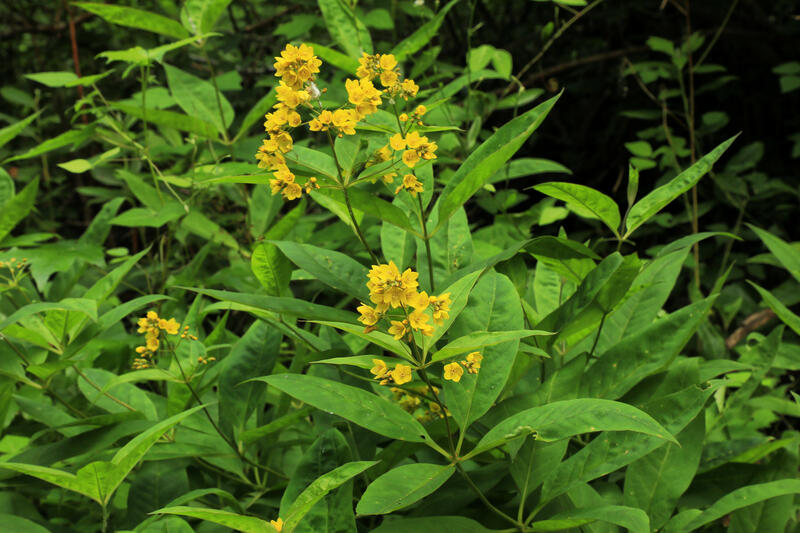
Perennial herb with stout, erect stems 2.5 - 5 feet (80 - 150 cm) tall, the upper stem covered with tiny, black-tipped hairs especially near the top. Leaves at midstem are 2.4 - 6 inches (6 - 15 cm) long and 0.8 - 2.4 inches (2 - 6 cm) wide, lance-shaped, in whorls of 3 - 6 leaves (sometimes opposite near the base of the stem), covered with purple or black dots (especially on the lower surface), and with a very narrow, red band around the leaf margins (10x magnification recommended); when held to the light, leaves do not show curving translucent lines. Flowers are in a loosely branched cluster up to 10 inches (25 cm) tall, held at the top of the stem, the branches and flower stalks covered with tiny, black-tipped hairs. The flower is up to 0.6 inch (1.5 cm) wide; sepals are 5 in number, narrow and pointed, visible between the petals, with black-tipped hairs on red, thickened margins; petals are 5 in number, spreading, solid yellow (not spotted). Fruit is a round capsule about 0.1 inch (3 - 5 mm) wide, not glandular.
Whorled Loosestrife (Lysimachia quadrifolia) may occur with Fraser’s Loosestrife. It has four leaves per whorl and single flowers on long, slender, drooping stalks arising from the junction of leaf and stem; its flowers are yellow with purple streaks and spots. Without flowers, the two can be distinguished using several vegetative characters. Whorled Loosestrife leaves lack a red border but, backlit, the leaves show many sinuous, translucent lines; and the upper stem is only sparsely hairy with long, non-glandular hairs (or rarely a few of the hairs with slightly bulbous tips).
Grassleaf Loosestrife (Lysimachia graminea, Georgia Special Concern) occurs in Coosa Valley flatwoods and wet prairies in northwest Georgia. For more information, see: http://www.efloras.org/florataxon.aspx?flora_id=1&taxon_id=250092254
Loomis's Loosestrife (Lysimachia loomisii, Georgia Special Concern) has not been seen in Georgia since the 1800s where it was seen in wetlands along the Ocmulgee River near Macon. For more information, see: http://www.efloras.org/florataxon.aspx?flora_id=1&taxon_id=250092255
Bog Candles (Lysimachia terrestris, Georgia Special Concern) is known from one site in Towns County. Its flowers are in cylindrical racemes and its leaves are opposite, not whorled. It occurs on stream banks and in wet meadows. For more information, see: http://www.efloras.org/florataxon.aspx?flora_id=1&taxon_id=250092260
Dry rock outcrops, rocky glades, rocky bars on streambanks, and other gaps in hardwood or mixed forest canopies. Roadsides and trails through these habitats.
Whorled Loosestrife is a perennial herb that reproduces both sexually (primarily by outcrossing) and vegetatively (by rhizomes). Plants leaf out in April and go dormant in October. Plants flower in early summer but in heavily shaded locations may not flower for years. Once a sunny opening is created – by fire, tree fall, stream scour, or hand-clearing – plants will flower and fruit vigorously. The flowers are pollinated by bees that collect pollen and nectar secreted by glands at the base of the anthers and petals. The seeds float and are dispersed by gravity and water.
Surveys are best conducted during flowering (mid-June–July) and fruiting (September–October).
Georgia, Alabama, South Carolina, North Carolina, Tennessee, Kentucky, and Illinois.
Destruction of habitat by clearing, logging, mining, and development. Road-widening. Stream impoundment. Exotic pest plant invasion. Plants require low level disturbance – such as fire, stream scouring, or other natural process – to maintain sunny conditions and eliminate weedy competitors.
| Threat 1 | Threat 2 | Threat 3 | |
|---|---|---|---|
| General Threat | Natural system modifications | Invasive & other problematic species, genes & diseases | Pollution |
| Specific Threat | None | None | None |
Lysimachia fraseri is ranked S2 by the Georgia Department of Natural Resources, indicating that it is imperiled in Georgia.Twenty-three populations have been documented in Georgia, 18 on National Forest and state conservation lands. Only six have been confirmed since 2000.
Protect streamsides and rock outcrops from disturbance. Avoid logging and clearing on slopes and along streams. Maintain naturally open sites with prescribed fire and hand-clearing. Protect roadside populations from mowing and herbicide applications.
Bates, M.C. 1998. Status survey of Fraser's Loosestrife (Lysimachia fraseri). U.S. Fish and Wildlife Service, Asheville, North Carolina.
Chafin, L.G. 2007. Field guide to the rare plants of Georgia. State Botanical Garden of Georgia and University of Georgia Press, Athens.
Godfrey, R.K. and J.W. Wooten. 1981. Aquatic and wetland plants of southeastern United States, Vol. 1, monocotyledons. University of Georgia Press, Athens.
Heikens, A.L. 2003. Conservation assessment for Fraser’s Loosestrife (Lysimachia fraseri Duby). USDA Forest Service, Eastern Region. https://www.fs.usda.gov/Internet/FSE_DOCUMENTS/fsm91_054350.pdf
NatureServe. 2019. Lysimachia fraseri comprehensive report. NatureServe Explorer. Arlington, Virginia. http://explorer.natureserve.org/servlet/NatureServe?searchName=Lysimachia+fraseri
Patrick, T.S., J.R. Allison, and G.A. Krakow. 1995. Protected plants of Georgia. Georgia Department of Natural Resources, Natural Heritage Program, Social Circle.
Porcher, R. D. and D. A. Rayner. 2001. A guide to the wildflowers of South Carolina. University of South Carolina Press, Columbia.
Simpson, B. B., J. L. Neff, and D. S. Seigler. 1983. Floral biology and floral rewards of Lysimachia (Primulaceae). American Midland Naturalist 110: 249-256. https://www.jstor.org/stable/2425266?origin=crossref&seq=1#metadata_info_tab_contents
Weakley, A.S. 2015. Flora of the southern and mid-Atlantic States. University of North Carolina Herbarium, University of North Carolina, Chapel Hill. http://www.herbarium.unc.edu/flora.htm
Linda G. Chafin
L. Chafin, June 2008: original account
K. Owers, Feb. 2010: added pictures
L. Chafin, March 2020: updated original account