



Loading profile. Please wait . . .
Ammospiza caudacuta (Gmelin, 1788)
Saltmarsh Sparrow



Federal Protection: No US federal protection
State Protection: No Georgia state protection
Global Rank: G2
State Rank: S2
Element Locations Tracked in Biotics: Yes
SWAP 2015 Species of Greatest Conservation Need (SGCN): Yes
SWAP 2025 Species of Greatest Conservation Need (SGCN): Yes
2025 SGCN Priority Tier: Highest Conservation Concern
Element Occurrences (EOs) in Georgia: 0
Habitat Summary for element in Georgia: Tidal brackish and salt marsh (low marsh)
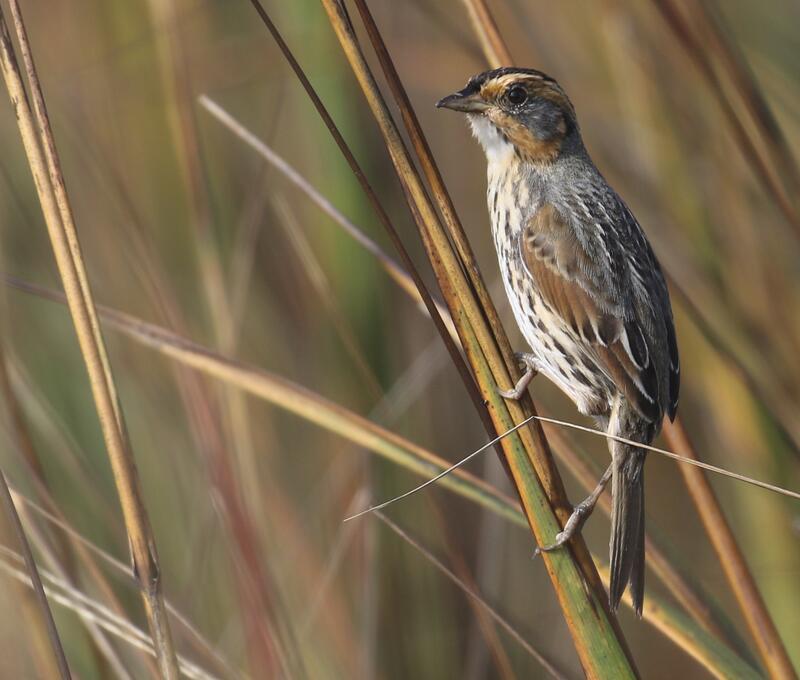
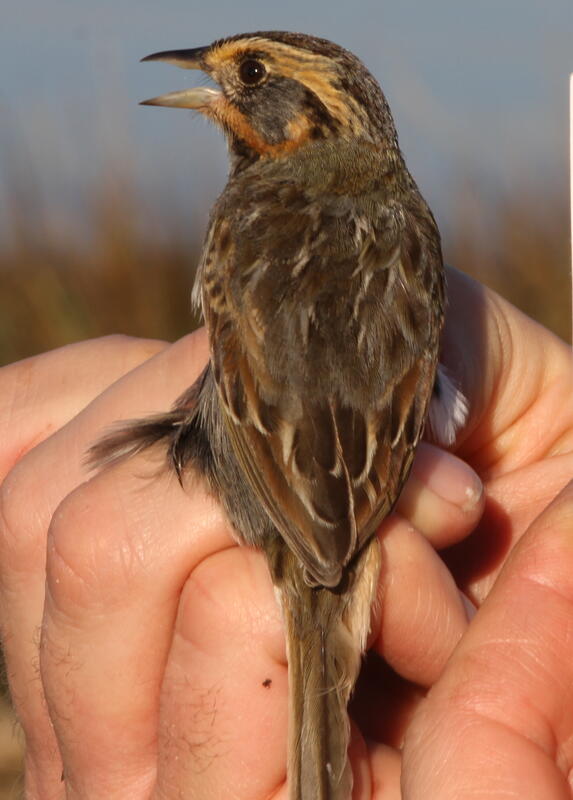
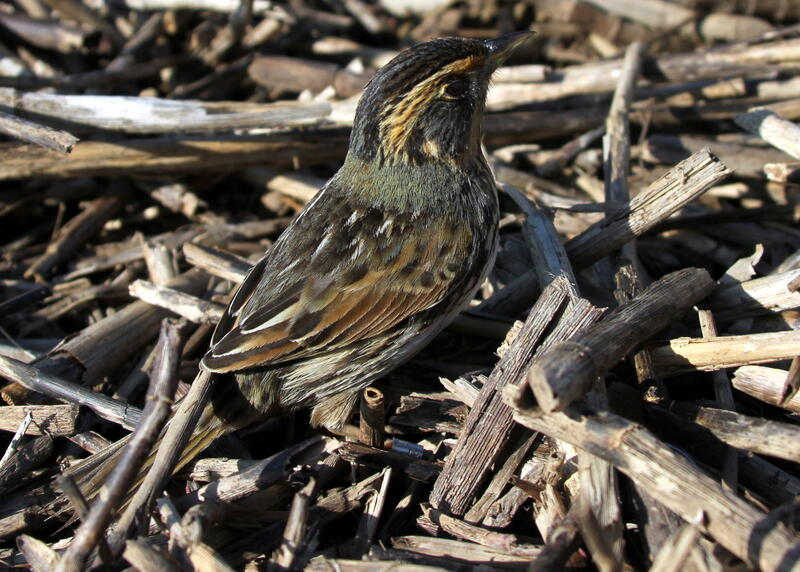
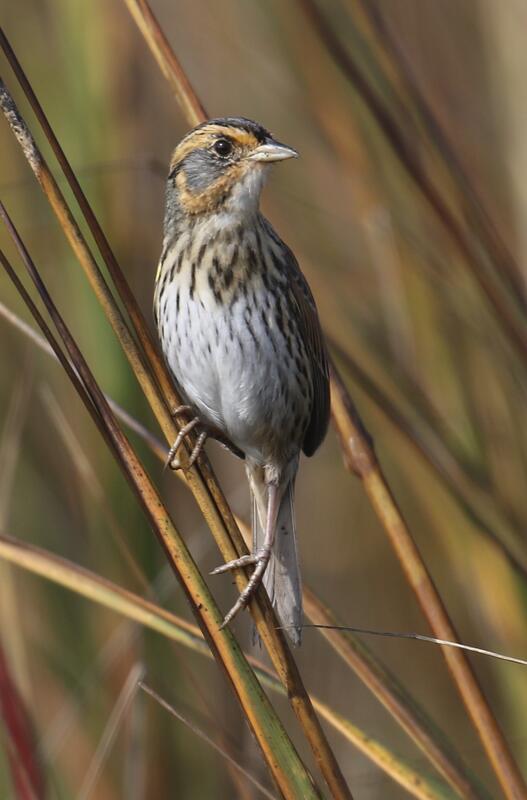
The saltmarsh sparrow is a small flat-headed sparrow with a relatively large bill and short tail exhibited by most of the genus Ammospiza. It typically exhibits varying degrees of dark buff color on the face that encircles a gray cheek. The upper breast and flanks typically have crisp bold streaks over a varying light yellowish buff to buff color, which quickly grades to white on most of the breast and the belly. The transition between the buffy breast and white belly is typically not well defined (like it is with Nelson’s sparrow). The saltmarsh sparrow shows a clean white throat bordered by orange malar, compared to the Nelson’s sparrow which has a less clean distinction between the malar and throat. A gray crown is flanked on both sides by dark stripes. This pattern is very similar to the interior subspecies of Nelson’s sparrow. The saltmarsh sparrow also has a plain gray unstreaked nape (often with some brown).
Most similar to Nelson’s sparrow (Ammospiza nelsoni) and considered to be conspecific (the same species) until 1995. A hybrid zone exists in southern Maine where the northern subspecies (A. c. caudacuta) interbreeds with the coastal nesting Nelson’s (A. n. subvirgatus). These hybrids are sometimes intermediate in appearance but can also be indistinguishable from pure forms of either species. Also similar in appearance to the LeConte’s sparrow (Ammospiza leconteii), which is a lighter buff color on the face and yellow buff color on the flanks, with heavy dark streaking. LeConte’s has a thin white median crown stripe flanked by wide dark stripes and small purplish spotting on the nape. The tertials (flight feathers nearest the body) are edged in white.
The saltmarsh sparrow, as the name suggests, is an obligate saltmarsh species that tends to nest in higher elevation areas of marsh dominated by dense meadows of cordgrass (Spartina patens) and black needle rush (Juncus roemerianus) with a deep layer of thatch. It winters in saltmarsh habitat in reed cordgrass (Spartina alterniflora), black needle rush, and seaside oxeye (Borrichia sp.). Wintering birds are typically widely dispersed across the marsh, but extreme high tides concentrate these birds along the marsh-upland ecotone where large numbers can be seen.
Primarily invertebrates including adult and larval insects, spiders, amphipods, and mollusks supplemented by grass seeds, which are increasingly consumed during migration and winter.
Saltmarsh sparrows spend their entire life cycle in coastal marshes. They exhibit a unique breeding system described as “scramble polygyny” where non-territorial males inhabit large home ranges, only the females care for young, and almost every brood shows mixed paternity. While females solicit mating when receptive, males attempt to forcibly mount females at any time during the nesting cycle. First eggs are typically laid between early May and early June with clutches normally 3-6 eggs. Females incubate the eggs for about 12 days, and young depart the nest 9-10 days after hatching. This species is known to produce second broods. Failed nests are rapidly replaced (within 2-3 days), possibly an adaptation to nesting in close synchrony with the tidal cycle, thereby minimizing the chances the new nest will be flooded during the higher spring tides. This likely works well when the original nest failure was due to tidal flooding; however, nest depredation can offset the synchrony with tides and increase chances the new nest will be flooded before the young fledge. Another adaptation to the risk of tidal flooding is the construction of a nest canopy which holds the eggs in the nest reducing the chances that eggs will float away during flooding. Fall migration occurs through October, and by November wintering populations are fairly stable, until spring departure in late April and May. Banding on the coast of Georgia has documented a high degree of intra and inter-annual site fidelity for this species, mirroring wintering studies in North Carolina and Virginia. Through nano-tagging (very small radio transmitters) efforts we have shown migratory connectivity between the Georgia coast and various locations from New Jersey to Rhode Island. (LINK TO STORY MAP). Both the northern (A. c. caudacuta) and the southern subspecies (A. c. diversus) winter in the state, with about 65% A. c. caudacuta and 35% A. c. diversus.
Georgia DNR has banded wintering saltmarsh sparrows since 2011. We have documented both subspecies at a number of locations from Tybee Island south to St. Andrews Sound (Cumberland Island area). A survey designed to estimate wintering numbers could indicate the importance of the Georgia coast to wintering populations. Mercury monitoring should be conducted to determine if contaminated sites in coastal Georgia may be contributing to mercury levels found in these birds.
Breeds in Atlantic Coast salt and brackish marsh from northern Maine to the Delmarva Peninsula of Virginia. Winters from southern New England to the eastern Gulf Coast of Florida. There are no records of the species outside the Americas.
Long-term degradation and loss of coastal marshes due to development and sea level rise are the greatest threat to the species. Habitat has declined by 40% on the Atlantic Coast since the 1880s. Quality of remaining habitat has often declined through tidal restrictions, introduced species, ditching, and pollution. Saltmarsh sparrows have been documented with higher levels of mercury than other tidal marsh sparrows, though the reason for this is unknown. The levels of mercury found in these birds is typically believed to be harmful to songbirds. In Virginia it appears that mercury uptake is highest on the breeding grounds, and birds shed mercury through feather molt during the winter. Areas with high mercury contamination, such as Brunswick Harbor in coastal Georgia, may lead to increased uptake in winter as well. Nesting saltmarsh sparrows are also susceptible to nest predation, typically by species such as raccoons, coyotes, crows, blackbirds, house cats, and rats, that are abundant due to high tolerance for human altered landscapes.
| Threat 1 | Threat 2 | Threat 3 | |
|---|---|---|---|
| General Threat | Climate change & severe weather | Climate change & severe weather | Climate change & severe weather |
| Specific Threat | Storms & flooding | Habitat shifting & alteration | Storms & flooding |
Survey work conducted on wintering populations since 2011 reveals that Georgia has significant numbers of both subspecies of saltmarsh sparrow. Banding suggests that the northern subspecies (A. c. caudacuta) may make up about 65% of wintering birds while the southern subspecies (A. c. diversus) may make up about 35% of the winter population.
Although Georgia has extensive salt and brackish marsh (153,000 ha) much of this habitat is threatened by sea level rise and other factors. While the clearest threats to the saltmarsh sparrow occur on the breeding grounds from the mid-Atlantic to the northeastern U. S., there will likely be deterioration in the quality of wintering habitat associated with marsh erosion and fragmentation. The potential impacts of these changes are unknown for the species. Conservation efforts in Georgia should focus on maintaining wintering habitat through land acquisition and easements that allow for marsh migration as sea level rises. Thin layer sediment deposition should be tested as a means to maintain habitat in suitable areas.
Cristol, D. A., F. M. Smith, C. W. Varian-Ramos, and B. D. Watts. (2011). Mercury levels of Nelson's and Saltmarsh sparrows at wintering grounds in Virginia, USA. Ecotoxicology 20:1773-1779.
Greenlaw, J., C. S. Elphick, W. Post, and J. D. Rising (2018). Saltmarsh Sparrow (Ammodramus caudacutus), version 2.0. In The Birds of North America (P. G. Rodewald, Editor). Cornell Lab of Ornithology, Ithaca, NY, USA.
Walsh, J., W. G. Shriver, B. J. Olsen, K. M. O’Brien, and A. Kovach. 2015. Relationship of phenotypic variation and genetic admixture in Saltmarsh-Nelson’s sparrow hybrid zone. Auk 132:704-716.
Gjerdrum, C., C. S. Elphick, and M. Rubega. 2005. Nest site selection and nesting success in saltmarsh breeding sparrows: the importance of nest habitat, timing, and study site differences. Condor 107:849-862.
Wiest, W. A., M. D. Correll, B. J. Olsen, C. S. Elphick, T. P. Hodgman, D. R. Curson, and W. G. Shriver. 2016. Population estimates for tidal marsh birds of high conservation concern in the northeastern USA from a design-based survey. Condor 118:274-288.
Winder, V. L., A. K. Michaelis, and S. D. Emslie. 2012. Winter survivorship and site fidelity of Nelson’s, Saltmarsh and Seaside Sparrows in North Carolina. Condor 114:421-429.
Tim Keyes
12/11/2018