


Loading profile. Please wait . . .
Hartwrightia floridana Gray ex S. Wats.
Hartwrightia


Federal Protection: No US federal protection
State Protection: Threatened
Global Rank: G2G3
State Rank: S1
Element Locations Tracked in Biotics: Yes
SWAP 2015 Species of Greatest Conservation Need (SGCN): Yes
SWAP 2025 Species of Greatest Conservation Need (SGCN): Yes
2025 SGCN Priority Tier: Highest Conservation Concern
Element Occurrences (EOs) in Georgia: 11
Habitat Summary for element in Georgia: Wet savannas; ditches, sloughs and flatwood seeps
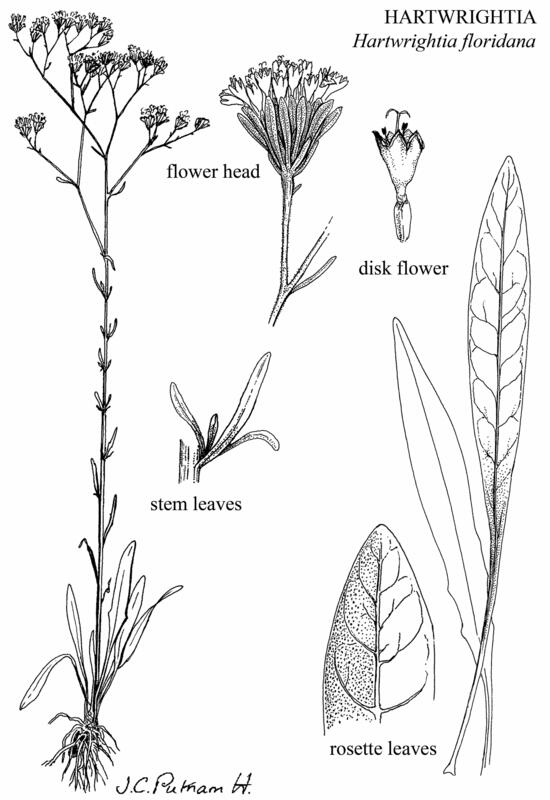
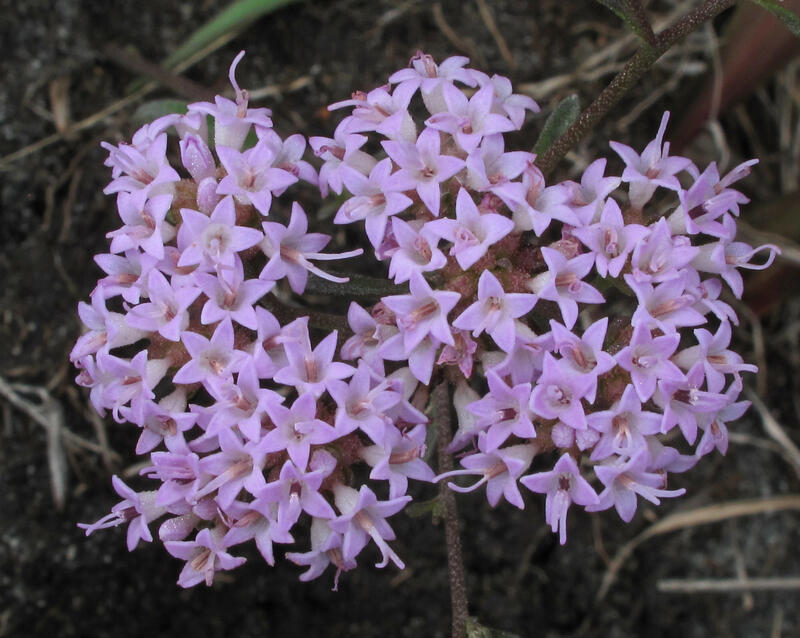
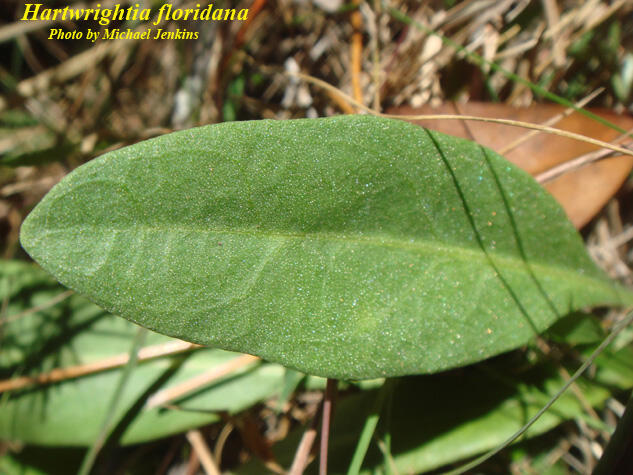
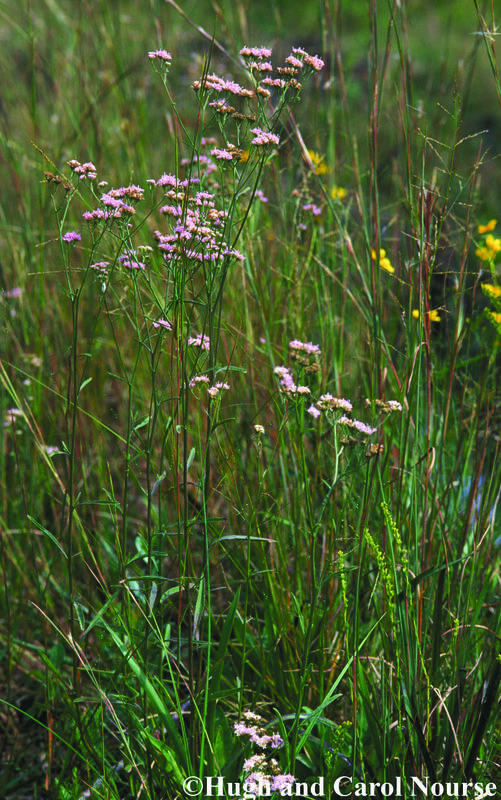
Perennial herb with a single, erect stem, 2 - 4 feet (60 - 120 cm) tall, rising from a rosette of basal leaves, usually branched only in the flower cluster. Rosette leaves are up to 10 inches (25 cm) long, with rounded tips and entire margins, the leaf bases tapering to a long leaf stalk; the leaves appear to have only a single vein. Stem leaves are mostly alternate and reduced in size upward along the stem until they become small, narrow bracts near the flower clusters. More or less flat-topped, branched flower clusters are held at the top of the stem and contain several flower heads. Flower heads are composed of 10 or fewer disc flowers; there are no ray flowers. Disc flowers are about 0.1 inch (3 - 3.5 mm) long, lavender, pale pink, or whitish, with 5 lobes. The fruits are dry, seed-like achenes, 5-angled or -grooved. All parts of the plant, from leaves to fruits, are dotted with glistening, sticky glands.
Vanilla Plant or Deer Tongue (Carphephorus odoratissimus) and related species occur in similar habitats and also have large basal leaves and dark pink flower heads in terminal clusters, but none of these have glistening glands.
Hartwrightia is the only species in its genus.
Open wet flatwoods, hillside seeps, and savannas with wet, peaty soils. Often with Hooded Pitcher-plants (Sarracenia minor) and Water-spider Orchid (Habenaria repens).
The reproductive biology of Hartwrightia has not been studied. Hartwrightia flowers are all perfect and fertile., Like most members of the aster family, Hartwrightia probably depends on insects to effect cross-pollination. Hartwrightia seeds are covered with sticky glands which may adhere to the bodies of insects or other animals that then disperse the seeds.
Surveys are best conducted during flowering (September–November); the rosette of sticky, gland-dotted leaves is distinctive, though not conspicuous, in spring and summer.
Southeast Georgia, northeast and central peninsular Florida.
Conversion of habitat to pine plantations and pastures; ditching and draining of wet flatwoods and seepage areas; logging and other clearing; cattle trampling; fire suppression.
| Threat 1 | Threat 2 | Threat 3 | |
|---|---|---|---|
| General Threat | Natural system modifications | Other options | None |
| Specific Threat | None | None | None |
Hartwrightia is ranked S1 by the Georgia Department of Natural Resources, indicating that it is critically imperiled in the state. Only 11 populations have been documented in Georgia, 1 on conservation land and another on a military base.
Apply prescribed fire every 2 - 3 years, primarily in the growing season, to eliminate woody competition. Avoid ditching, draining, or mechanical site preparation. Fence populations if needed to exclude cattle.
Chafin, L.G. 2007. Field guide to the rare plants of Georgia. State Botanical Garden of Georgia and University of Georgia Press, Athens.
Chafin, L.G. 2000. Field guide to the rare plants of Florida. Florida Natural Areas Inventory, Tallahassee.
Cronquist, A. 1980. Vascular flora of the southeastern United States, Vol. 1, Asteraceae. University of North Carolina Press, Chapel Hill.
GADNR. 2020. Element occurrence records for Hartwrightia floridana. Georgia Department of Natural Resources, Wildlife Resources Division, Social Circle, Georgia.
Godfrey, R.K. and J.W. Wooten. 1981. Aquatic and wetland plants of southeastern United States, Vol. 2, dicotyledons. University of Georgia Press, Athens.
Kral, R. 1983. A report on some rare, threatened, or endangered forest-related vascular plants of the South. Technical Publication R8-TP2. United States Forest Service, Atlanta.
NatureServe. 2019. Hartwrightia floridana comprehensive report. NatureServe Explorer. Arlington, Virginia. http://explorer.natureserve.org/servlet/NatureServe?searchName=Hartwrightia+floridana
Nesom, G.L. 2006. Hartwrightia floridana species account. Flora of North America, Vol. 21. Oxford University Press, New York. http://www.efloras.org/florataxon.aspx?flora_id=1&taxon_id=220006087
Nourse, H. 2002. The elusive Hartwrightia. Tipularia, Journal of the Georgia Botanical Society 17: 36-40.
Patrick, T.S., J.R. Allison, and G.A. Krakow. 1995. Protected plants of Georgia. Georgia Department of Natural Resources, Natural Heritage Program, Social Circle.
Weakley, A.S. 2015. Flora of the southern and mid-Atlantic States. University of North Carolina Herbarium, University of North Carolina, Chapel Hill. http://www.herbarium.unc.edu/flora.htm
Linda G. Chafin
L. Chafin, Feb. 2008: original account.
K. Owers, Jan. 2010: added pictures.
L. Chafin, Feb 2020: updated original account.