


Loading profile. Please wait . . .
Rallus elegans Audubon, 1834
King Rail


Federal Protection: No US federal protection
State Protection: No Georgia state protection
Global Rank: G4
State Rank: S3
Element Locations Tracked in Biotics: Yes
SWAP 2015 Species of Greatest Conservation Need (SGCN): Yes
SWAP 2025 Species of Greatest Conservation Need (SGCN): Yes
2025 SGCN Priority Tier: High Conservation Concern
Element Occurrences (EOs) in Georgia: 4
Habitat Summary for element in Georgia: Freshwater to brackish emergent herbaceous wetlands of grasses, sedges, cattails, wild rice; herbaceous portions of forested wetlands.
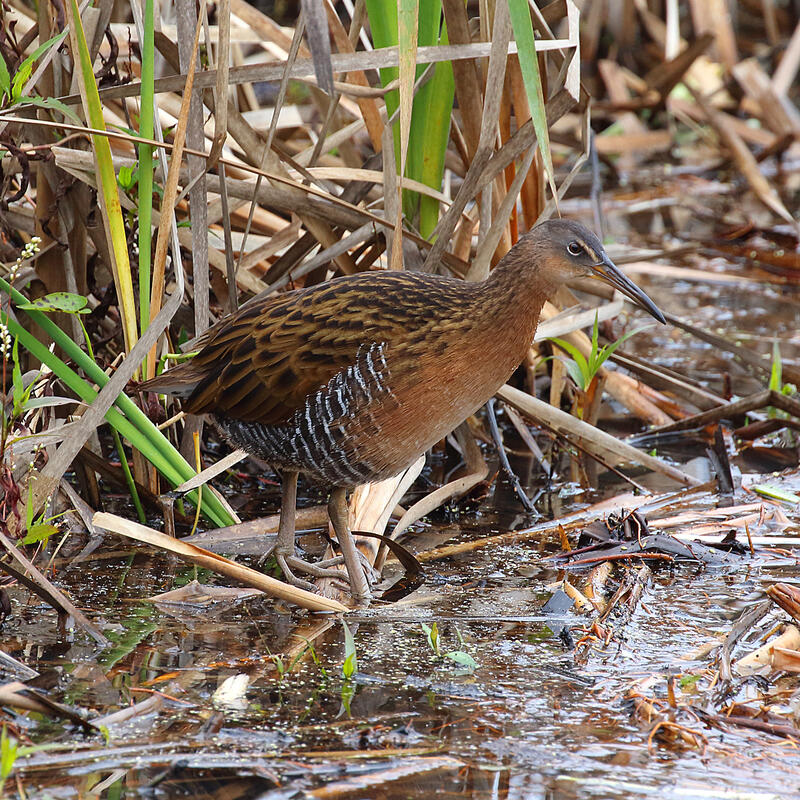
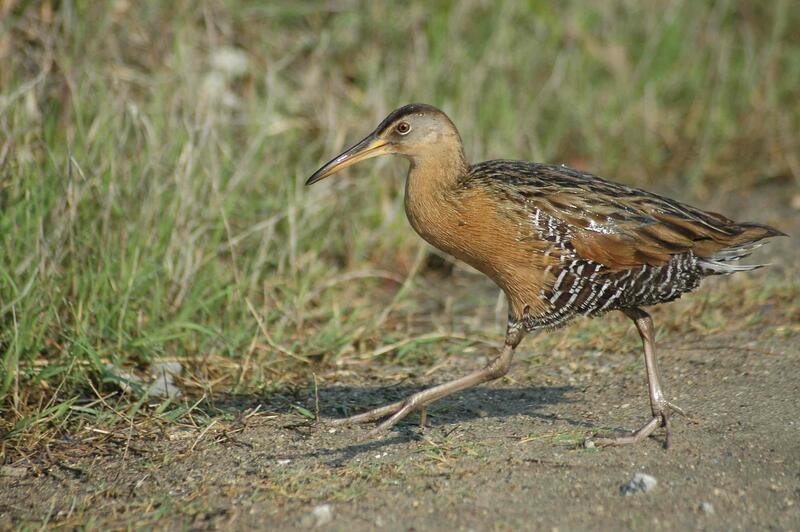
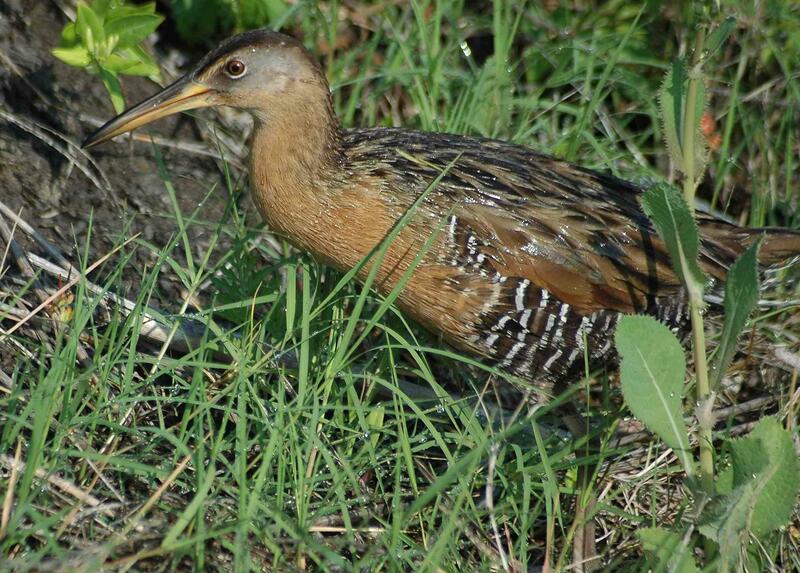
A large and striking rail, this bird has a relatively long down-curved bill that is yellow with gray on the dorsal surface of the upper mandible and on the tip. A brown crown extends from the base of the bill across the top of the head and down the back of the neck to the nape. The auricular and area behind the red-orange eye is light gray. A white chin gives way to a brown throat, neck, and breast. Scapular feathers are blackish with wide buff colored margins. Upper portions of the primary feathers are darker brown to black with buffy to brown edges. The flanks have alternating broad dark stripes separated by thinner white stripes. Legs are pinkish-gray to gray. In flight, the upper wing coverts show a distinct chestnut color.
Looks very similar to its congener, the clapper rail (Rallus crepitans), and at times the two have been considered a superspecies or conspecific (the same species). In fact, most of the king rail’s vocalizations are indiscernible from, or very similar to, those of the clapper rail, and occasionally these two species interbreed where their habitats overlap in brackish marshes. Clapper rails tend to be more gray in color, but the best characteristic to distinguish these two species in the field is the color of the scapular feather margins, which are buff color for king rails, and gray for clapper rails.
Freshwater (tidal and non-tidal) marshes, tidal brackish marshes, scrub-shrub swamps with adequate herbaceous vegetative cover, rice fields, and impoundments. Vegetative cover includes grasses, sedges, rushes, cattails (Typha spp.), smartweed (Polygonum spp.), and similar herbaceous plants. Water levels vary from moist soils to water depths of about 30cm. Micro-topography is important with sites usually containing an interspersion of hummocks, swales, and dry patches.
Foods include crayfish, fiddler crabs (in brackish habitats), small clams, snails, aquatic insects, beetles, grasshoppers, crickets, fish, frogs, spiders, and seeds of aquatic plants (mostly in winter).
The breeding season in Georgia likely starts as early as February with pair formation. Nest building probably begins in late February or early March and continues through July or August. Nests with eggs have been found in Georgia from April through June. The egg nest is constructed from dead vegetation with a base composed of wet decaying material and a platform built from dry grasses, sedges, or rushes, often with a canopy woven from adjacent plant stems. It is usually placed several centimeters above the ground in or near a clump of grasses or sedges. A ramp of dead vegetation is attached, which aids the young as they leave the nest. Additional nest platforms are built nearby as brooding sites. Usually 10-12 eggs are laid (range 4-15 eggs) at one day intervals. Both sexes share incubation duties, which normally start after the last egg is laid and continue for 21-23 days. Chicks are semiprecocial, leaving the nest anywhere from one to several hours after hatching. Day-old chicks are already able to follow their parents for a substantial distance and will take food from their bills. While chicks may start to pick up food from the ground as soon as their second day, they are still fed almost exclusively by their parents for an additional three weeks. By weeks 4-6, young birds are feeding on their own more than half the time and by weeks 7-9 the young are usually feeding themselves exclusively. Double brooding, while not documented, is likely to occur in the southern portion of this bird’s range given the long breeding season and the fact that the closely related clapper rail can double-brood. It is thought that most king rails that breed in the northern portion of the range migrate south for winter; however, the exact locations of migration pathways and wintering sites is unknown. Wintering birds use habitats similar to those used during breeding, although occasionally some individuals are found in more saline marshes. Birds that breed in Florida, along the Atlantic and Gulf coasts, the southern Mississippi River Valley, Mexico, and Cuba are year-round residents. Fall migration starts in September and likely continues through October or early November. Migration in spring probably starts in March and likely is finished by late May. It appears individuals migrate alone and at night.
Call playback that incorporates a series of recorded king rail vocalizations as well as passive listening periods is the most effective survey technique to use during the breeding season. This technique had been used successfully at Altamaha WMA by Wildlife Conservation Section staff for several years starting in 2011 when standardized playback surveys were conducted for secretive marshbirds, including the king rail. These surveys were also conducted at Silver Lake, Clayhole Swamp, and Chickasawhatchee WMAs and a Georgia Department of Transportation mitigation site in Brooks County; however, no king rails were detected at these sites. Additional sites that should be surveyed in the future include Lake Seminole, Grand Bay, and Ocmulgee WMAs, Arrowhead and Paradise Public Fishing Areas (PFAs), and Banks Lake, Eufaula, Savannah, and Okefenokee NWRs.
Breeding occurs locally throughout most of the eastern United States, except in the Appalachian Mountains, the northern New England states, and the very northern reaches of the Midwest. It also breeds in very southern Ontario, Canada. This bird is a year-round resident along the Atlantic coast from New York to Georgia, in all of Florida and Louisiana, most of Mississippi, coastal Alabama, southeastern Arkansas, eastern Texas, areas near the Mississippi River in Missouri, Tennessee, Kentucky, and southern Illinois, along the Gulf Coast of Mexico from Tamaulipas south almost to Tabasco, interior areas of central Mexico, and Cuba. Populations are greatest along the Atlantic and Gulf coasts and in the Mississippi River drainage, including most of the rice belt. In Georgia, the king rail breeds fairly commonly throughout the Coastal Plain, particularly near the coast, and less commonly in the Piedmont, where habitat is widely scattered. It was rarely documented during Breeding Bird Atlas surveys (1994-2001) due to its secretive nature and inaccessibility of much of its breeding habitat. Breeding was confirmed during the Breeding Bird Atlas in Greene, Stewart, Cook, and Appling counties. It is known to be a regular breeder at Altamaha WMA, and Eufaula, Okefenokee, and Savannah NWRs.
Ditching, filling, and draining of wetlands has resulted in the loss of a significant percentage of king rail habitat and continues to be the greatest threat to this species. However, climate change, with predicted warmer and drier conditions, will likely further reduce the number and quality of wetlands through decreased water inputs, higher evaporation rates, and more erratic rainfall patterns which may become an even greater threat than direct human impacts. Other threats associated with wetland loss and modification that decrease the functionality of remaining wetlands include; displacement of native wetland vegetation by invasive native and non-native plant species (e.g., Phragmites), fragmentation of wetland habitats from construction of roads, utility rights-of-way, and levees; siltation and excess nutrient loads from the surrounding landscape; saltwater intrusion into tidal, freshwater marshes caused by sea level rise; incompatible management practices for other species (e.g., open water management for waterfowl; inappropriate fire regimes); and contaminant runoff causing direct mortality or indirectly disrupting food supplies. In addition, increased numbers of raccoons (Procyon lotor), and other predators caused by development and other human modifications to the landscape could cause elevated predation rates in some areas.
| Threat 1 | Threat 2 | Threat 3 | |
|---|---|---|---|
| General Threat | Climate change & severe weather | Climate change & severe weather | Natural system modifications |
| Specific Threat | Habitat shifting & alteration | Storms & flooding | Dams & water management/use |
There are several wildlife management areas, national wildlife refuges, and other state and federal lands that have breeding and wintering king rail populations. Some of these that likely have significant populations include; Altamaha, Phinizy Swamp, and Lake Seminole WMAs and Eufaula, Savannah, and Okefenokee NWRs.
Georgia appears to have many areas of potentially suitable breeding and wintering habitat including sites on state and federal lands as well as private lands. Altamaha WMA is one of the larger (~3000 acres of impoundments) and better sites that could be effectively managed for both rails and waterfowl. One of the biggest impediments here has been failing and non-functioning water control structures due to age and damage caused by hurricanes and other storms as well as relatively flat topography in the impoundments due to past history as a rice plantation. Recently, most of these water control structures have been repaired or replaced and most of the water control structures are now functional. Creation of micro-topography within the impoundments could effectively create a substantial amount of suitable habitat for king rails, and other marshbirds, while retaining the habitat qualities needed for wintering waterfowl. Other WMAs and NWRs with impoundments within the state also offer potential for management for king rails and associated marshbirds. Effective management of these state and federal lands is particularly critical given that little quality habitat remains on private lands across the range of this species. Fire has been used as a management tool to maintain marshbird habitat. Studies of the effects and effectiveness of this management tool should be conducted to evaluate both the potential positive and negative effects of various prescribed fire regimes on king rail and marshbird habitat quality and populations.
Bailey, H. B. 1883. Memoranda of a collection of eggs from Georgia. Bulletin of the Nuttall Ornithological Club 8:37-43.
Beaton, G. 2010. King Rail (Rallus elegans). Pp. 148-149 in T. M. Schneider, G. Beaton, T. S. Keyes, and N. A. Klaus, eds. The Breeding Bird Atlas of Georgia. University of Georgia Press, Athens.
Bell, G. W., and R. C. Werner. 1947. General notes: King Rail in DeKalb County near Atlanta. Oriole 12:36-37.
Burleigh, T. D. 1958. Georgia Birds. University of Oklahoma Press, Norman, OK.
Cooper, T. R. 2008. King Rail Conservation Plan, Version 1. U. S. Fish and Wildlife Service, Fort Snelling, Minnesota. 121pp.
Eddleman, W. R., F. L. Knopf, B. Meanley, F. A. Reid, and R. Zembal. 1988. Conservation of North American Rallids. Wilson Bulletin 100:458-475.
Erichsen, W. J. 1921. Notes on the habits of the breeding water birds of Chatham County, Georgia. Wilson Bulletin 33:16-28; 69-82.
Griffin, W. W. 1940. Nesting extremes for bird breeding in the Atlanta region. Oriole 5:1-6.
Griffin, W. W., and J. C. Major. 1947. General notes: King Rail Rallus elegans elegans. Oriole 12:36.
Johnston, D. W. 1954. Supplemental notes on birds of the Athens area. Oriole 19:1-3.
Meanley, B. 1953. Nesting of the King Rail in the Arkansas ricefields. Auk 70:262-269.
Meanley, B. 1956. Food habits of the King Rail in the Arkansas ricefields. Auk 73:252-258.
Meanley, B. 1962. Ecological notes on mixed populations of King Rails and Clapper Rails in Delaware Bay marshes. Auk 79:453-457.
Meanley, B. 1969. Natural history of the King Rail. North American Fauna No. 67. 108 pp.
Meanley, B., and D. K. Wetherbee. 1962. Ecological notes on mixed populations of King Rails and Clapper Rails in Delaware Bay marshes. Auk 79:453-457.
Patterson, T. K. 1976. Breeding records of some pond and marsh birds in Laurens County, Georgia. Oriole 41:8-13.
Poole, A. F., L. R. Bevier, C. A. Marantz and B. Meanley. 2005. King Rail (Rallus elegans).In The Birds of North America Online (A. Poole, Ed.). Ithaca: Cornell Laboratory of Ornithology; Retrieved from BNA Online database: http://bna.birds.cornell.edu/BNA/account/King_Rail/ .
Reid, F. A., B. Meanley, and L. H. Fredrickson. 1994. King Rail. Pages 180-191 in: Tacha, Thomas C. and Clait E.Braun [Eds]. Migratory Shore and Upland Game Bird Management in North America. International Association of Fish and Wildlife Agencies. Washington DC. 223 pp.
Ripley, S. D. 1977. Rails of the World: A Monograph of the Family Rallidae. David R. Godine, Boston, MA.
Giff Beaton and Todd M. Schneider
G. Beaton Breeding Bird Atlas account; 2010
T. Schneider (modified and edited text): 6 March 2019