



Loading profile. Please wait . . .
Isoetes boomii Luebke
Boom's Quillwort


Federal Protection: No US federal protection
State Protection: No Georgia state protection
Global Rank: G1
State Rank: S1S2
Element Locations Tracked in Biotics: Yes
SWAP 2015 Species of Greatest Conservation Need (SGCN): Yes
SWAP 2025 Species of Greatest Conservation Need (SGCN): Yes
2025 SGCN Priority Tier: Highest Conservation Concern
Element Occurrences (EOs) in Georgia: 6
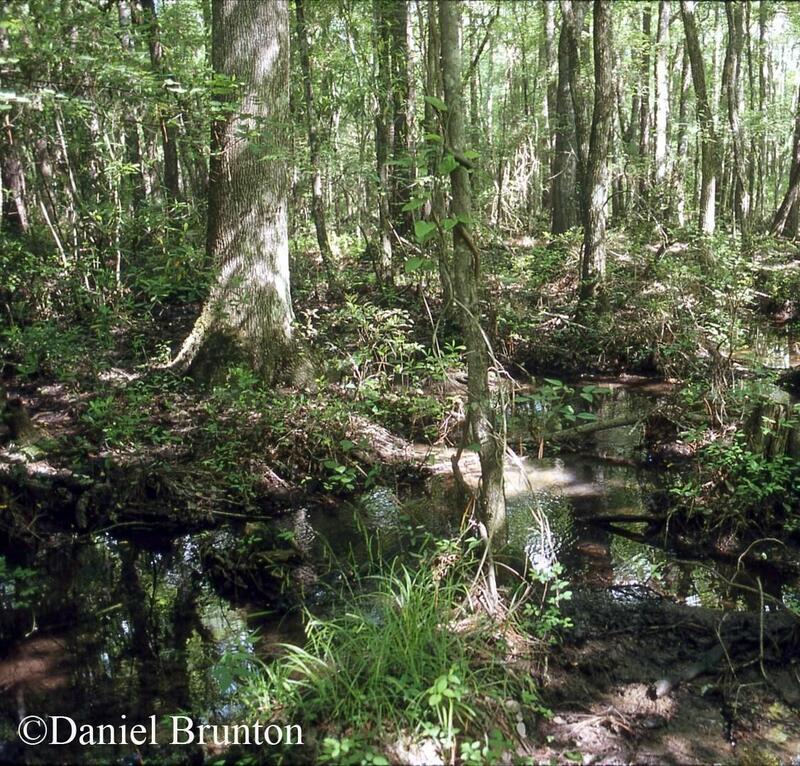
Habitat Summary for element in Georgia: Shallow water (one foot deep) of slow moving streams
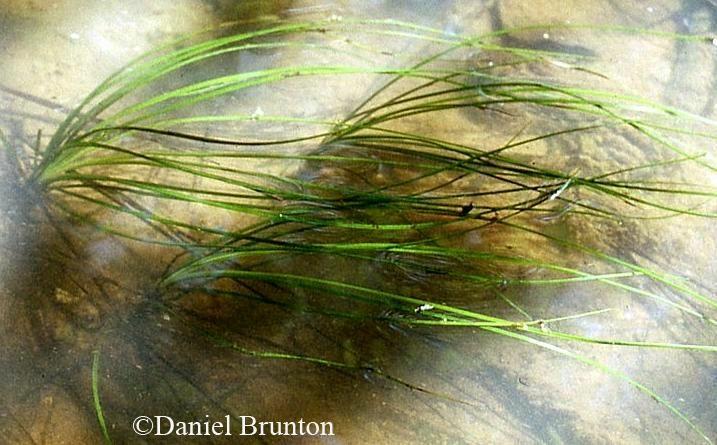
Perennial herb arising from a round rootstock and forming clumps in flowing water. The rootstock (corm) is nearly round, with two lobes. The leaves arise from directly from the corm and are up to 18 inches (45 cm) long, bright green fading to pale green at the base, flexible, with an expanded base, tapering tip, 4 cross-walls, and single midvein. Spores are produced in a sporangium, a small, brown-streaked chamber in the leaf base, with a translucent membrane (velum) covering approximately 30% of the chamber opening. Dozens of tiny female spores (megaspores), approximately 0.6 mm across, may be seen with 10 - 20x magnification; these are white with brown streaks and covered with a densely congested pattern of narrow, interconnecting ridges. Light gray, dust-sized male spores (microspores) are produced on separate leaves but are indistinguishable without much higher magnification.
Quillworts are distinguished from flowering, wetland plants by their spongy leaves with conspicuous cross-walls and by the presence of sporangia in the dilated base of the leaves.
Southern quillwort (Isoetes flaccida, Georgia Special Concern) occurs in habitats similar to Boom’s quillwort’s and also has long, flexible leaves; however, its velum completely covers the spore cavity, which is colorless, not streaked with brown, and the megaspores are white with a bumpy surface.
Georgia quillwort (Isoetes georgiana, Georgia Special Concern) is similar but with wider velum coverage and a coarser megaspore ornamentation pattern.
Engelmann’s quillwort (Isoetes engelmannii) and Appalachian quillwort (I. appalachiana, Georgia Special Concern) have smaller megaspores with reticulate (honeycomb) ornamentation patterns and smaller velum coverages (less than 30%) over their sporangia.
Winter quillwort (Isoetes hyemalis) also has smaller megaspores with a coarse, low-spiny ornamentation pattern and smaller velum coverage (less than 25%) over the sporangia.
Twelve quillwort species are state-listed or considered of Special Concern in Georgia. Information about each of these species may be found at these links:
Appalachian Quillwort (Isoetes appalachiana) http://explorer.natureserve.org/servlet/NatureServe?searchName=Isoetes+appalachiana
Boom's Quillwort (Isoetes boomii) https://www.georgiabiodiversity.org/portal/editprofile?group=plants&es_id=17134
Glade Quillwort (Isoetes butleri) http://www.efloras.org/florataxon.aspx?flora_id=1&taxon_id=250076861
Florida Quillwort (Isoetes flaccida) https://www.georgiabiodiversity.org/portal/profile?group=plants&es_id=19963
Georgia Quillwort (Isoetes georgiana) https://www.georgiabiodiversity.org/portal/profile?group=plants&es_id=16950
Winter Quillwort (Isoetes hyemalis) https://www.georgiabiodiversity.org/portal/profile?group=plants&es_id=17363
Rush Quillwort (Isoetes junciformis) https://www.georgiabiodiversity.org/portal/profile?group=plants&es_id=18998
Black-footed Quillwort (Isoetes melanopoda) http://www.efloras.org/florataxon.aspx?flora_id=1&taxon_id=250076862
Black-spored Quillwort (Isoetes melanospora) https://www.georgiabiodiversity.org/portal/profile?group=plants&es_id=22510
Broxton Rocks Quillwort (Isoetes "snowii," undescribed) https://bioone.org/journals/castanea/volume-83/issue-2/17-122/Interesting-Provocative-and-Enigmatic--Morphological-Observations-on-Southeastern-Quillworts/10.2179/17-122.full
Mat-forming Quillwort (Isoetes tegetiformans) https://www.georgiabiodiversity.org/portal/profile?group=plants&es_id=20422
Mountain Bog Quillwort (Isoetes valida) https://www.jstor.org/stable/1547604?seq=1#metadata _info_tab_contents
Shallow, flowing water of deeply shaded streams through swamps, with few or no associated plants.
Quillworts are seedless, non-flowering plants that reproduce by spores and have a short, fleshy, rootstock called a corm; leaves are produced on the upper surface of the corm, roots on the lower surface. The leaves wither during dry periods on exposed plants; however, the corm remains alive and will begin to produce leaves again when there is adequate water. The leaves have hollow chambers at the base where two types of spores are produced: tiny, dust-sized microspores develop sperm-producing structures, and larger (though still minute) megaspores produce eggs. Sperm swim to the eggs in available water and unite to form new plants. Quillworts compete poorly with other aquatic plants and are typically found in relatively sterile sand or silt or in frequently water-worn sites that support few or no other vascular plants.
Surveys are best conducted in spring–early summer when plants are most conspicuous and leaves have not withered; mature megaspores are best developed in mid–late summer but can usually be found (from previous years’ growth) in the soil at the base of plants in the spring.
Four counties in the upper Coastal Plain of Georgia, one county in northeast Florida, and possibly one county in southeastern Alabama.
Ditching, draining, and filling in wetlands; impounding streams; clearcutting in swamps and floodplains; and trash dumping in wetlands.
| Threat 1 | Threat 2 | Threat 3 | |
|---|---|---|---|
| General Threat | Natural system modifications | Pollution | Invasive & other problematic species, genes & diseases |
| Specific Threat | None | None | None |
Isoetes boomii is ranked S1S2 by the Georgia Department of Natural Resources, indicating that it is imperiled in Georgia. Six populations have been documented in Georgia; two occur on conservation lands.
Protect floodplains and swamps from damming, clearing, draining, filling, and trash dumping. Maintain water quality (including nutrient and water temperature conditions) within local watersheds.
Brunton, D.F. 2015. Key to the Quillworts (Isoëtes: Isoëtaceae) of the Southeastern United States. American Fern Journal 105(2): 86-100. https://www.jstor.org/stable/44076059?seq=1#metadata_info_tab_contents
Brunton, D.F. 27 February 2007. Letter to Linda Chafin, State Botanical Garden of Georgia, Athens.
Brunton, D.F. and D.M. Britton. 1996. The status, distribution, and identification of Georgia quillwort (Isoëtes georgiana, Isoetaceae). American Fern Journal 86: 105-113. https://www.jstor.org/stable/1547149
GADNR. 2020. Element occurrence records for Isoetes boomii. Georgia Department of Natural Resources, Wildlife Resources Division, Social Circle, Georgia.
Luebke, N.T. 1992. Three new species of Isoëtes from the southeastern United States. American Fern Journal 82(1): 23-26. https://www.jstor.org/stable/1547757
Musselman, L.J. 2001. Georgia quillworts. Tipularia, Journal of the Georgia Botanical Society 16: 2-19, and 40.
NatureServe. 2019. Isoëtes boomii comprehensive report. NatureServe Explorer. Arlington, Virginia. http://explorer.natureserve.org/servlet/NatureServe?searchName=Isoëtes+boomii
Russell, C.L. and R.D. Bray. 1997. A comparative study of Isoëtes boomii and I. georgiana. ASB Bulletin 44(2).
Taylor, W.C., N.T. Luebke, D.M. Britton, R.J. Hickey, D.F. Brunton. 1993. Isoëtes boomii species account. Flora of North America, Vol. 2. Oxford University Press, New York. http://beta.floranorthamerica.org/Iso%C3%ABtes_boomii
Weakley, A.S. 2015. Flora of the southern and mid-Atlantic States. University of North Carolina Herbarium, University of North Carolina, Chapel Hill. http://www.herbarium.unc.edu/flora.htm
Linda G. Chafin and Daniel F. Brunton
L. Chafin and D. Brunton, Dec. 2008: original account
K. Owers, Feb. 2010: added pictures
L. Chafin, March 2020: updated original account.