



Loading profile. Please wait . . .
Setophaga cerulea (Wilson, 1810)
Cerulean Warbler



Federal Protection: No US federal protection
State Protection: Rare
Global Rank: G4
State Rank: S1B
Element Locations Tracked in Biotics: Yes
SWAP 2015 Species of Greatest Conservation Need (SGCN): Yes
SWAP 2025 Species of Greatest Conservation Need (SGCN): Yes
2025 SGCN Priority Tier: Moderate Conservation Concern
Element Occurrences (EOs) in Georgia: 0
Habitat Summary for element in Georgia: Mature deciduous forest; floodplains or other mesic conditions
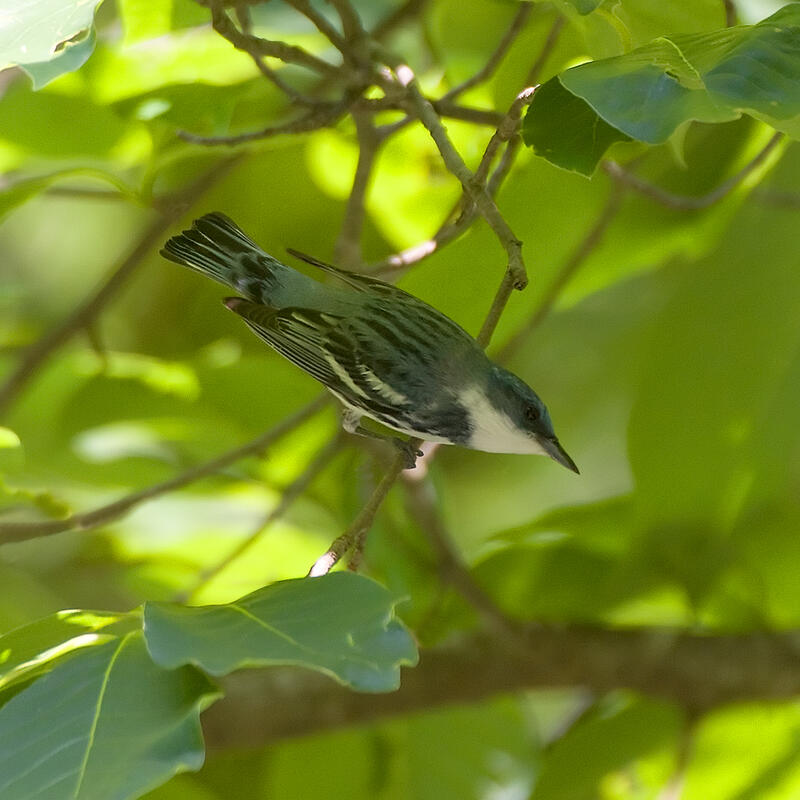
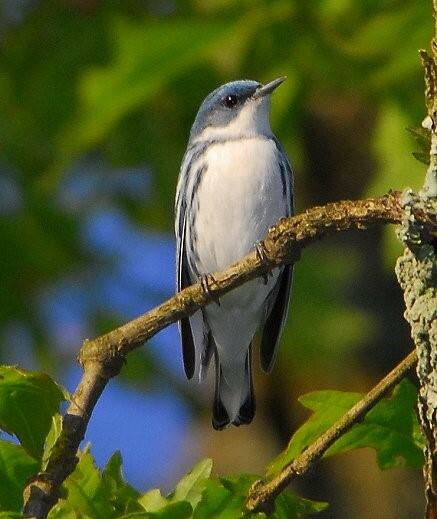
A small, chunky, short-tailed warbler about 11.5-12.0 cm (4.5-4.75 in) long. Males have light blue upperparts with black streaking, white throat and underparts, two white wingbars, a dark blue and black band separating the throat and breast, and blue streaking on the flanks. Females have bluish-green upperparts, light grayish-white throat and underparts, a whitish-gray eyebrow (superciliary) stripe above the eye, no neck band, and yellowish-gray flanks with faint grayish streaking. Immature females are similar in appearance to adult females but have a more creamy-yellow hue to the throat and flanks, only very faint streaking on the flanks, and a creamy-yellow eyebrow stripe.
The male black-throated blue warbler (Setophaga caerulescens) is somewhat similar in appearance, but has deeper blue upperparts, a black face and upper throat, and black flanks. It has a distinctive single white wing bar, which often appears to be a small white rectangle or triangle. Female black-throated blue warblers are a drab greenish-brown on both the upper and lower parts, except the vent area, which is white. Black-throated blue warblers generally inhabit the shrubby midstory and understory of rich hardwood sites while the cerulean warbler spends most of its time high in the canopy. Adult male blackpoll warblers (Setophaga striata) that are migrating through the state in fall can look similar to female cerulean warblers, but have gray streaking on the back, darker gray and more olive green hues on the back, face, throat, and flanks, and a thin gray lateral throat stripe. First year female blackpolls can also look similar to female cerulean warblers, but tend to have olive green upperparts rather than the blue-green of the cerulean. The female blackpoll also has faint streaking on the shoulder and upper back, grayish color on the neck, and the superciliary is very thin. The first year female blackburnian warbler (Setophaga fusca) may also look similar to the female cerulean, but it has a gray tone to its upperparts, gray cheek and cap, and light colored streaking on its back.
Typical breeding habitat across this bird's range includes mature broad-leafed forest, particularly old-growth bottomland forest; however, it will at times use second growth forest. It appears that this species prefers larger forest tracts with at least some very large trees and a canopy with horizontal heterogeneity. In Georgia, the cerulean warbler is usually found only in the Southern Appalachians during the breeding season, though it is an uncommon migrant in the western part of the state and a very rare migrant in the eastern part of the state. It typically inhabits rich oak-hickory or cove forests, often near a ridge top, where canopies are more likely to be damaged by storms. Males usually focus their territories on these gaps, but each territory also includes adjacent areas of extensive forest with a complex, well-developed, multilayered canopy. These sites generally have 0.4-1.6 large trees per hectare (1-4 trees per acre) and a dense understory of young trees.The nest is normally placed in one of the largest trees in the territory. This species preferentially nests in uneven-aged stands with at least a few very large trees. It appears to be a forest interior species, preferring to nest in areas with high regional forest cover.
The diet of this species is poorly studied but limited research shows it likely consists mostly of arthropods, particularly cicadas, leafhoppers, aphids, sawflies, bees, ants, wasps, and butterflies and moths (especially larvae) during the breeding season. It also may eat some plant material during migration or on wintering grounds.
The breeding season in Georgia begins in mid-April. Males arrive first at the breeding site with females arriving as much as a week or more later. Pair formation occurs soon after females arrive and nest building usually commences by late April or early May. The nest is constructed by the female and is normally placed in one of the largest trees in the territory. Construction takes about 3-8 days after which the female lays 3-4 eggs that she incubates for 11–12 days before they hatch; young fledge 10–11 days later. Usually only one brood is raised per year, although it is possible that two broods could be raised in the southern portion of its range, but this has not been observed. During spring and fall migration this nocturnal migrant traverses the Gulf of Mexico between southern Central America and the U. S. Gulf Coast. Spring migrants arrive along the Gulf Coast from late March through mid-May. Due to the large distance between breeding and wintering sites spring migration can take up to two months. In fall ceruleans depart breeding sites as early as late July and most depart the Gulf Coast for Central America from late August through early October. Fall migration can last as long as four months, particularly for birds that breed at the northern edge of the range and winter near the southern edge. Kennesaw Mountain just west of Atlanta has been recognized as a significant stopover site for this species in both spring and fall. Cerulean warblers winter in humid subtropical and montane forests of the northern Andes from October through March. Most sites are at elevations between 500-1800 m. Here they often associate with canopy flocks of tanagers and other insectivorous birds.
Detection probabilities for this species are notoriously low. It is normal for a site of known occupancy to repeatedly have no detections during ten-minute point counts and no response to song playback. Since detection probability declines as the nesting season progresses, the best time to survey for this species is in late April or early May. Consider conducting repeated visits to a site and using playback after the passive aural point counts to elicit singing. It is likely that paired males vocalize considerably less than those without a mate, leading to a potential bias toward incorrectly characterizing marginal habitats as suitable breeding sites based on singing activity, while failing to detect the best occupied habitats.
Breeding range includes an area from southeastern Nebraska eastward across the southern Great Lakes region to southern Ontario, southwestern Quebec, and western New England, south to northern Texas, northern Alabama and Georgia, western North Carolina, and Maryland. In Georgia, the cerulean warbler is found only in the southern Appalachians during the breeding season. Breeding populations occur along Ivylog and Gumlog ridges in the Chattahoochee-Oconee National Forest in Union County. A few individuals have also been seen in other areas in Fannin, Lumpkin, Murray, Towns, and Union counties in recent years. During the Breeding Bird Atlas project (1994-2001) this species was found in the Jacks Gap, Neels Gap, Wilscot, and Blairsville 7.5 minute topographic quadrangles. This bird is an uncommon migrant in the western part of the state and a very rare migrant in the east. Sizable numbers occur at Kennesaw Mountain National Battlefield during both spring and fall migration. Winters primarily in a narrow elevational zone (500-1800 m) on the eastern slopes of the Andes Mountains from Colombia and Venezuela through Ecuador to Peru.
Cerulean warblers are habitat specialists and seem to prefer the complex canopy structure associated with older stands. In theory as the second growth forests of the Chattahoochee-Oconee National Forest continue to mature they will become more suitable for this species. In the meantime, cerulean warblers seem to be on the decline again in Georgia, with very few detections of this species on nesting territories in recent years. Range-wide declines are also being observed but determining a causal mechanism for these declines remains elusive. In addition to a lack of structural stand diversity, forest fragmentation or issues on the wintering grounds may be part of the reason for these declines.The effects of collisions with communications towers and other structures are not fully known, but a significant numbers of cerulean warblers were killed at a northwest Florida communications tower during a long-term study.
| Threat 1 | Threat 2 | Threat 3 | |
|---|---|---|---|
| General Threat | Natural system modifications | Climate change & severe weather | None |
| Specific Threat | Other ecosystem modifications | Temperature extremes | None |
Even though the Ivylog-Gumlog area of the Chattahoochee-Oconee National Forest has the only substantial population of the cerulean warbler known in the state, this species has also been found in Fannin, Lumpkin, and Murray counties in recent decades. In addition, there are several breeding season records for the cerulean warbler in the vicinity of Atlanta, though none recently.
During the Breeding Bird Atlas (1994-2001), Possible breeding occurred in the Jacks Gap quad (a quad is a 7.5 minute topographic quadrangle map), NE block (the northeast 1/6 of the 7.5 minute topographic quadrangle map); Neels Gap quad CW and NE blocks; and Wilscot quad, CW block. Probable breeding was recorded in the Blairsville quad, SW block and breeding was confirmed in the Blairsville quad, CE block. These sites are in Fannin, Lumpkin, Towns, and Union counties.
According to Breeding Bird Survey data, the Cerulean Warbler experienced annual population declines of 2.6% survey-wide from 1966-2015. This bird likely has undergone a similar decline in the Southern Appalachians. Sound forest management practices that enhance canopy complexity may improve habitat for this species. Creating gaps through the use of shelterwood and group selection harvests were effective in establishing new territories of this species in Georgia in the early 2000s. Key to the success of this effort was the siting of the project. Harvest needed to be in otherwise suitable forest types, rich cove hardwoods and rich upland hardwoods, and they needed to be close to existing populations of cerulean warblers. In addition to conservation issues on the breeding grounds, the cerulean warbler is very susceptible to habitat loss and fragmentation on its wintering grounds in the mature, humid evergreen forest of the Andean foothills.
Beaton, G. 2004. Birds of Kennesaw Mountain: An Annotated Checklist. Georgia Ornithological Society Occasional Publication 16.
Bell, G. W. 1938. Some nesting data on north Georgia birds. Oriole 3:21–22.
Buehler, D. A., and C. P. Nicholson. 1998. Ecology of the Cerulean Warbler in the Cumberland Mountains and the Southern Appalachians. Annual Report. University of Tennessee, Knoxville.
Crawford, R. L. 1981. Bird casualties at a Leon County, Florida tv tower: A 25-year migration study. Tall Timbers Research Station Bulletin 22.
Denton, J. F. 1936. Does the Cerulean Warbler nest in Georgia? Oriole 1:10.
Denton, J. F. 1947. A note on the occurrence and habits of the Cerulean Warbler at Augusta. Oriole 12:37-38.
Hamel, P. B. 2000a. Cerulean Warbler (Dendroica cerulea). In A. Poole and F. Gill, eds., The Birds of North America, no. 511. The Birds of North America, Inc., Philadelphia, Pa.
Hamel, P. B. 2000b. Cerulean Warbler Status Assessment. U.S. Fish and Wildlife Service, Minneapolis, Mn.
Hamel, P., and J. Jones. 2005. Biology of the Cerulean Warbler, Current Ideas on Status, and Activities of the Cerulean Warbler Technical Group in Modeling the South American Range of the Cerulean Warbler. Cumbayá, Ecuador, 1-3 November 2005. http://www.srs.fs.usda.gov/egc/events/conf2005/ProceedingsEnglishFin.pdf
Howell, A. H. 1924. Birds of Alabama. Dept. Game and Fish of Alabama, and U.S. Department of Agriculture, Bureau of Biological Survey, Montgomery, Alabama. 348 pp.
Klaus, N. A. 2010. Cerulean Warbler (Dendroica cerulea). Pp. 342–343 in T. M. Schneider, G. Beaton, T. S. Keyes, and N. A. Klaus, eds. The Breeding Bird Atlas of Georgia. University of Georgia Press, Athens.
LaPrade, W. H. Jr. 1922. Breeding warblers around Atlanta, Georgia. Wilson Bulletin 34:80–83.
Mayfield, G. R. 1944. D. C. Peacock — pioneer in field work for G.O.S. — an appreciation. Oriole 9:24–26.
Mueller, A. J., D. J. Twedt, and C. R. Loesch. 2000. Development of management objectives for breeding birds in the Mississippi Alluvial Valley. Pp. 12–17 in R. Bonney, D. N. Pashley, R. J. Cooper, and L. Niles, eds., Strategies for Bird Conservation: The Partners in Flight Planning Process. Proceedings of the 3rd Partners in Flight Workshop, October 1–5, 1995, Cape May, N.J. rmrs-p-16. U.S. Department of Agriculture Forest Service, Rocky Mountain Experimental Station, Ogden, Utah.
Nutt, L. N. 1998. An Interim Management Policy for Dendroica cerulea, Clinch Ranger District, George Washington and Jefferson National Forests. U.S. Department of Agriculture Forest Service, Wise, Va.
Oliarnyk, C. J., and R. J. Robertson. 1996. Breeding behavior and reproductive success of Cerulean Warblers in southeastern Ontario. Wilson Bulletin 108:673–684.
Ramey, J. F. 1996. Cerulean Warbler draft habitat management policy for national forests in North Carolina. U.S. Department of Agriculture Forest Service.
Robbins, C. S., J. W. Fitzpatrick, and P. B. Hamel. 1992. A warbler in trouble: Dendroica cerulea. Pp. 549–562 in J. M. Hagan III and D. W. Johnston, eds., Ecology and Conservation of Neotropical Migrant Landbirds. Smithsonian Institution Press, Washington, D.C.
Sauer, J. R., D. K. Niven, J. E. Hines, D. J. Ziolkowski, Jr., K. L. Pardieck, J. E. Fallon, and W. A. Link. 2017. The North American Breeding Bird Survey, Results and Analysis 1966-2015. Version 2.07.2017 U.S.G.S. Patuxent Wildlife Research Center, Laurel, MD.
Nathan A. Klaus and Todd M. Schneider
N. Klaus, 2010: Breeding Bird Atlas species account
T. Schneider, July 2010: modified and edited text
K. Owers, July 2010: updated status and ranks, added picture
G. Krakow, April 2016: updated link to Hamel, P. B. 2000b
T. Schneider, April 2019; Added photo 1 & 2
N. Klaus and T.Schneider, October 2019, modified and edited text