


Loading profile. Please wait . . .
Matelea alabamensis (Vail) Woods.
Alabama Milkvine


Federal Protection: No US federal protection
State Protection: Threatened
Global Rank: G2
State Rank: S1
Element Locations Tracked in Biotics: Yes
SWAP 2015 Species of Greatest Conservation Need (SGCN): Yes
SWAP 2025 Species of Greatest Conservation Need (SGCN): Yes
2025 SGCN Priority Tier: Highest Conservation Concern
Element Occurrences (EOs) in Georgia: 8
Habitat Summary for element in Georgia: Open bluff forests; mesic margins of longleaf pine sandridges
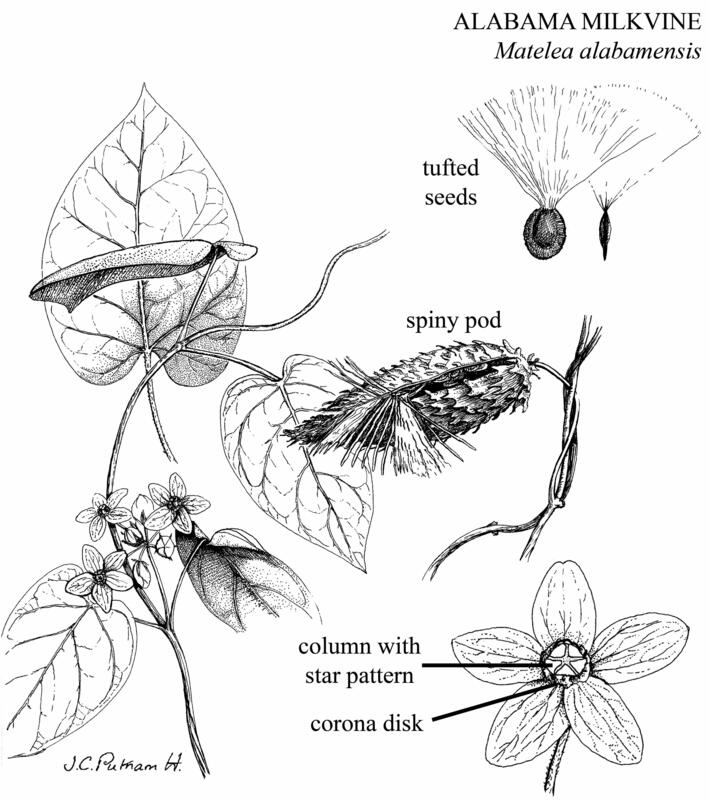
Perennial vine with non-woody, twining stems up to 6 feet (2 meters) long. The leaves are up to 6 inches (15 cm) long and 4.7 inches (12 cm) wide, opposite, heart-shaped; the leaf stalks are 1 - 2 inches (3 - 5 cm) long. Flowers are up to 1 inch (2.5 cm) wide, with 5 pale green petals marked with a network of darker green veins. At the center of the flower, a fleshy, dark yellow ring (corona) surrounds the column; at the top of the column, five white anther flaps create a green (or sometimes yellowish) star pattern. The fruit is a spiny, yellow-green pod up to 4 inches (10 cm) long. Seeds are flat with tufts of white hairs at their tips. All parts of the plant have milky latex.
All of Georgia’s milkvines have nearly identical stems and heart-shaped leaves; flowers or fruits must be present and considered along with location and habitat data in order to make a positive field identification.
The most common milkvine found throughout Georgia is Eastern Anglepod (Gonolobus suberosus, synonym Matelea gonocarpa or gonocarpus). Its flowers are yellowish-green with a dark brown star surrounding the corona and column. Its fruits are smooth, five-angled, and not spiny.
Five species of Matelea are rare in Georgia:
Alabama Milkvine (Matelea alabamensis) flowers are green with a conspicuous network of darker green veins and a dark yellow ring (corona) surrounding the central column; at the top of the column, five white anther flaps create a star pattern. For more information, see: https://www.georgiabiodiversity.org/portal/editprofile?group=plants&es_id=16946
Yellow Milkvine (Matelea flavidula) flowers are also green with a less well defined network of veins; the yellow ring (corona) surrounding the central column appears to broken into 5 segments, and the top of the column is green without a conspicuous star pattern. For images, see: https://www.flickr.com/search/?user_id=7449293%40N02&view_all=1&text=matelea%20flavidula
Florida Milkvine (Matelea floridana) usually has dark maroon or yellowish-green flowers. It is known from only one southwest Georgia county. For more information, see: https://georgiabiodiversity.org/portal/editprofile?group=plants&es_id=20426
Limerock Milkvine (Matelea obliqua) flowers are rose, maroon, green, or cream-colored with narrow, pointed petals that are frequently curved upward; in Georgia, it occurs only in northwestern counties in moist, limestone-based hardwood forests. For more information, see: https://www.wildflower.org/plants/result.php?id_plant=MAOB2
Trailing Milkvine (Matelea pubiflora) leaves are only up to 2 inches long and its flowers are very hairy; it occurs in southeast Georgia in open, dry, sandy scrub or sand ridge habitat. For more information, see: https://www.georgiabiodiversity.org/portal/profile?group=plants&es_id=22014
Sunny openings in pine-hardwood forests on bluffs and upper ravine slopes, and in open transition zones between slopes and longleaf pine sandhills.
Alabama Milkvine is a perennial vine that reproduces sexually by seeds. Flowering is more likely to take place in sunny areas where the plants have been able to climb upward on other plants or fallen tree branches. Its flowers are pollinated by small flies which visit the flowers to obtain nectar; flowers must be cross-pollinated to set fruit and produce seed. Flowers remain open for 5 - 6 days. When a fly inserts its proboscis into a flower in search of nectar, a packet of pollen may stick to the underside of the proboscis; the packet may then be transferred to a flower on the next plant the fly visits, although this actually happens fairly infrequently. The percentage of plants producing fruit has been found to be low, 6 - 21%. Alabama Milkvine fruits mature in late summer and fall when they split open to release hundreds of tufted seeds that are dispersed by the wind. However, its ravine habitat is sheltered from the wind and long distance dispersal is rare.
Surveys are best conducted during flowering (April–June, peaking in mid-May); flowers are required for identification.
Georgia, Florida Panhandle, and southeast Alabama. It is rare throughout its range.
Clearing and conversion of habitat to pine plantations and residential and commercial developments. Canopy closure related to fire suppression. Invasion by exotic pest plants such as Kudzu and Japanese Honeysuckle.
| Threat 1 | Threat 2 | Threat 3 | |
|---|---|---|---|
| General Threat | Agriculture & aquaculture | Human intrusions & disturbance | Natural system modifications |
| Specific Threat | None | None | None |
Matelea albamensis is ranked S1 by the Georgia Department of Natural Resources, indicating that it is critically imperiled in Georgia. Seven populations of Alabama Milkvine have been documented in Georgia, two in a state park, the rest on private timber lands.
Protect hardwood slope forests from clearcutting, erosion, and conversion to pine plantations. Allow prescribed fires in uplands to burn into upper edges of slope forests. Eradicate exotic pest plant species such as Kudzu and Japanese Honeysuckle.
Allison, J.R. 1996. Status survey of Matelea alabamensis (Vail) Woodson: Alabama Spiny Pod. Georgia Department of Natural Resources, Wildlife Resources Division, Social Circle.
Chafin, L.G. 2007. Field guide to the rare plants of Georgia. State Botanical Garden of Georgia and University of Georgia Press, Athens.
Drapalik, D.J. 1970. A biosystematic study of the genus Matelea in the southeastern United States. Dissertation, University of North Carolina, Chapel Hill.
GADNR. 2020. Element occurrence records for Matelea alabamensis. Georgia Department of Natural Resources, Wildlife Resources Division, Social Circle, Georgia.
Gordon, D.R. 1993. Responses of two rare species to manipulation: effects of fire on Matelea alabamensis and effects of transplanting and shade on Conradina glabra. The Nature Conservancy, Gainesville, Florida.
Kral, R. 1983. A report on some rare, threatened, or endangered forest-related vascular plants of the South. Technical Publication R8-TP2. United States Forest Service, Atlanta.
McDonnell, A., M. Parks, and M. Fishbein. 2018. Multilocus phylogenetics of New World milkweed vines (Apocynaceae, Asclepiadoideae, Gonolobinae). Systematic Botany 43(1): 77-96. https://bioone.org/journals/Systematic-Botany/volume-43/issue-1/036364418X697021/Multilocus-Phylogenetics-of-New-World-Milkweed-Vines-Apocynaceae-Asclepiadoideae-Gonolobinae/10.1600/036364418X697021.pdf
NatureServe. 2019. Matelea alabamensis comprehensive report. NatureServe Explorer. Arlington, Virginia. http://explorer.natureserve.org/servlet/NatureServe?searchName=Matelea+alabamensis
Patrick, T.S., J.R. Allison, and G.A. Krakow. 1995. Protected plants of Georgia. Georgia Department of Natural Resources, Wildlife Resources Division, Social Circle.
Vail, A.M. 1903. Studies in the Asclepiadaceae – VII. A new species of Vincetoxicum from Alabama. Bulletin of the Torrey Botanical Club 30(3): 178-179. https://www.jstor.org/stable/2478477
Weakley, A.S. 2015. Flora of the southern and mid-Atlantic States. University of North Carolina Herbarium, University of North Carolina, Chapel Hill. http://www.herbarium.unc.edu/flora.htm
Linda G. Chafin
L. Chafin, Jun. 2008: original account
K. Owers, Feb. 2010: added pictures
L. Chafin, Mar. 2020: updated original account.