


Loading profile. Please wait . . .
Macbridea caroliniana (Walt.) Blake
Carolina Birds-in-a-nest


Federal Protection: No US federal protection
State Protection: Rare
Global Rank: G3
State Rank: S1
Element Locations Tracked in Biotics: Yes
SWAP 2015 Species of Greatest Conservation Need (SGCN): Yes
SWAP 2025 Species of Greatest Conservation Need (SGCN): Yes
2025 SGCN Priority Tier: Highest Conservation Concern
Element Occurrences (EOs) in Georgia: 12
Habitat Summary for element in Georgia: Bogs; marshes; alluvial woods
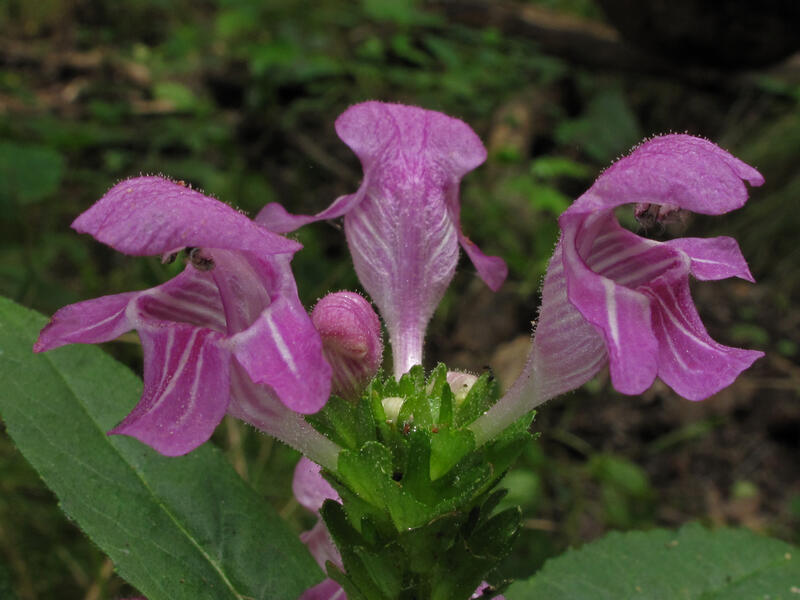
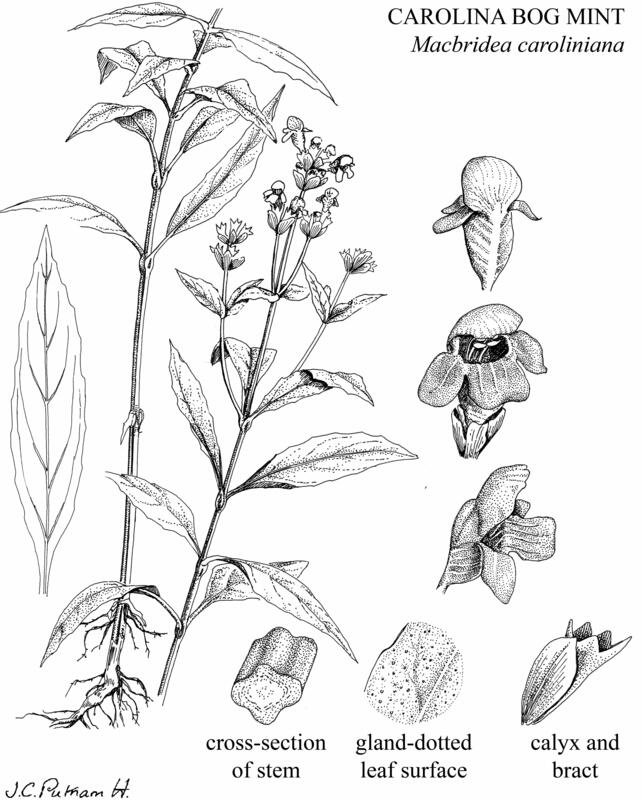
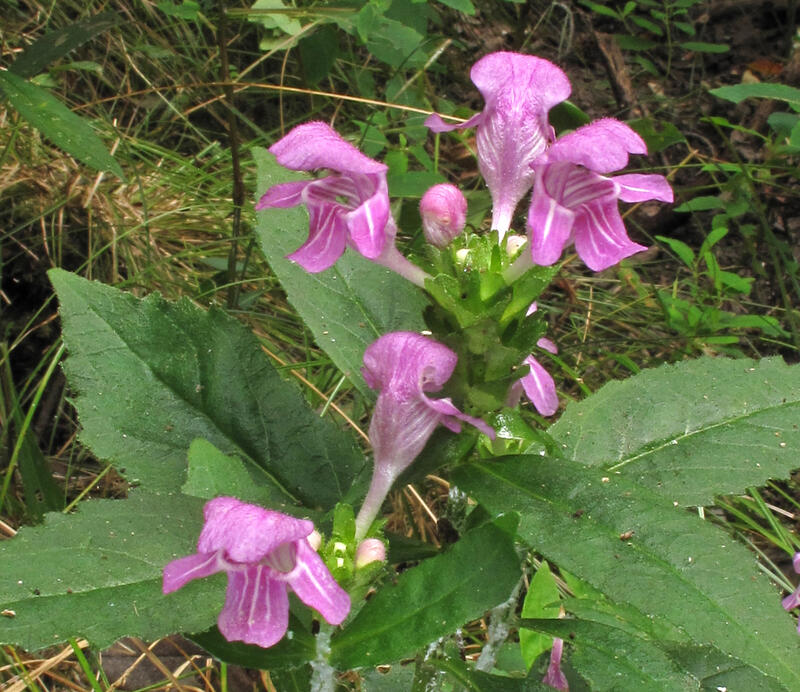
Perennial herb with erect, 4-sided stems, 2 - 3 feet (60 - 90 cm) tall. Leaves are 2.4 - 5 inches (6 - 13 cm) long, 0.6 - 1.6 inches (1.5 - 4 cm) wide, opposite, oval with pointed tips and tapering bases, both surfaces covered with tiny gland dots; the lower leaves have leaf stalks, the upper leaves do not; leaf nodes are swollen and pale. Flower clusters are held at the tips of the main stem and branches, with many rounded, leafy, overlapping bracts surrounding the bases of the flowers. Flowers are 0.8 - 1.6 inches (2 - 4 cm) long, dark pink with white and purple stripes, tubular with a hood-like upper lip and a spreading, 3-lobed lower lip. Fruits are four round nutlets, each about 0.1 inch (2.5 mm) wide, visible inside the base of the calyx after the flower falls.
Purple Obedient-plant (Physostegia purpurea) has similar stems and leaves but its two-lipped, pink-purple flowers are in an erect, elongated cluster at the top of the plant. There are no round, overlapping bracts at the base of its flowers.
Slender-leaf Obedient Plant (Physostegia leptophylla, Special Concern) occurs mainly in freshwater tidal marshes in coastal counties, with one population in a wet savannah in Decatur County. For more information, see: http://www.namethatplant.net/PDFs/physle.pdf
Narrow-leaf Obedient Plant (Physostegia angustifolia, Special Concern) is similar but has sharply toothed leaves; it occurs in southwest Georgia in seasonally wet, grassy openings over limestone bedrock. For photos and description, see: http://www.floraofalabama.org/Plant.aspx?id=2436 AND http://www.southeasternflora.com/view_flora.php?plantid=34
Blackwater creek swamps and seepage bogs and streams in the Coastal Plain and Fall Line regions; Atlantic White Cedar swamps ("whitewater swamps") in the western Fall Line sandhills; wet roadside ditches through these habitats.
Carolina Bog-mint is a deciduous, perennial herb that reproduces vegetatively by the spread of rhizomes and sexually by seeds. Pollinators observed on its flowers include bumblebees and skipper butterflies; it does not produce fruit or viable seeds without cross-pollination.
Surveys are best conducted during flowering (mid-July–early September).
Coastal Plain of Georgia, South Carolina, and North Carolina
Conversion of wetlands to agriculture, pine plantations, and developments. Clearcutting in floodplains. Destruction of streamside habitat by road and bridge construction. Digging by feral hogs. Invasion by wetland invasive plant species such as Japanese Stilt-grass (Microstegium vimineum) and Asiatic Day-flower (Murdannia keisak).
| Threat 1 | Threat 2 | Threat 3 | |
|---|---|---|---|
| General Threat | Agriculture & aquaculture | Natural system modifications | Transportation & service corridors |
| Specific Threat | None | None | None |
Macbridea caroliniana is ranked S1 by the Georgia Department of Natural Resources, indicating that it is critically imperiled in Georgia. It is listed as Rare by the State of Georgia. Twelve populations have been documented in Georgia, nine of which have been confirmed since 2000. One population occurs on conservation land, two on a military installation, the rest on private land.
Avoid clearcutting, filling, ditching, and draining wetlands. Avoid logging near streams. Protect streams and floodplains from sedimentation during road and bridge construction. Because this species is dependent on pollinators to set fruit, effective conservation depends on protection of pollinator populations.
Chafin, L.G. 2007. Field guide to the rare plants of Georgia. State Botanical Garden of Georgia and University of Georgia Press, Athens.
GADNR. 2020. Element occurrence records for Macbridea caroliniana. Georgia Department of Natural Resources, Wildlife Resources Division, Social Circle, Georgia.
Godfrey, R.K. and J.W. Wooten. 1981. Aquatic and wetland plants of southeastern United States, Vol. 2, dicotyledons. University of Georgia Press, Athens.
LeBlond, R.J. and B.A. Sorrie. 2002. Macbridea caroliniana status survey. U.S. Fish and Wildlife Service, Asheville, North Carolina.
NatureServe. 2019. Macbridea caroliniana comprehensive report. NatureServe Explorer. Arlington, Virginia. http://explorer.natureserve.org/servlet/NatureServe?searchName=Macbridea+caroliniana
Radford, A.E., H.E. Ahles, and C.R. Bell. 1968. Manual of the vascular flora of the Carolinas. University of North Carolina Press, Chapel Hill.
Weakley, A.S. 2015. Flora of the southern and mid-Atlantic States. University of North Carolina Herbarium, University of North Carolina, Chapel Hill. http://www.herbarium.unc.edu/flora.htm
Weeks, K.F. 2009. Population ecology of the floodplain herb Macbridea caroliniana (Lamiaceae) with investigations on the species' habitat, breeding system, and genetic diversity. Ph.D. Dissertation, Clemson University. https://tigerprints.clemson.edu/cgi/viewcontent.cgi?referer=https://scholar.google.com/&httpsredir=1&article=1437&context=all_dissertations
Linda G. Chafin
L. Chafin, June 2008: original account
K. Owers, Feb. 2010: added pictures
L. Chafin, March 2020: updated original account.