


Loading profile. Please wait . . .
Eccremidium floridanum Crum
Florida Eccremidium Moss


Federal Protection: No US federal protection
State Protection: No Georgia state protection
Global Rank: G1?
State Rank: S1?
Element Locations Tracked in Biotics: Yes
SWAP 2015 Species of Greatest Conservation Need (SGCN): Yes
SWAP 2025 Species of Greatest Conservation Need (SGCN): Yes
2025 SGCN Priority Tier: Highest Conservation Concern
Element Occurrences (EOs) in Georgia: 5
Habitat Summary for element in Georgia: Sandy (or clay) dry, open, disturbed sites, thin soil over exposed rocks around Taxodium swamp margins
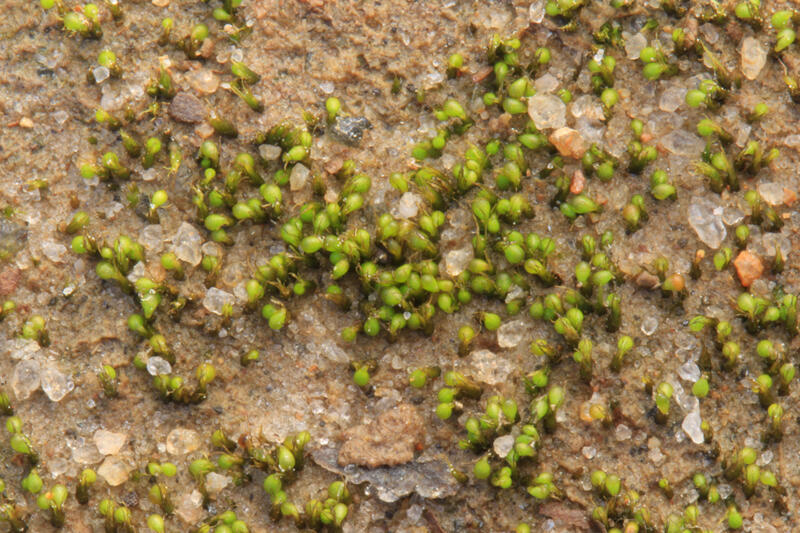
Florida Pygmy Moss is a very small, non-vascular plant, only a little larger than a sand grain, and, when viewed from a few feet away, a population appears like a yellowish-green stain on its rocky substrate. Each plant consists of a nearly invisible stem and a few yellow-green or reddish-brown leaves, 1-1.6 mm long and 0.5 mm wide which must be viewed under magnification. The leaves are erect, elongated, concave at the base, sharply pointed at the tip, toothed above the middle, and with a visible midrib for most of their length. Separate clusters of (microscopic) archegonia and antheridia develop in different leaf axils on the same plant producing, respectively, the egg and sperm that will unite to produce a stalked capsule (the sporophyte). The capsule emerges from the side of the plant rather than the top and is held at the end of a tiny, distinctly down-curved stalk; the capsule is round or oval-shaped and about 0.7 mm long; it quickly overtops the withering gametophyte plant that produced it. The capsule opens just above the middle and releases mature spores–the plants exist as spores for most of the year. When they germinate, they produce the tiny, green gametophytes.
Without close inspection, a population of Florida Pygmy Moss resembles an algal film or a green microlichen; a hand lens is necessary to distinguish the diagnostic leaves and capsules. Florida Pygmy Moss is the only species in this genus in North America; it most closely resembles Eccrimidium exiguum which occurs in Australia and South Africa.
Florida Pygmy Moss is the only species in this genus in North America.
In Georgia, Florida Pygmy Moss has been found only on Altamaha Grit outcrops in south-central Georgia. In the Florida Panhandle, it has been found in Sand Pine-Turkey Oak stands, sandy fields, and roadsides as well as the margin of Pond Cypress swamps. It prefers sandy sites with persistent winter moisture and full sun. The Georgia populations have been found growing in open areas amongst Selaginella acanthonota and mosses such as Archidium spp. and Bruchia flexuosa.
Like other mosses, Florida Pygmy Moss has two distinct generations: a sporophyte (2n) generation and a leafy gametophyte (1n) generation. During the gametophyte generation, clusters of (microscopic) archegonia and antheridia develop in different leaf axils on the same plant, producing, respectively, the eggs and sperms that unite to form a zygote that matures into the capsule (the 2n sporophyte generation) that emerges from a leaf axil on the gametophyte, November through February. The capsule releases mature spores (1n) that undergo meiosis and mitosis and germinate to produce the tiny, green (1n) gametophytes.
Florida Pygmy Moss will be most visible just before and during the time that capsules mature, from mid-November through early March. It persists through the rest of the year as spores that are invisible without high magnification. Plants are easily damaged by hard freezes. Surveys should be focused on Altamaha Grit and other rock outcrops in south Georgia that are wet in the winter, with full sun, thin or no soil, and very little competing vegetation.
Florida Pygmy Moss has been found in five counties in the Florida Panhandle (Liberty, Okaloosa, Wakulla, and Washington counties) and one county in south-central Georgia (Coffee); it also occurs in Brazil and possibly Mexico. It is likely to occur elsewhere in the Southeast in xeric sandy and rocky habitats but its minute size and ephemeral life cycle mean it is easily overlooked.
Florida Pygmy Moss is threatened by degradation – by fire suppression and conversion to pine plantations, pasture, or development – of the woodlands that surround its Grit outcrop habitat. Plants growing on the outcrops are threatened by vehicular traffic and trash dumping.
| Threat 1 | Threat 2 | Threat 3 | |
|---|---|---|---|
| General Threat | Climate change & severe weather | None | None |
| Specific Threat | Temperature extremes | None | None |
Florida Pygmy Moss has been discovered in a state Wildlife Management Area, a privately owned conservation preserve, and one privately owned tract.
The Altamaha Grit outcrops where this species occurs are considered critically imperiled in Georgia and support several other rare or endemic species. These outcrops need protection from trash dumping, vehicular traffic, and other human disturbances. Fire applied to the surrounding matrix of Longleaf Pine woodlands should be allowed to burn across the outcrops where vegetation is sufficient to carry fire.
Buck, W.R. 2007. Eccremidium floridanum species account. Bryophyte Flora of North America, Vol 1. Oxford University Press. http://www.efloras.org/florataxon.aspx?flora_id=50&taxon_id=242443750.
Cressler, A. Eccremidium floridanum. Photo caption, Flickr. Accessed 17 May 2019. https://www.flickr.com/photos/alan_cressler/12583078764/in/photolist-kaVyVS-kaTFz8-kaU4T4-kaUzQE
Crum, H. 1981. Eccremidium, a Genus of Ditrichaceae new to the Americas. The Bryologist 84(4): 527-532. https://www.jstor.org/stable/3242561?seq=1#metadata_info_tab_contents
Davison, P.G. 2010. Species profile for Eccremidium floridanum. Georgia Department of Natural Resources, Wildlife Resources Division, Social Circle GA.
Edwards, L., J. Ambrose, and L.K. Kirkman. 2013. Natural communities of Georgia. University of Georgia Press, Athens.
GADNR. 2019. Eccremidium floridanum element occurrence records. Georgia Department of Natural Resources, Wildlife Resources Division, Social Circle GA.
Griffin, D. and F. Snow. 1998. Broxton Rocks ecological preserve: bryophyte refugium of south Georgia. Tipularia 13: 23-28.
NatureServe. 2019. Eccremidium floridanum, Florida Eccremidium Moss comprehensive report. NatureServe Explorer. Arlington, Virginia. https://explorer.natureserve.org/Taxon/ELEMENT_GLOBAL.2.123737/Eccremidium_floridanum
NatureServe. 2020. Altamaha Grit Glade comprehensive report. NatureServe Explorer. Arlington, Virginia. https://explorer.natureserve.org/Taxon/ELEMENT_GLOBAL.2.684024/(Pinus_palustris)_-_Bigelowia_nuttallii_-_Phemeranthus_teretifolius_-_Allium_cuthbertii_-_Penstemon_dissectus_Altamaha_Grit_Grassland
NatureServe. 2020. Altamaha Grit Longleaf Pine Woodland Ecological Association Comprehensive Report. NatureServe Explorer. Arlington, Virginia. https://explorer.natureserve.org/Taxon/ELEMENT_GLOBAL.2.688221/Pinus_palustris_-_Quercus_marilandica_-_Quercus_laevis_-_Aristida_beyrichiana_-_Nolina_georgiana_Woodland
Linda G. Chafin
L. Chafin, 20 May 2019: Original account