



Loading profile. Please wait . . .
Carex misera Buckl.
Wretched Sedge


Federal Protection: No US federal protection
State Protection: Threatened
Global Rank: G3
State Rank: S1
Element Locations Tracked in Biotics: Yes
SWAP 2015 Species of Greatest Conservation Need (SGCN): No
SWAP 2025 Species of Greatest Conservation Need (SGCN): Yes
2025 SGCN Priority Tier: High Conservation Concern
Element Occurrences (EOs) in Georgia: 1
Habitat Summary for element in Georgia: Grassy balds
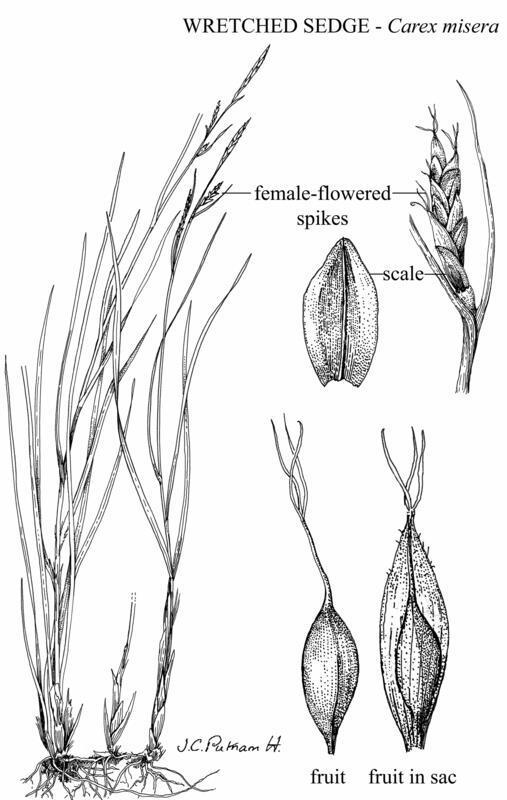
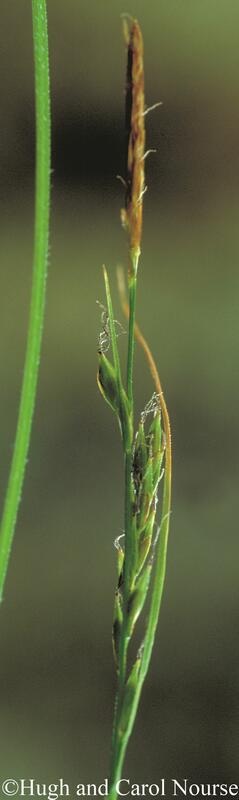
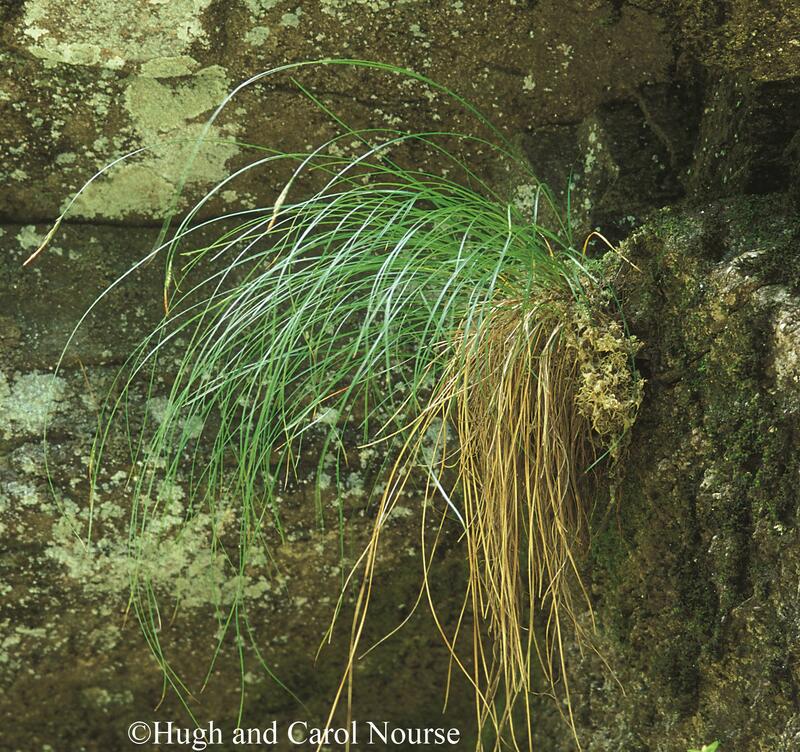
Perennial, grass-like herb forming dense clumps. Leaves are up to 16 inches (40 cm) long, very narrow, light green, hairy on the lower surface, with a softly hairy, purplish, basal sheath that encircles the stem; old sheaths form a mass of tan fibers on the lower stems. Flowering stems are up to 20 inches (50 cm) long, arching down and outward, 3-angled with rough hairs on the angles and a purple base. Female-flowered spikes 2 - 3 per stem, up to 1⅜ inches (3.5 cm) long, reddish-brown, held below the male-flowered spike on the same stem. Male-flowered spikes are up to 1 inch (2.5 cm) long, reddish-brown, solitary at the top of the flowering stem. Fruits are about 0.1 inch (2.5 mm) long, oblong, 3-angled, pale brown, enclosed in an elongated, red-dotted sac (perigynium) with faint ribs and hairy tip. Magnification of 10x is needed to examine the spikes and fruits.
Wretched Sedge resembles many other sedges but is distinguished by its habitat and by the hairy leaf sheaths, purple stem bases, reddish-brown spikes, and hairy perigynia.
Forty-five species of Carex are rare in Georgia, see: https://georgiabiodiversity.org/portal/element_lists?group=plant
Detailed information about these 11 rare Carex species is provided on this website:
Acid-Loving Sedge (C. acidicola): https://georgiabiodiversity.org/portal/profile?group=plants&es_id=34933
Baltzell's Sedge (C. baltzellii): https://georgiabiodiversity.org/portal/profile?group=plants&es_id=15974
Granite Dome Sedge (C. biltmoreana): https://georgiabiodiversity.org/portal/profile?group=plants&es_id=19146
Lime-fleeing Sedge (C. calcifugens): https://georgiabiodiversity.org/portal/profile?group=plants&es_id=33655
Velvet Sedge (C. dasycarpa): https://georgiabiodiversity.org/portal/profile?group=plants&es_id=15939
Cypress-knee Sedge (C. decomposita): https://georgiabiodiversity.org/portal/profile?group=plants&es_id=21206
Meager Sedge (C. exilis): https://georgiabiodiversity.org/portal/profile?group=plants&es_id=34936
Wretched Sedge (C. misera): https://georgiabiodiversity.org/portal/profile?group=plants&es_id=16740
Radford’s Sedge (C. radfordii): https://georgiabiodiversity.org/portal/profile?group=plants&es_id=15374
Roan Mountain Sedge (C. roanensis): https://georgiabiodiversity.org/portal/profile?group=plants&es_id=21034
Thorne's Sedge (C. thornei): https://georgiabiodiversity.org/portal/profile?group=plants&es_id=34939
Seepy areas around rock ledges and outcrops at high elevations, with Yellow Birch, Sugar Maple, Mountain Laurel, and Rhododendron.
Wretched Sedge, like most sedges, is wind-pollinated. Nothing has been published about seed dispersal or other aspects of reproduction for this species. Genetic studies have shown that Wretched Sedge, like many species with restricted habitats and ranges, has low genetic variability, underscoring the need to protect as many populations throughout the species’ range as possible.
Surveys are best conducted during fruiting, June–August; mature fruits are important for identification. Plants flower May–June.
About 25 populations are known in Georgia, North Carolina, and Tennessee. It is a Southern Appalachian endemic that is rare throughout its range.
Logging, clearing, and development in high elevation forests. Excessive recreational use by climbers and hikers of high elevation rock outcrops.
| Threat 1 | Threat 2 | Threat 3 | |
|---|---|---|---|
| General Threat | Biological resource use | Human intrusions & disturbance | Natural system modifications |
| Specific Threat | None | None | None |
Carex misera is ranked S1 by the Georgia Department of Natural Resources, indicating that it is critically imperiled in the state. It is listed as Threatened by the State of Georgia. Only one population is known; it occurs in the Chattahoochee National Forest.
Protect high elevation forests from logging, clearing, and development. Direct trails and other recreational activity away from high elevation rock outcrops.
Chafin, L.G. 2007. Field guide to the rare plants of Georgia. State Botanical Garden of Georgia and University of Georgia Press, Athens.
GADNR. 2019. Element occurrence records for Carex misera. Georgia Department of Natural Resources, Wildlife Resources Division, Social Circle, Georgia.
Godt, M.J.W., B.R. Johnson, and J.L. Hamrick. 1996. Genetic diversity and population size in four rare southern Appalachian plant species. Conservation Biology 10: 796-805. https://conbio.onlinelibrary.wiley.com/doi/abs/10.1046/j.1523-1739.1996.10030796.x
Kral, R. 1983. A report on some rare, threatened, or endangered forest-related vascular plants of the South. Technical Publication R8-TP2. United States Forest Service, Atlanta.
Massey, J.R., D.K.S. Otte, T.A. Atkinson, and R.D. Whetstone. 1983. Atlas and illustrated guide to the threatened and endangered vascular plants of the mountains of North Carolina and Virginia, Technical Report SE-20. Department of Agriculture, Southeastern Forest Experiment Station, Asheville, North Carolina. https://www.fs.usda.gov/treesearch/pubs/download/684.pdf
NatureServe. 2019. Carex misera comprehensive report. NatureServe Explorer. Arlington, Virginia. http://explorer.natureserve.org/servlet/NatureServe?searchName=Carex%20misera
Patrick, T.S., J.R. Allison, and G.A. Krakow. 1995. Protected plants of Georgia. Georgia Department of Natural Resources, Natural Heritage Program, Social Circle.
Schell, C.M and M.J. Waterway. 1992. Allozyme variation and the genetic structure of populations of the rare sedge Carex misera (Cyperaceae). Plant Species Biology 7: 141-150. https://esj-journals.onlinelibrary.wiley.com/doi/abs/10.1111/j.1442-1984.1992.tb00226.x
Waterway, M.J. 2003. Species account for Carex misera. Flora of North America. Vol. 23, Magnoliophyta: Commelinidae (in part), Cyperaceae (part 1). Oxford University Press, New York. http://www.efloras.org/florataxon.aspx?flora_id=1&taxon_id=242357338
Weakley, A.S. 2015. Flora of the southern and mid-Atlantic States. University of North Carolina Herbarium, University of North Carolina, Chapel Hill. http://www.herbarium.unc.edu/flora.htm
Wiser, S.K. 1994. High-elevation cliffs and outcrops of the southern Appalachians: vascular plants and biogeography. Castanea 59: 85-116. https://www.jstor.org/stable/4033723?seq=1#metadata_info_tab_contents
Wiser, S.K. 1996. High-elevation rock outcrop vegetation of the southern Appalachian mountains. Journal of Vegetation Science 7: 703-722. https://onlinelibrary.wiley.com/doi/abs/10.2307/323638
Linda G. Chafin
L. Chafin, Oct. 2007: original account.
K. Owers, Jan. 2010: updated status and ranks, added pictures.
L. Chafin, Jan 2020: updated original account.