

Loading profile. Please wait . . .
Carya myristiciformis (Michx. f.) Nutt.
Nutmeg Hickory


Federal Protection: No US federal protection
State Protection: Rare
Global Rank: G4
State Rank: S1
Element Locations Tracked in Biotics: Yes
SWAP 2015 Species of Greatest Conservation Need (SGCN): Yes
SWAP 2025 Species of Greatest Conservation Need (SGCN): Yes
2025 SGCN Priority Tier: High Conservation Concern
Element Occurrences (EOs) in Georgia: 5
Habitat Summary for element in Georgia: Calcareous flatwoods
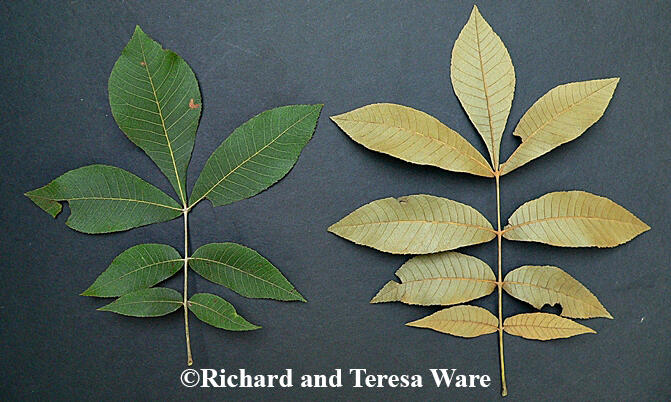
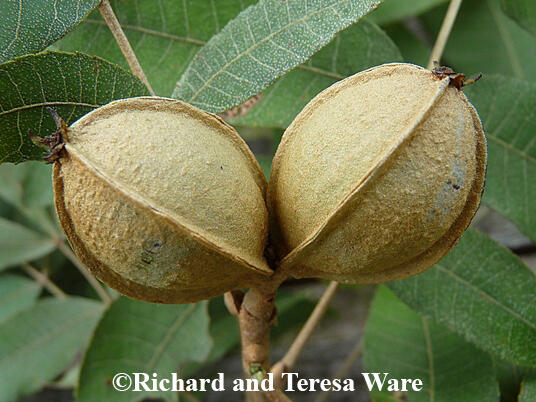
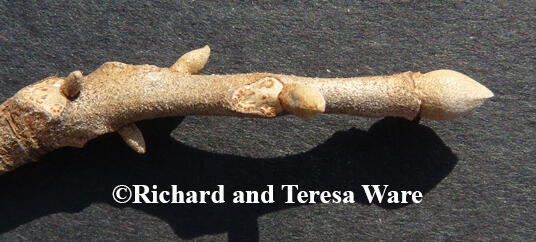
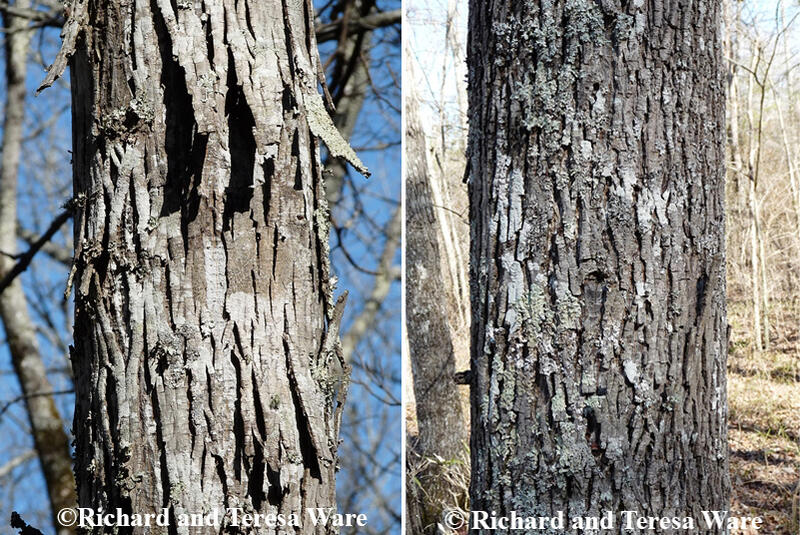
Deciduous tree up to 115 feet (35 meters) tall and 2 feet (60 cm) in diameter. Bark is brownish-gray, breaking into narrow strips and forming diamond-shaped patterns on the lower trunk, and peeling away from the trunk in narrow strips or plates on the upper trunk. Twigs are brown with a metallic sheen, densely coated in silvery scales but without hairs. Buds, held at the tips of twigs, are less than 0.25 inch (4-6 mm) long, plump, covered in yellow-brown hairs and silvery scales. Leaves are 12 - 24 inches long (30 - 60 cm), alternate, with 5 - 9 toothed, opposite leaflets that are 1 - 6.7 inches long and 0.4 - 3 inches wide (3-17 cm long and 1-8 cm wide), and are finely to coarsely toothed. The leaf stalk and rachis are densely scaly but not hairy. Upper leaflet surfaces are dark green with scattered scales and with hairs along the veins in spring. Lower leaflet surfaces are hairy along the midvein in spring, and densely coated throughout with a mix of small and large bronze scales. Female and male flower clusters are on the same tree. Female flowers are tiny, nutlike, and held at the tips of twigs. Male flowers are held in drooping catkins up to 2.4 inches (6 cm) long. Fruits are about 1 inch long and 0.7 inch wide (2 - 3 cm long and 1.5 - 2 cm wide); the relatively thin husk is rough with a dense coating of golden scales and 4 winged seams. The seams split open to release the single, round, thick-shelled nut, which is reddish-brown with silver-tan patches or stripes, resembling a nutmeg. The nutmeat is sweet.
No other hickory species has twigs, buds, leaves, and nuts coated with golden or silvery metallic scales. Pale Hickory (Carya pallida) leaflets have silvery-tan scales on the lower surface, and the leaf stalk and rachis is very hairy. Its bark is tightly woven in a diamond pattern and it occurs in dry, upland forests.
Shagbark Hickory (Carya ovata) and Southern Shagbark Hickory (C. carolinae-septentrionalis) have much shaggier bark, with the ends of the plates curving up and away from the trunk.
Butternut (Juglans cinerea) occurs in Georgia's Blue Ridge Mountains. For more information, see: https://georgiabiodiversity.org/portal/profile?group=plants&es_id=20809
Coosa Valley flatwoods, bottomland forests and moist hillsides over calcium-rich soils in northwest Georgia.
Nutmeg Hickory is monoecious, i.e. female and male reproductive parts occur in separate flowers on the same tree. It is shade-tolerant as a young tree and may persist in the understory for many years until a sunny gap opens up in the canopy. As a mature tree, it is intolerant of shade and fire. It flowers April–May, as the new leaves begin to expand, and is wind-pollinated. Nuts are produced every 2 - 3 years, beginning when the tree reaches about 30 years of age; peak bearing age is 50 - 125 years old. The fruit matures in the autumn and falls September–December. The nut is reddish-brown with silver stripes, resembling a nutmeg (Myristica fragrans), inspiring both common and scientific names. The nuts are sweet and rich in oils, but the nutshells are so thick (not the husks, which are thin) that few are eaten by animals, although they are relished by squirrels when they can get them.
Surveys are best conducted during growing season when leaves are out although the bark and twigs are distinctive during the winter.
Georgia, South Carolina, North Carolina, Alabama, Mississippi, Louisiana, Texas, Arkansas, Oklahoma, and northeastern Mexico. Although widespread, Nutmeg Hickory is rare and local throughout most of its range and is thought to be a relict of an ancient flora.
Logging, clearing, and conversion of habitat to pine plantations or residential and commercial developments. Alterations in bottomland hydrology.
| Threat 1 | Threat 2 | Threat 3 | |
|---|---|---|---|
| General Threat | Biological resource use | Agriculture & aquaculture | Natural system modifications |
| Specific Threat | Logging & wood harvesting | Wood & pulp plantations | Other ecosystem modifications |
Carya myristiciformis is ranked S1 by the Georgia Department of Natural Resources, indicating that it is critically imperiled in Georgia. It is listed as Rare by the State of Georgia. Five populations, with a total of about 120 trees, have been documented.
Protect sites from logging, clearing, and hydrological alternations.
Chafin, L.G. 2007. Field guide to the rare plants of Georgia. State Botanical Garden of Georgia and University of Georgia Press, Athens.
GADNR. 2019. Element occurrence records for Carya myristiciformis. Georgia Department of Natural Resources, Wildlife Resources Division, Social Circle, Georgia.
Grauke, L. J. 2005. Carya myristiciforrmis. U.S.D.A.-ARS Pecan Genetics, Somerville, Texas. https://cgru.usda.gov/carya/species/myristiciformis/myristiciformis.HTMhttp://aggie-horticulture.tamu.edu/carya
Kirkman, L.K., C.L. Brown, and D.J. Leopold. 2007. Native trees of the southeast. Timber Press, Portland, Oregon.
Maisenhelder, L.C. and J.K. Francis. 1990. Nutmeg hickory. In, Silvics of North America, Vol. 2, Agriculture Handbook 654. U.S. Department of Agriculture, Washington D.C. https://tinyurl.com/ybhqd4yo
NatureServe. 2019. Carya myristiciformis comprehensive report. NatureServe Explorer. Arlington, Virginia. http://explorer.natureserve.org/servlet/NatureServe?searchName=Carya%20myristiciformis
Stone, D.E. 1997. Carya myristiciformis species account. Flora of North America. Vol. 3, Magnoliophyta: Magnoliidae and Hamamelidae. Oxford University Press, New York. http://www.efloras.org/florataxon.aspx?flora_id=1&taxon_id=233500319
Weakley, A.S. 2015. Flora of the southern and mid-Atlantic States. University of North Carolina Herbarium, University of North Carolina, Chapel Hill. http://www.herbarium.unc.edu/flora.htm
Wikipedia. 2020. Carya mysticiformis. Wikipedia: the free encyclopedia. https://en.wikipedia.org/wiki/Carya_myristiciformis
Linda G. Chafin
L. Chafin, Oct. 2007: original account.
K. Owers, Jan. 2010: updated status and ranks, added pictures.
Z. Abouhamdan, April 2016: updated link.
L. Chafin, Jan 2020: updated original account.