



Loading profile. Please wait . . .
Danaus plexippus (Linneaus, 1758)
Monarch


Federal Protection: Candidate
State Protection: No Georgia state protection
Global Rank: G4
State Rank: S4
Element Locations Tracked in Biotics: No
SWAP 2015 Species of Greatest Conservation Need (SGCN): Yes
SWAP 2025 Species of Greatest Conservation Need (SGCN): Yes
2025 SGCN Priority Tier: Moderate Conservation Concern
Element Occurrences (EOs) in Georgia: 4
Habitat Summary for element in Georgia: Milkweeds
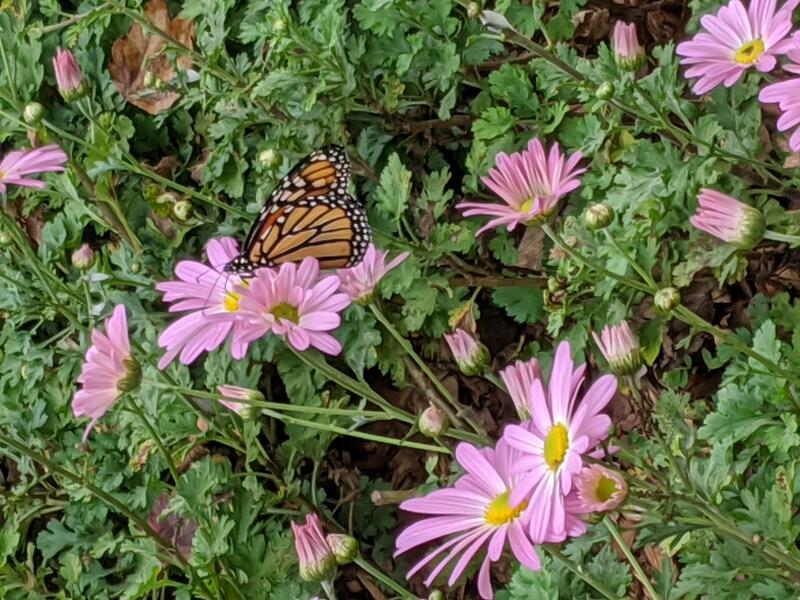
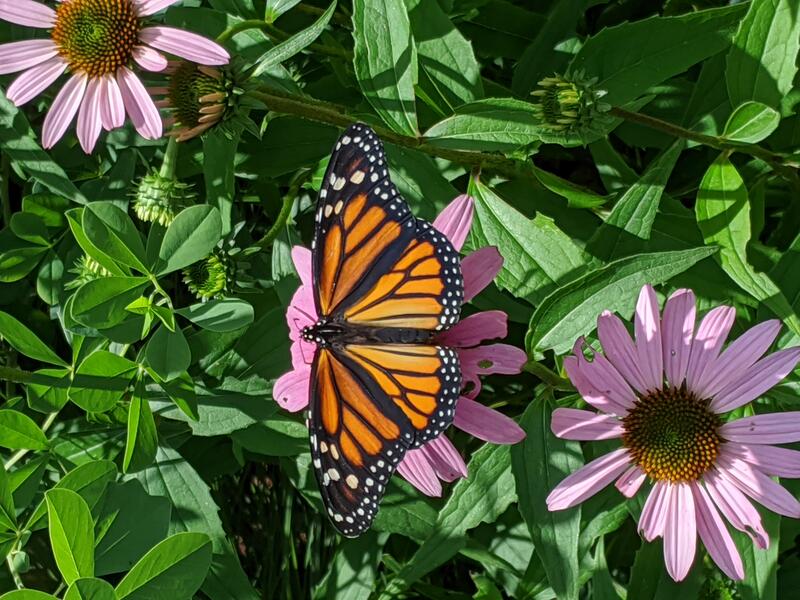
Adults have a wingspan of 3 3/8 – 4 7/8 inches (8.6-12.4 cm) The dorsal side of the male is bright orange with wide black borders and thin black veins; a small black androconial scent patch is centered on each hindwing. The dorsal side of the female is orange-brown with wide black borders and blurred black veins. Both sexes have white spots on borders and apex.
Eggs are laid singly on the host plant, are ~1 mm in height, football-shaped, glossy cream color with vertical ridges.
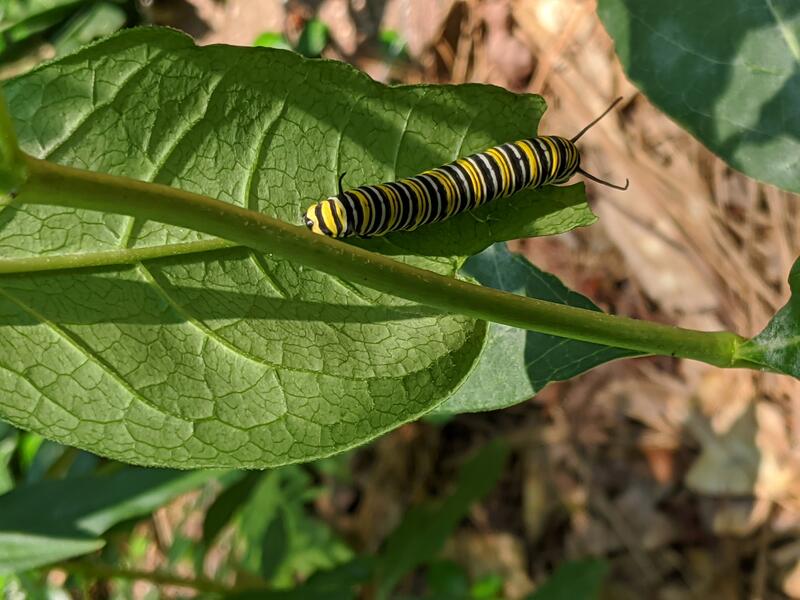
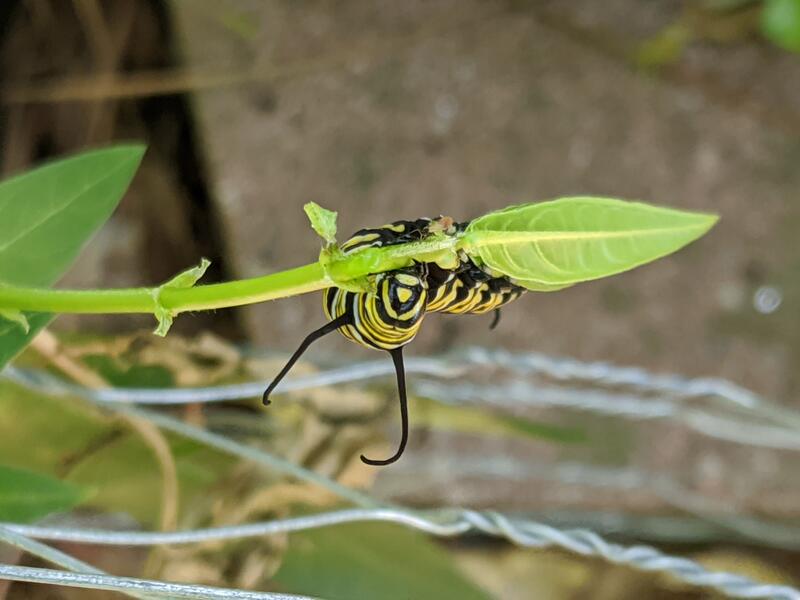
Larvae (second – fifth instars) are striped yellow, black, and white with two pairs of tentacles (on the front and back ends).
Pupae are jade green in color with gold markings and hang suspended from a silk pad by a cremaster.
Viceroys (Limenitis archippus) are Mullerian mimics but can be distinguished by a black postmedian line through the hind wings and smaller size. Queens (Danaus gilippus) are typically smaller, more mahogany in color and dorsally have less defined wing veins. Soldiers (Danaus eresimus) have a band of blotchy pale spots on the underside of the hind wing and their range is usually limited to Texas and Florida.
Breeding habitat must contain milkweeds although adults can be found in a variety of sunny, open spaces, both natural and disturbed. These include but are not limited to fields, meadows, urban and suburban parks and gardens, managed corridors, roadsides, agricultural areas (and dunes particularly for fall migrants along the coast).
Larvae feed on their host plant, milkweed (Genera Asclepias, Cynanchum, and Matelea). Asclepias tuberosa, A. verticillata, A. amplexicaulis, and A. variegata are four native species that are widely distributed across the state.
Adults are generalists but blooms in the Asteraceae, Apocynaceae, Lamiaceae, and Rubiaceae Families are known nectar sources.
Monarchs, like other butterflies and moths, undergo complete metamorphosis, going through the four stages of egg, larva (caterpillar), pupa (chrysalis), and adult. The egg and caterpillar stages occur only on species of milkweed whereas adults survive by nectaring on a variety of flowering plants.
Each fall, North American monarchs travel from their summer breeding grounds to overwintering locations. East of the Rocky Mountains, monarchs migrate from as far north as southern Canada to central Mexico. West of the Rockies migration is to the California coast. There is evidence of some interchange between the eastern and western populations particularly during migration movements.
Decreasing day length and temperatures, as well as the senescing of milkweed trigger a change in the development. Unlike summer generations that live for two to six weeks as adults, adults in the migratory generation can live up to nine months. Most monarch butterflies that emerge after about mid-August in the eastern U.S. enter reproductive diapause (do not breed) and begin to migrate towards Mexico. Along the way, they must find nectar sources to fuel the flight and to build up their fat stores for the winter. They roost (cluster in trees) at night and during inclement weather. Usually arriving in the Trans-Mexican Volcanic Belt in early November, monarchs aggregate in oyamel fir trees on south-southwest facing mountain slopes. These locations provide a micro-climate allowing them to conserve enough energy to survive winter. In March, this generation breaks reproductive diapause and begins the journey north into Texas and southern states, laying eggs and nectaring as they migrate and breed. The first-generation offspring from the overwintering population continue the journey from the southern U.S. to recolonize the eastern breeding grounds, migrating north through the central latitudes in approximately late April through May. Second and third generations populate the breeding grounds throughout the summer. It is generally the fourth generation that repeats this annual cycle migrating through the central and southern U.S. and northern Mexico to the wintering sites in central Mexico.
Resident populations, that breed year-round and do not migrate, have been documented in southern Florida and other parts of the Gulf Coast.
Monarchs are native to North and South America, but spread throughout much of the world in the 1800's. They were first seen in Hawaii in the 1840's, and spread throughout the South Pacific in the 1850's-60's. In the early 1870's, the first monarchs were reported in Australia and New Zealand. Monarchs also inhabit Portugal and southern Spain along the Iberian Peninsula.
The North American migratory population ranges from southern Canada south through much of the United States into Mexico and the Caribbean Islands. Monarchs are considered a visitor, not a resident, in Georgia, although breeding typically occurs in the spring (April-May) and in the fall (August-September) on their migration north and south respectively.
Monarchs face many risks that are resulting in declining populations in both the eastern and western parts of their North American range. The largest impacts come from the loss of habitat for breeding, migrating, and overwintering. In addition, pesticides that are used to control insects and weeds have harmful unintended consequences for monarchs, a changing climate may be making some habitat less suitable and forcing changes in migratory patterns, and monarchs face many risks from natural enemies, such as predators, parasitoids, and diseases. Other anthropogenic concerns include the untimely management of rights-of-way, vehicle collisions, and the year-round persistence of non-native tropical milkweeds, such as Ascelpias curassavica, which allow monarchs to breed throughout the winter and are associated with higher transmission rates of the protozoan parasite, Ophryocystis elektroscirrha (OE).
| Threat 1 | Threat 2 | Threat 3 | |
|---|---|---|---|
| General Threat | Climate change & severe weather | Pollution | Natural system modifications |
| Specific Threat | Other impacts | Air-borne pollutants | Other ecosystem modifications |
References
Lotts, Kelly and Thomas Naberhaus, coordinators. 2017. Butterflies and Moths of North America. Accessed 2020-11-21 at https://www.butterfliesandmoths.org/species/Danaus-plexippus
Monarch Larva Monitoring Project. 2016. Monarch Larva Monitoring Project: Activity #1: Measuring Monarch Density. Accessed 2020-11-22 at https://monarchjointventure.org/images/uploads/presentations/Activity1_2016_revisions.pdf
State Botanical garden of Georgia, University of Georgia. 2020. Monarch Butterflies & Georgia Gardeners. Accessed 2020-11-21 at https://botgarden.uga.edu/wp-content/uploads/2018/03/milkweedinformation.pdf.
The Xerces Society for Invertebrate Conservation. 2006-2020. Roadside Habitat for Monarchs: Milkweeds of the Southeast. Accessed 2020-11-21 at 19-031.pdf (xerces.org)
The Xerces Society for Invertebrate Conservation. 2006-2020. Monarch Nectar Plants: Southeast. Accessed 2020-11-21 at 16-047_01_XercesSoc_MonarchNectarPlants_Southeast_web-3page.pdf.
United States Department of Agriculture, Natural Resources Conservation Service, Field Office Technical Guide. (2015) Preferred Nectar Source Monarch. Accessed 2020-11-22 at Preferred_Nectar_Source_Monarch.pdf (usda.gov)
The Monarch Joint Venture. 2020. About Monarchs: Migration. Accessed 2020-11-23 at https://monarchjointventure.org/monarch-biology/monarch-migration
The Monarch Joint Venture. 2020. About Monarchs: Global Distribution. Accessed 2020-11-22 at https://monarchjointventure.org/monarch-biology/global-distribution
Journey North, University of Wisconsin – Madison Arboretum. 1997-2019. Sightings. Accessed 2020-11-22 at https://journeynorth.org/sightings/
The Monarch Joint Venture. 2020. About Monarchs: Threats. Accessed 2020-11-22 at https://monarchjointventure.org/monarch-biology/threats
Center for Food Safety. 2020. FAQs on the Monarch Butterfly Endangered Species Act Petition. Accessed 2020-11-22. https://www.centerforfoodsafety.org/fact-sheets/3419/faqs-on-the-monarch-butterfly-endangered-species-act-petition
National Wildlife Federation. Educational Resources: Wildlife Guide: Invertebrates: Monarch Butterfly. Accessed 2020-11-23 at Monarch Butterfly | National Wildlife Federation (nwf.org)
S. Meyers, Monarchs Across Georgia
December 7, 2020