


Loading profile. Please wait . . .
Fimbristylis brevivaginata Kral
Flatrock Fimbry


Federal Protection: No US federal protection
State Protection: No Georgia state protection
Global Rank: G1G2
State Rank: S2
Element Locations Tracked in Biotics: Yes
SWAP 2015 Species of Greatest Conservation Need (SGCN): Yes
SWAP 2025 Species of Greatest Conservation Need (SGCN): Yes
2025 SGCN Priority Tier: Highest Conservation Concern
Element Occurrences (EOs) in Georgia: 11
Habitat Summary for element in Georgia: Granite outcrops
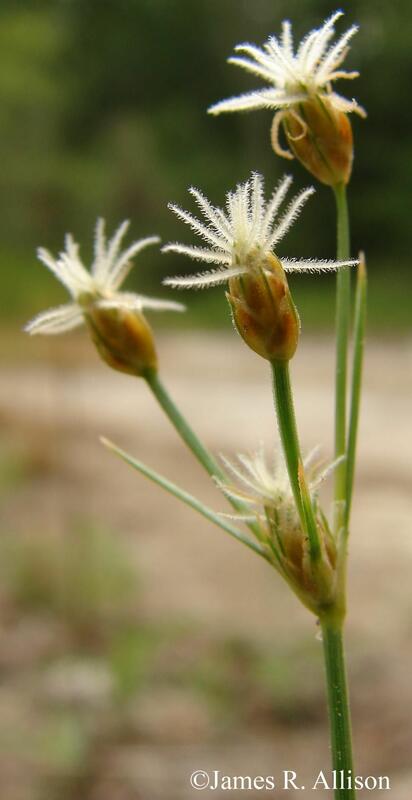
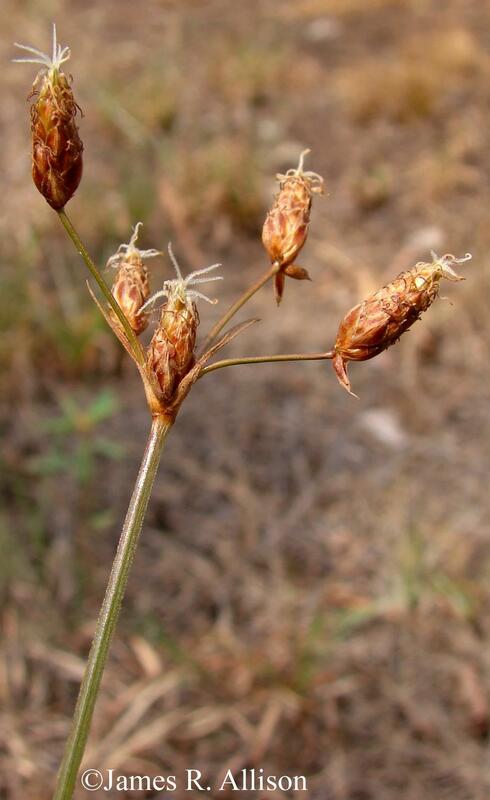
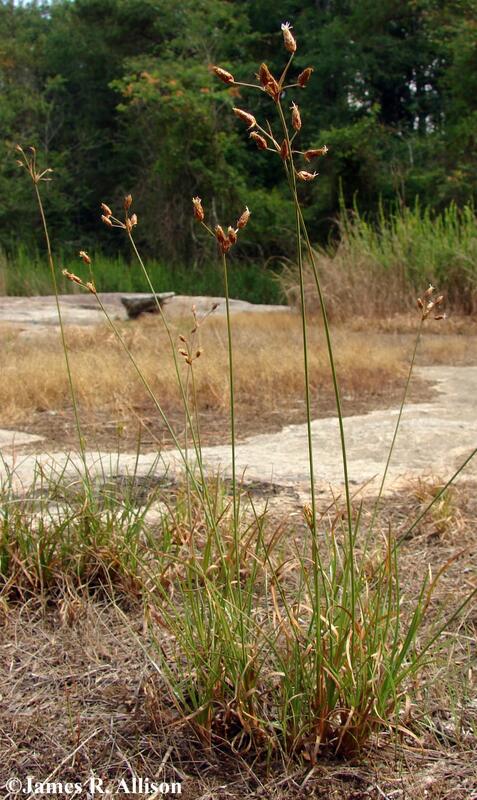
Perennial, tuft-forming herb, 8 - 20 inches (20 - 50 cm) tall, with a bulb-like base and underground stems (rhizomes) connecting to other tufts. Leaves are grass-like, flat, less than 0.1 inch (1.5 - 2.5 mm) wide, erect or spreading, with rough-hairy margins; the base of the leaf is enclosed by a sheath bearing a line of hairs where the leaf emerges from the sheath. The flower stalks are twice as long as the leaves, round near the base, 3-5 angled near the top. A cluster of 2 - 9 stalked flower spikes is held at the top of the stalk with several narrow, leaf-like bracts spreading from the base of the cluster. Each flower spike is 0.2 - 0.6 inch (0.5 - 1.5 cm) long, oval or cylindrical, reddish-brown, composed of many small, oval, sharp-pointed scales that conceal flowers and fruits. The fruit is tiny, oval, ribbed, and seed-like, with a pitted surface (10x magnification or greater is required to see the features of spikes and fruits).
Most of the fimbry species that occur on granite outcrops (such as Fimbristylis autumnalis, F. dichotoma, and F. annua) are weedy, annual invaders of open, disturbed areas; none have the bulb-like base and rhizome of Flatrock Fimbry. Fimbristylis puberula is found occasionally on outcrops; it has a hardened, knotty, rather than bulbous, base and lacks rhizomes; its leaves are inrolled rather than flat, as with Flatrock Fimbry. Another similar appearing species, F. caroliniana, occurs only in coastal habitats or, occasionally, in pine flatwoods in the Coastal Plain.
Harper’s Fimbry (Fimbristylis perpusilla) occurs in Georgia's Coastal Plain on muddy shores and exposed bottoms of limesink, flatwoods, and farm ponds, silty sandbars in blackwater rivers, dried-up backwater sloughs. For more information, see: https://www.georgiabiodiversity.org/portal/profile?group=plants&es_id=17656on this website.
Sunny, wet areas on Georgia’s Piedmont granite outcrops, such as around pools or along wet cracks in the rock. In northeast Alabama, Flatrock Fimbry occurs on sandstone outcrops.
Flatrock Fimbry is a perennial herb that reproduces sexually as well as by the spread of underground stems (rhizomes). Its flowers are wind-pollinated, and its seeds are likely dispersed by water seepage, birds, and other small animals.
Surveys are best conducted during fruiting, summer–fall; fruits are important for identification. However, the bulb-like base is visible throughout the growing season.
Georgia and northeastern Alabama; it is rare throughout its range.
Flatrock Fimbry is threatened by quarrying of granite outcrops, and by mulching, trash dumping, and off-road vehicle use on outcrops. Invasion by exotic pest plants, especially Chinese Privet, is also a threat.
| Threat 1 | Threat 2 | Threat 3 | |
|---|---|---|---|
| General Threat | Human intrusions & disturbance | Natural system modifications | Invasive & other problematic species, genes & diseases |
| Specific Threat | None | None | None |
Fimbristylis brevivaginata is ranked S2 by the Georgia Department of Natural Resources, indicating that it is imperiled in the state. Eleven populations have been documented in Georgia, but only one has been seen in the last 20 years–it occurs on conservation land.
Avoid quarrying of granite outcrops. Limit foot traffic on outcrops to unvegetated areas. Exclude vehicles from outcrops. Prevent trash dumping. Purchase and manage granite outcrops for conservation.
Carter, R. 2005. An introduction to the sedges of Georgia. Tipularia, Journal of the Georgia Botanical Society 17-45. https://www.valdosta.edu/~rcarter/ga.sedges.tipularia.final.lowres.2005.pdf
Kral, R. 2003. Fimbristylis brevivaginata species account. Flora of North America, vol. 23. Oxford University Press, New York. http://www.efloras.org/florataxon.aspx?flora_id=1&taxon_id=242357823
Kral, R. 1992. A new species of Fimbristylis (Cyperaceae) from the sandstone and granitic outcrops of Alabama and Georgia. SIDA, Contributions to Botany 15(2): 317-321. https://www.jstor.org/stable/41967007?seq=2#metadata_info_tab_contents
Godfrey, R.K. and J.W. Wooten. 1979. Aquatic and wetland plants of southeastern United States, Vol. 1, monocotyledons. University of Georgia Press, Athens.
NatureServe. 2019. Fimbristylis brevivaginata comprehensive report. NatureServe Explorer. Arlington, Virginia. http://explorer.natureserve.org/servlet/NatureServe?searchName= Fimbristylis+brevivaginata
Weakley, A.S. 2015. Flora of the southern and mid-Atlantic States. University of North Carolina Herbarium, University of North Carolina, Chapel Hill. http://www.herbarium.unc.edu/flora.htm
Linda G. Chafin
L. Chafin, Jan. 2008: original account
K. Owers, Jan 2010: added pictures
L. Chafin, Feb 2020: updated original account.