



Loading profile. Please wait . . .
Desmodium ochroleucum M.A. Curtis ex Canby
Creamflower Tick-trefoil


Federal Protection: No US federal protection
State Protection: Threatened
Global Rank: G2G3
State Rank: S1
Element Locations Tracked in Biotics: Yes
SWAP 2015 Species of Greatest Conservation Need (SGCN): Yes
SWAP 2025 Species of Greatest Conservation Need (SGCN): Yes
2025 SGCN Priority Tier: Highest Conservation Concern
Element Occurrences (EOs) in Georgia: 4
Habitat Summary for element in Georgia: Open, calcareous woodlands, including lower slope of Pigeon Mountain
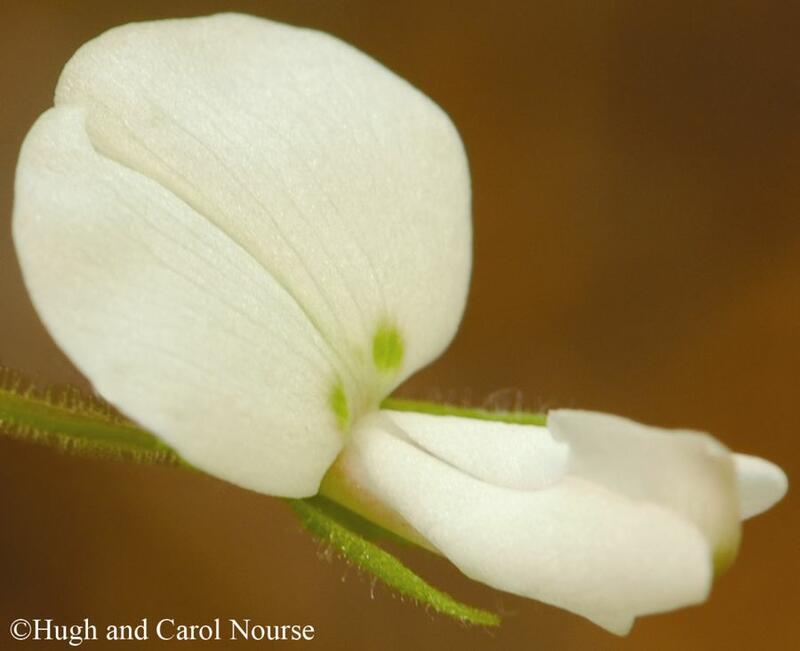
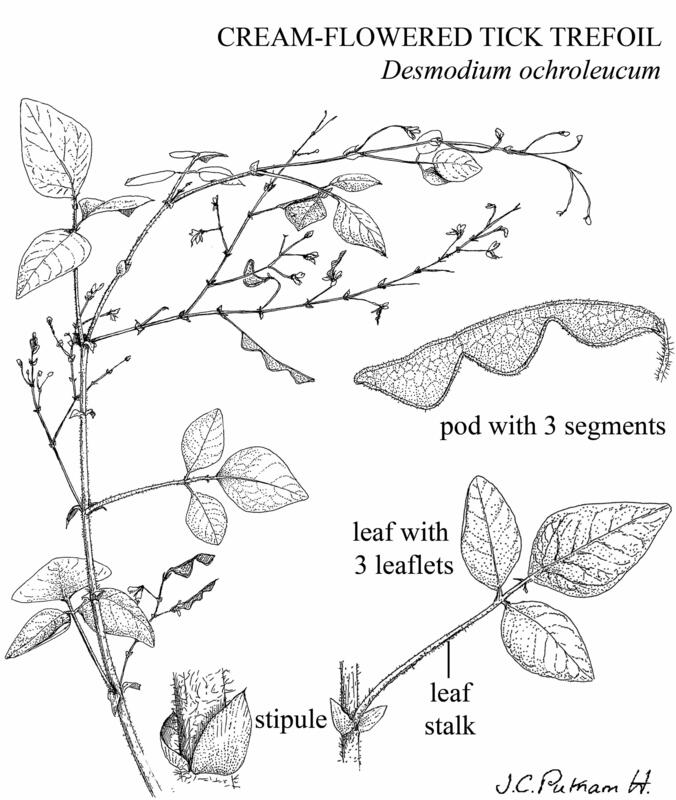
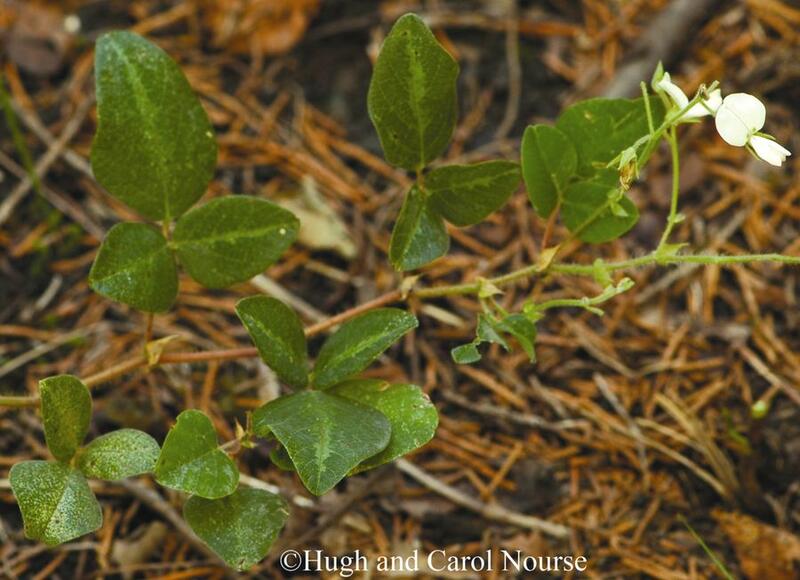
Perennial herb with hairy, slightly zigzag stems up to 3 feet (1 meter) long that trail along the ground with only the flowering branches erect. Leaves are alternate and compound, each with 3 leaflets; the leaflets are 1 - 2.4 inches (2.5 - 6 cm) long, the middle leaflet largest; all leaflets are oval or diamond-shaped with bluntly pointed tips, hairless, often with a pale streak along the midvein. The leaf stalk is up to 2 inches (1.5 - 5 cm) long, hairy, with 2 small, oval to triangular stipules at the base. Flowers are small, white or cream-colored, with a round banner petal and 2 wing petals partially enclosing the keel petal, which surrounds the pistil and developing fruit. The fruit is a flattened pod up to 2 inches (5 cm) long, composed of 3 - 5 veiny, triangular segments that are hairless except along the edges.
There are many species of Desmodium in dry woodlands and forests in Georgia. Desmodium ochroleucum is distinguished by its trailing stems, oval or diamond-shaped (not round) leaflets, oval or triangular stipules, yellowish-white flowers, and a fruit pod that is hairy only along the edges.
Sessile-leaf Tick-trefoil (Desmodium sessilifolium) has erect, hairy stems and narrow leaflets with very short or no leafstalks. It is widespread in the eastern U.S., but occurs in only one Georgia county (Chattahoochee County), in dry, open woodlands of the Fall Line sandhills.
Sunny openings in dry woodlands over calcareous bedrock; limestone glades with Eastern Red Cedar, Persimmon, and Redbud; eastern prairies.
Desmodium flowers are pollinated by long-tongued bees, which are drawn to the flowers by colored patches at the base of the banner petal. When bees alight on the keel petal, their weight presses the keel down, exposing the stigmas and stamens; as the bee enters the flower looking for nectar, the stamens brush the bee’s abdomen, depositing pollen which is then carried to the next flower the bee visits. Once mature, Desmodium fruits break into segments, each with a single seed, which are carried away on the fur of animals; the segments have hooked hairs along the edges which attach to feather, fur, and clothing.
Surveys are best conducted during flowering (June to August) or fruiting (August to October) although leaflet and stipule shape and growth habit are useful for identification throughout the growing season.
Historically known from 11 eastern states, from Florida north to New Jersey, Desmodium ochroleucum is now very rare, with fewer than 25 sites throughout its range.
Logging and other mechanical disturbances to soil. Fire suppression. Invasion by exotic pest plants.
| Threat 1 | Threat 2 | Threat 3 | |
|---|---|---|---|
| General Threat | Natural system modifications | Agriculture & aquaculture | Agriculture & aquaculture |
| Specific Threat | None | None | None |
Desmodium ochroleucum is ranked S1 by the Georgia Department of Natural Resources, indicating that it is critically imperiled in Georgia. It is listed as Threatened by the State of Georgia. A population in Walker County (in northwest Georgia) is protected on a conservation area. Two other populations in the Coastal Plain have not been since since 1903 and the 1940s, respectively.
Avoid logging and soil disturbance in glades and surrounding woodlands. Hand-clear or use fire to maintain openings in woodlands, glades, and prairies. Eradicate exotic pest plants.
Chafin, L.G. 2007. Field guide to the rare plants of Georgia. State Botanical Garden of Georgia and University of Georgia Press, Athens.
Chafin, L.G. 2000. Field guide to the rare plants of Florida. Florida Natural Areas Inventory, Tallahassee.
GADNR. 2020. Element occurrence records for Desmodium ochroleucum. Georgia Department of Natural Resources, Wildlife Resources Division, Social Circle, Georgia.
Isely, D. 1990. Vascular flora of the southeastern United States, Vol. 3, Part 2, Leguminosae (Fabaceae). University of North Carolina Press, Chapel Hill.
NatureServe. 2019. Desmodium ochroleucum comprehensive report. NatureServe Explorer. Arlington, Virginia. http://explorer.natureserve.org/servlet/NatureServe?searchName=Desmodium%20ochroleucum
Radford, A.E., H.E. Ahles, and C.R. Bell. 1968. Manual of the vascular flora of the Carolinas. University of North Carolina Press, Chapel Hill.
Schotz, A.R. 2003. Status survey report on Desmodium ochroleucum, Creamflower Tick-trefoil, in Alabama, Florida, and Mississippi. Alabama Natural Heritage Program, Montgomery.
Tyndall, R.W. and P.L. Groller. 2006. Transplant survival, reproductive output, and population monitoring of Desmodium ochroleucum M. A. Curtis at Chicone Creek Woods in Maryland. Castanea 71(4): 329-332. https://www.jstor.org/stable/4034224
Weakley, A.S. 2015. Flora of the southern and mid-Atlantic States. University of North Carolina Herbarium, University of North Carolina, Chapel Hill. http://www.herbarium.unc.edu/flora.htm
Linda G. Chafin
L. Chafin, Feb. 2007: original account
K. Owers, Jan. 2010: updated status and ranks, added pictures
L. Chafin, Feb 2020: updated original account.